


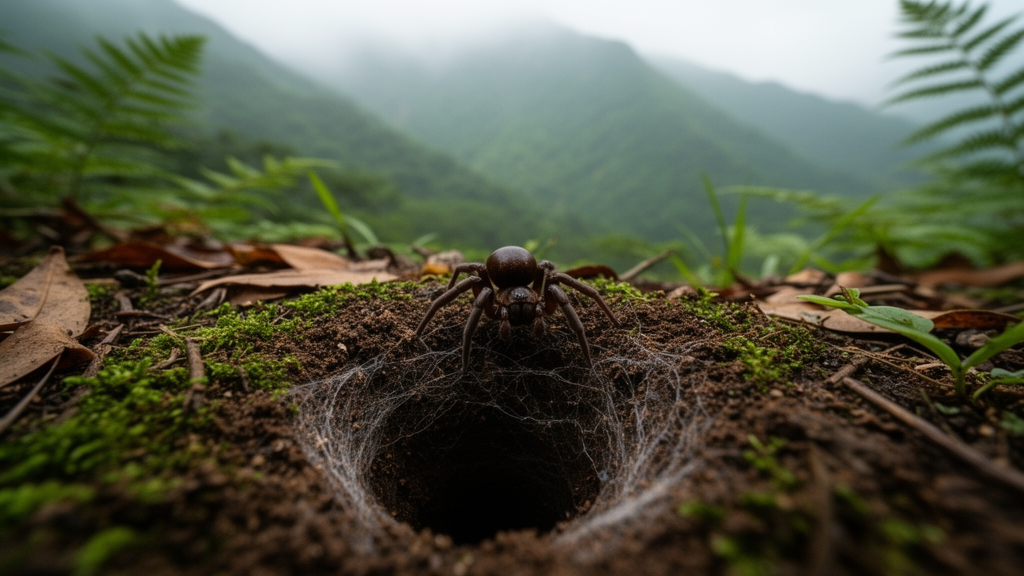
Deep in the misty subtropical forests of Jinggangshan National Nature Reserve in Jiangxi Province, China, a team of researchers has uncovered a spider that no one had ever formally recorded from the region. The discovery, published in the Biodiversity Data Journal, marks the first confirmed presence of the spider family Nemesiidae in Jiangxi Province and introduces a brand-new species to science: Raveniola zhangzongxuni, a medium-sized burrowing spider that had somehow slipped past decades of biological survey work in one of China’s most ecologically significant mountain reserves.
The find matters far beyond a simple checklist entry. Nemesiidae belongs to the infraorder Mygalomorphae, an ancient lineage of spiders that includes tarantulas, trapdoor spiders and funnel-web spiders. These are the heavyweights of the spider world, typically medium to large in size, and they rely on burrows and silk-lined retreats rather than webs to catch prey. Before this study, only two mygalomorph species from two entirely different families had ever been formally documented in Jinggangshan: Calommata jinggangica and Conothele jinggangshan. That strikingly low number suggested the region’s mygalomorph diversity was far from fully revealed, and the new discovery confirms that suspicion in dramatic fashion.
The genus Raveniola is the most widely distributed of all nemesiid genera in Asia, currently comprising 74 known species that stretch from West Asia through Central Asia all the way to East Asia. What makes this new record particularly significant is its geographic position. Previously, the easternmost records of Raveniola in China were confined to Zhejiang, Fujian and northern Guangdong, leaving a conspicuous gap in the intervening provinces. The new species from Jinggangshan bridges that gap, connecting the south-western and eastern distribution ranges of the genus and making its known Chinese distribution considerably more continuous on the map.
Identifying the new species required meticulous morphological examination combined with preliminary molecular data. The researchers dissected and examined male and female copulatory organs in 80% ethanol, cleared epigynes with pancreatin solution, and photographed specimens using a CCD camera mounted on a compound microscope. They also extracted DNA from the spiders’ legs and amplified approximately 600 base pairs of the mitochondrial cytochrome c oxidase subunit I gene, the standard DNA barcode for animal identification. The resulting barcode sequences have been deposited in GenBank, providing a permanent molecular reference for future studies.
The physical characteristics of Raveniola zhangzongxuni are distinctive. The male holotype measures 10.94 millimetres in total body length, with a yellowish-brown carapace marked by radial dark brown streaks and a distinct red-brown fovea. The female paratype is larger at 14.61 millimetres. Among the diagnostic features that separate this species from its closest relatives are the dorsal abdominal pattern, which consists of numerous darker spots on a lighter background rather than the reverse, and the maxillae bearing only three or four cuspules, compared with twelve to fifteen in the closely related R. chayi. The copulatory bulb is also relatively broad, approximately 1.2 to 1.5 times as long as it is wide, a proportion that clearly distinguishes it from relatives whose bulbs are two and a half to four times as long as wide.
Based on these structural peculiarities, the new species has been assigned to the R. gracilis species group, one of four distinct groups into which all known Chinese Raveniola species have been preliminarily sorted according to the latest taxonomic framework. The assignment rests on the hook-shaped distal embolus and the low number of maxillary cuspules. Only one Chinese species, R. xizangensis, still cannot be definitively placed in any established group due to insufficient morphological data, underscoring how much work remains to be done even within this single genus.
The ecology of the new species adds another layer of interest. Female specimens were collected by digging them out of soil burrows, while the lone male was found beneath stones. This behavioural split reflects a broader pattern within the genus: most Raveniola species utilise natural retreats such as cavities beneath rocks or abandoned burrows of other animals as shelters, and only a minority inhabiting arid lowlands or high-altitude zones construct their own burrows. The spiders’ habit of hiding in these overlooked microhabitats likely explains why they have gone undetected for so long in Jiangxi, where no systematic surveys of Nemesiidae had ever been conducted despite the family being known from the neighbouring provinces of Hunan, Hubei, Fujian and Zhejiang.
The species name itself carries historical weight. Raveniola zhangzongxuni is named in honour of Zong-xun Zhang, one of the famous figures of the extremely hard and bitter struggle in Jinggangshan, the mountainous region that played a pivotal role in Chinese revolutionary history. The holotype and paratypes are deposited in the Animal Specimen Museum at the College of Life Science, Jinggangshan University, ensuring that the physical evidence of this discovery remains accessible to future researchers.
Perhaps the most important takeaway from this discovery is what it implies about the state of biodiversity knowledge in eastern China. The researchers emphasise that the mygalomorph fauna of central-eastern China remains significantly under-sampled, and that targeted surveys of overlooked microhabitats such as soil burrows and under-stone retreats are likely to yield additional undescribed species. In a region where subtropical montane forests harbour countless invertebrates that have never been catalogued, a single field survey in a single nature reserve was enough to reveal a genus previously unknown to the province. That suggests the true diversity of these ancient burrowing spiders in China may be far greater than current records indicate.
For biogeographers, the new record provides crucial data for understanding the phylogenetic relationships and distribution patterns of Nemesiidae across the Oriental Region. Every new locality record helps refine models of how these spiders dispersed across Asia and how geographic barriers shaped their evolutionary history. As exploration continues in Jiangxi and adjacent provinces, scientists expect the map of Raveniola and its relatives to fill in further, potentially revealing more hidden species in the forests and mountains of one of the world’s most biodiverse yet least-studied spider faunas.
Subject of Research: Discovery and description of a new burrowing spider species, Raveniola zhangzongxuni, in Jiangxi Province, China
Article Title: A new species of Raveniola Zonstein, 1987 ( Araneae , Nemesiidae ) from Jinggangshan National Nature Reserve, Jiangxi Province, China
Article References: Li, C., Liang, Q., Wang, Z., & Liu, K.-K. (2026). A new species of Raveniola Zonstein, 1987 (Araneae, Nemesiidae) from Jinggangshan National Nature Reserve, Jiangxi Province, China. Biodiversity Data Journal, 14, Article e211761. https://doi.org/10.3897/bdj.14.e211761
Image Credits: AI Generated
Keywords: Raveniola zhangzongxuni, Nemesiidae, Mygalomorphae, Jinggangshan National Nature Reserve, Jiangxi Province, new species, spider taxonomy, DNA barcoding, biogeography, burrowing spiders, East Asia biodiversity, species discovery
Cite Scienmag News
Margaret Porter. (October 16, 2026). New burrowing spider species uncovered in China’s Jinggangshan mountains. Scienmag. https://scienmag.com/new-burrowing-spider-species-uncovered-in-chinas-jinggangshan-mountains/
Margaret Porter. "New burrowing spider species uncovered in China’s Jinggangshan mountains." Scienmag, 16 October 2026, https://scienmag.com/new-burrowing-spider-species-uncovered-in-chinas-jinggangshan-mountains/. Accessed 16 October 2026.
Margaret Porter. "New burrowing spider species uncovered in China’s Jinggangshan mountains." Scienmag. October 16, 2026. https://scienmag.com/new-burrowing-spider-species-uncovered-in-chinas-jinggangshan-mountains/


