


Agates have dazzled collectors for centuries with their swirling, banded interiors, yet the physics behind those stripes has resisted explanation for more than a hundred years. Now a team at Japan Women’s University in Tokyo has shown that a simple laboratory recipe—cyclically switching an electric voltage between high and low levels in a slab of agarose gel—can reproduce the most stubborn features of natural agate banding, including irregularly spaced stripes, curved and distorted bands, and the horizontal layering seen in onyx. The work, published in Frontiers in Physics, positions a new reaction–transport–reaction (RTR) framework as a powerful complement to the classical Liesegang phenomenon that has long dominated thinking about geological banding.
The Liesegang phenomenon, first described in the nineteenth century, occurs when two reactive chemicals diffuse toward each other through a gel and precipitate in periodically spaced bands. It has been the standard explanation for banded minerals, but it leaves key observations unexplained. Natural agates show irregular band spacing, crystal structures that change from layer to layer, and horizontal bands shaped by gravity—features that a purely diffusion-driven Liesegang model cannot readily account for. Geologists have therefore treated agate genesis as a continuing enigma, invoking additional mechanisms such as textural self-organization and episodic pulses of hydrothermal fluid infiltrating silica gel inside rock cavities.
Hisashi Hayashi and Kaho Yamada built on their earlier discovery of a new class of periodic banding systems driven by electricity rather than by a concentration gradient alone. In their setup, metal electrodes are embedded in an agarose hydrogel containing a dilute sodium nitrate electrolyte. When the applied voltage exceeds a threshold, the anode releases metal ions while the cathode generates hydroxide ions from water. These counter-propagating ions meet inside the gel and react to form insoluble metal hydroxide precipitates. Because the system couples ionic transport with two distinct reaction regimes—electrochemical generation at the electrodes and precipitation in the bulk—the researchers call it a reaction–transport–reaction process.
The crucial twist is the cyclic voltage program. The team alternated between a high potential of 3 to 4 volts applied for one hour and a low potential of 2 volts applied for two hours, repeating the cycle 14 to 16 times at a constant 298 kelvin. During the high-voltage intervals, ions are produced at the electrode surfaces; during the low-voltage intervals, generation stops and the ions already in the gel continue to migrate and react. A digital camera recorded the spatiotemporal evolution of the precipitate bands in real time, allowing the researchers to track exactly when and where each new band appeared.
By systematically changing the number, position, and metal species of the anodes, the team engineered four distinct families of two-dimensional stripe patterns. A single, off-center copper anode produced diverging stripes: overlapping precipitation bands that run nearly parallel near the electrode axis but curve markedly toward the anode farther away. Adding a second copper anode yielded distorted stripes, with bands convexly warped toward the electrodes—morphologies that are unprecedented in conventional Liesegang experiments but common in natural agates such as blue lace agate. Reversing the polarity and using one anode against three cathodes generated arching stripes, elegant arch-shaped bands perpendicular to the interelectrode axes that closely resemble the black-banded agates prized as gemstones.
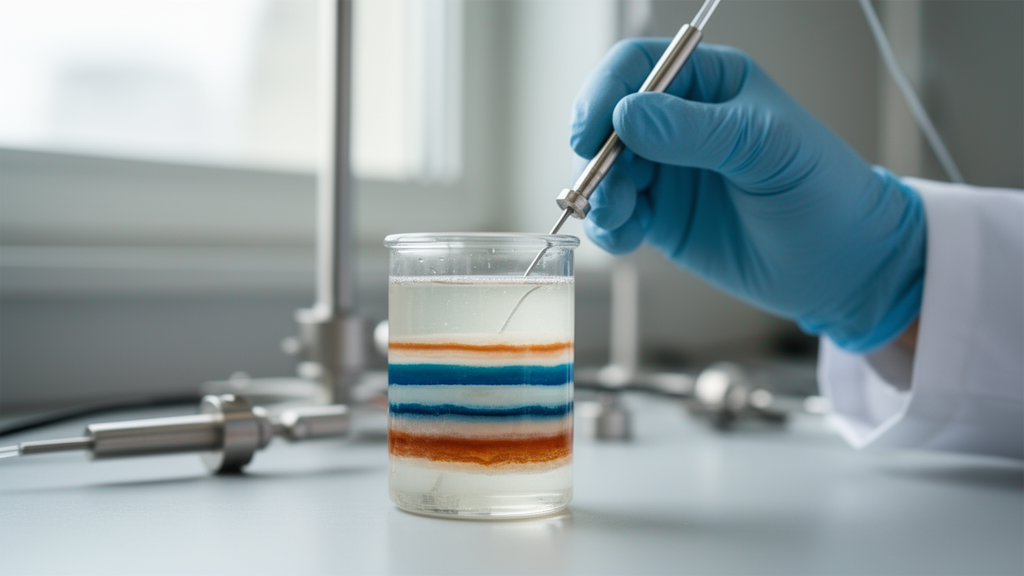
The most striking demonstration came from pairing two different metals. With an iron anode on one side and a copper anode on the other, the gel developed multicolored bands—reddish-brown iron hydroxide and blue copper hydroxide—that grew in parallel, curved downward beneath their respective anodes, and met at a distorted boundary, mimicking the zebra agate found in nature. Time-lapse imaging revealed that the copper bands formed first and advanced toward the iron side; iron hydroxide then nucleated near the tip of the advancing copper precipitate. The two precipitation zones sharpened their segregation over successive cycles rather than intermixing, showing how distinct pulsating ion sources can build chemically differentiated, geode-like architectures in a synthetic matrix.
The underlying mechanism hinges on a well-known quirk of aqueous chemistry: hydroxide ions move far faster than metal ions because of the Grotthuss mechanism, in which protons and hydroxide ions hop through the hydrogen-bonded network of water molecules by breaking and reforming bonds rather than physically diffusing. This transport asymmetry means the hydroxide front penetrates the advancing metal-ion front in a tunneling-like fashion, so precipitation is incomplete within the reaction zone. Unreacted ions slip past the nascent band and keep migrating. When the next high-voltage pulse begins, residual metal ions from the previous cycle encounter freshly emitted hydroxide ions, nucleating a new band displaced toward the cathode. Repeating this synchronized cycle propagates the periodic banding—one new band per cycle—in agreement with the team’s earlier one-dimensional results.
Quantitative measurements confirmed the trends. Duplicate samples run under identical conditions were never morphologically identical, reflecting the subtle spatiotemporal ion distributions, but their qualitative features were consistently reproduced. The interband spacing near the electrode axis and the band widths matched values previously reported for one-dimensional copper systems, while the curved bands far from the electrode axis were spaced roughly 1.4 to 2.6 times wider. The radius of curvature decreased in a consistent order from diverging to distorted to arching stripes, and the arching pattern showed band widths roughly ten times larger in places, apparently from coalescing bands. The authors note that these structural parameters, despite large standard deviations, should prove useful for validating future numerical simulations.
Modeling the two-dimensional system rigorously remains a challenge because the potential gradient is spatially non-uniform, unlike the essentially uniform field of one-dimensional cells. The researchers therefore offer a conceptual model: ions emitted along each interelectrode axis spread in a fan-shaped profile that widens under diffusion and narrows under the localized electric field. Where the fast hydroxide front outruns the slower metal ions, the precipitation zone deflects toward the anode, explaining the observed curvatures. As cycles accumulate, lateral diffusion gradually homogenizes the ion distribution, and by roughly the eighth cycle the bands straighten into the parallel geometry characteristic of one-dimensional systems.
The authors are careful about what the model can and cannot claim. Hydrogel experiments at room temperature cannot reproduce the high temperatures, pressures, convection, and dehydration chemistry of real hydrothermal systems, and they compress millennia of geological accretion into days or weeks. But they argue that the geometric hallmarks of precipitation patterns appear to be invariant features of the underlying nonlinear dynamics, independent of temperature, pressure, or the driving force. Because the two-dimensional RTR setup allows intermittent, localized, multi-directional ion influx—mirroring how hydrothermal fluids seep into agate cavities through multiple gaps and in episodic bursts—it offers a controllable platform for probing the reaction–transport coupling that governs mineral morphogenesis. As a complement to the Liesegang phenomenon, which statically builds concentric rings in a reactant-rich medium, the RTR process dynamically constructs linear, onyx-like stripes in a reactant-depleted one, opening a new experimental window onto one of mineralogy’s oldest puzzles.
Subject of Research: Laboratory reproduction of agate-like banded precipitation patterns using cyclic-voltage-driven reaction–transport–reaction processes in hydrogels
Article Title: Agate-like stripe pattern formation via cyclic-voltage-driven reaction-transport -reaction process
Article References: Hayashi, H., & Yamada, K. (2026). Agate-like stripe pattern formation via cyclic-voltage-driven reaction-transport -reaction process. Frontiers in Physics, 14, Article 1926941. https://doi.org/10.3389/fphy.2026.1926941
Image Credits: AI Generated
DOI: 10.3389/fphy.2026.1926941
Keywords: agate, Liesegang phenomenon, periodic precipitation, reaction–transport–reaction, pattern formation, hydrogels, electrochemistry, Grotthuss mechanism, metal hydroxides, geological morphogenesis, hydrothermal fluids, onyx
Cite Scienmag News
Violet Maxwell. (October 16, 2026). Scientists Grow Agate-Like Stripes by Switching Voltage On and Off. Scienmag. https://scienmag.com/scientists-grow-agate-like-stripes-by-switching-voltage-on-and-off/
Violet Maxwell. "Scientists Grow Agate-Like Stripes by Switching Voltage On and Off." Scienmag, 16 October 2026, https://scienmag.com/scientists-grow-agate-like-stripes-by-switching-voltage-on-and-off/. Accessed 16 October 2026.
Violet Maxwell. "Scientists Grow Agate-Like Stripes by Switching Voltage On and Off." Scienmag. October 16, 2026. https://scienmag.com/scientists-grow-agate-like-stripes-by-switching-voltage-on-and-off/


