


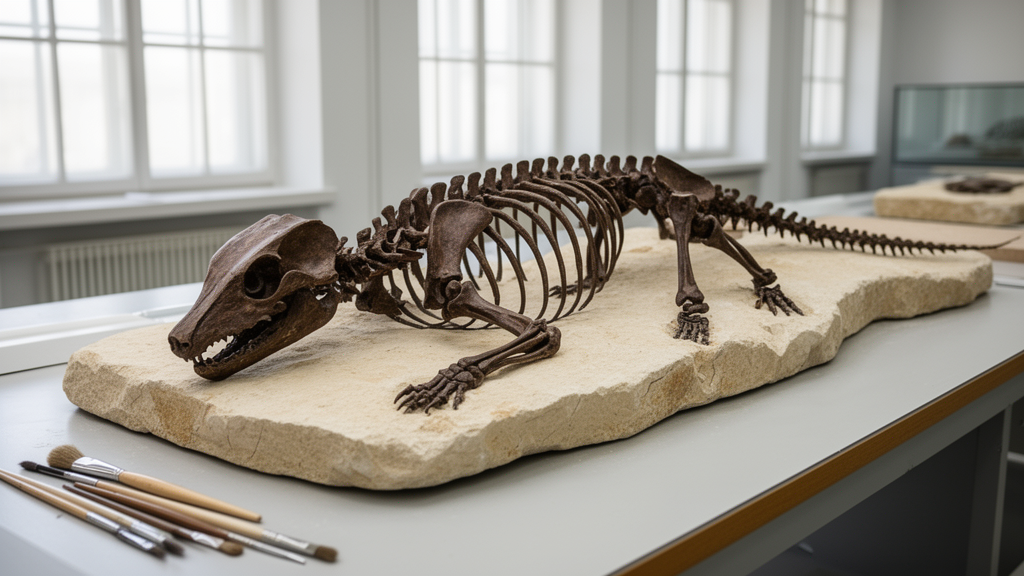
For more than 170 years, one of the most distinctive lineages of North American predators has been known almost entirely from its skulls and teeth. Leptarctine mustelids, an extinct family of Neogene carnivorans, sported some of the strangest cranial and dental features of any mammalian carnivore, yet scientists had essentially no idea how these animals moved, hunted or lived. Now, the first known partial skeleton of a leptarctine is rewriting that story, revealing a badger-like terrestrial generalist that occupied open Miocene landscapes long before true badgers arrived on the continent.
The newly described specimen, catalogued as UCMP 114136 in the University of California Museum of Palaeontology, comes from the Rome Beds of Oregon and is Hemphillian in age, corresponding to the later portion of the Miocene epoch. Its significance lies not only in its completeness but in the unambiguous association of postcranial bones with a nearly complete mandible and partial cranium. Because leptarctine taxonomy has historically rested on craniodental characters, isolated limb bones from fossil sites could never previously be attributed to the lineage with confidence. The associated dentition removes that ambiguity, allowing every described limb element to be tied directly to a named species, Leptarctus wortmani, rather than to an unidentified carnivoran.
The anatomical coverage of the skeleton is remarkable for a lineage whose postcranial record previously consisted of a single articulated atlas and axis from Inner Mongolia, reported more than six decades ago. The new specimen preserves elements of the fore-limb, including a scapula, humerus, radius and ulna; the hind-limb, including pelvis fragments, femur and tibia; wrist and ankle bones such as the scapholunar, navicular, astragalus and calcaneum; metapodials and phalanges of both hand and foot; and a substantial portion of the pre-sacral vertebral column with associated rib fragments. This breadth permits a whole-body assessment of locomotor adaptation rather than inference from one or two isolated bones.
The analytical approach combined two complementary lines of evidence. External limb proportions were quantified through fourteen functional indices calculated from eighteen linear measurements, following a framework widely used in carnivoran ecomorphology. These indices capture features such as relative limb segment lengths and joint lever arms that correlate with locomotor modes across living carnivorans. In parallel, the internal structure of the long bones was examined through microcomputed tomography. The humerus and femur were scanned at voxel sizes ranging from 16 to 43 micrometres, and the spongy bone within their epiphyses, the regions near the joints, was analysed for nine trabecular traits, including bone volume ratio, trabecular thickness, trabecular spacing, connectivity and the degree of anisotropy, which describes how strongly the internal struts are aligned in a preferred direction.
Trabecular bone is remodelled in response to the mechanical loads experienced during life, so its architecture carries a signal of how an animal habitually used its limbs. Arboreal climbers, which contend with bending and torsional stresses on inclined branches, tend to show particular patterns of trabecular orientation and volume, while fossorial diggers and terrestrial walkers each leave their own structural signatures. Comparing these traits in Leptarctus wortmani against extant reference species, the Eurasian badger Meles meles, the American badger Taxidea taxus, the raccoon Procyon lotor and the red fox Vulpes vulpes, provided a comparative benchmark spanning digging, generalist terrestrial and somewhat scansorial lifestyles among caniform carnivorans of broadly similar body size.
Both lines of evidence converged on the same conclusion. The functional indices of external limb proportions and the internal trabecular architecture of the humerus and femur together indicate a generalist terrestrial locomotor mode. Critically, the analysis found no support for the arboreal habits that had been proposed for some leptarctines on the basis of dental similarities to koalas and kinkajous. That earlier hypothesis illustrates a persistent pitfall in palaeoecological reconstruction: teeth and skulls can converge between ecologically distant animals, and dietary inferences drawn from dental form alone can be misleading when no postcranial evidence is available to test them. The new skeleton demonstrates that whatever the teeth of Leptarctus resembled, its limbs were built for life on the ground.
In overall postcranial form, L. wortmani most closely resembles the extant Eurasian badgers of the genus Meles, though with two notable differences: the ungual phalanges, the bony cores of the claws, are reduced, and the long bones are more elongate for an animal of its size. The reduced claws argue against a specialised digging habit of the kind seen in the American badger, whose forelimbs are among the most powerful digging apparatuses in the modern carnivoran fauna. The elongate limbs suggest a somewhat more cursorial, longer-striding animal than a typical badger, consistent with movement through the open and heterogeneous habitats that spread across North America as grasslands expanded after the Mid-Miocene Climatic Optimum.
This palaeoecological reconstruction has implications that extend beyond the biology of a single species. Leptarctines first appeared in Asia and established an extensive fossil record in both Asia and North America, with Leptarctus itself among the best-represented mustelid genera in the North American record in terms of geographic spread and abundance of craniodental material. Yet for all that abundance, the lineage’s ecological role remained speculative. The new evidence suggests that L. wortmani occupied a badger-like niche as a medium-sized terrestrial generalist during the middle and late Miocene, effectively pre-empting the ecological position later filled by true North American badgers such as Pliotaxidea and the modern Taxidea, which appear in the fossil record only after the leptarctines had declined.
That temporal sequence raises the possibility of competitive replacement. If leptarctines and early badgers exploited similar resources in similar habitats, the arrival and diversification of the latter may have contributed to the extinction of the former by the Pliocene. Such priority-and-replacement patterns are a recurring theme in mammalian palaeontology, but they are rarely testable for lineages whose ecology is as poorly constrained as leptarctines were before this study. By anchoring the group’s locomotor repertoire and likely habitat use in skeletal evidence, the new skeleton provides the ecological baseline needed to evaluate whether the overlap in niche was close enough for competition to plausibly have played a role.
The study also demonstrates how methodological advances can unlock long-standing questions from existing museum collections. The specimen itself is not a recent discovery of an entirely new fossil site but a partial skeleton whose value depended on comparative infrastructure: reference skeletons of extant carnivorans held in the University of California Museum of Palaeontology, micro-CT scanning facilities capable of resolving trabecular architecture at tens of micrometres, and published analytical frameworks for both functional indices and bone internal structure. All of the computed tomography image stacks generated in the study have been made publicly available on MorphoSource, allowing other researchers to re-analyse the data independently, an increasingly common practice that extends the scientific utility of rare specimens far beyond a single publication.
For the leptarctines specifically, the description of the first partial skeleton marks a turning point in a research history stretching back to 1856, when the genus Leptarctus was erected. Generations of palaeontologists have described new species, revised taxonomy and debated function based on skulls and dentition alone, producing a rich but ecologically ambiguous record. With postcranial anatomy now available for at least one well-diagnosed species, hypotheses about how other leptarctines moved and lived can be framed and tested against concrete skeletal expectations rather than analogy alone. Whether the badger-like body plan of L. wortmani characterised the whole clade or represented one ecological variant among a more diverse radiation remains an open question, but it is now a question that future discoveries of associated postcranial material can meaningfully address.
Subject of Research: Functional morphology and palaeoecology of the first known skeleton of the extinct mustelid Leptarctus wortmani
Article Title: Functional morphology of the first known skeleton of Leptarctus ( Mustelidae , Carnivora ) clarifies the palaeoecology of a distinctive predator lineage
Article References: Tseng, Z. J. (2026). Functional morphology of the first known skeleton of Leptarctus (Mustelidae, Carnivora) clarifies the palaeoecology of a distinctive predator lineage. Swiss Journal of Palaeontology, 145, 703-721. https://doi.org/10.3897/sjp.145.195025
Image Credits: AI Generated
Keywords: Leptarctus, Mustelidae, paleontology, Miocene, functional morphology, locomotion, badgers, fossil skeleton, trabecular bone, North America, palaeoecology, carnivorans
Cite Scienmag News
Gavin Prescott. (October 16, 2026). First Full Skeleton of Ancient Leptarctus Reveals a Badger-Like Predator That Once Ruled Miocene North America. Scienmag. https://scienmag.com/first-full-skeleton-of-ancient-leptarctus-reveals-a-badger-like-predator-that-once-ruled-miocene-north-america/
Gavin Prescott. "First Full Skeleton of Ancient Leptarctus Reveals a Badger-Like Predator That Once Ruled Miocene North America." Scienmag, 16 October 2026, https://scienmag.com/first-full-skeleton-of-ancient-leptarctus-reveals-a-badger-like-predator-that-once-ruled-miocene-north-america/. Accessed 16 October 2026.
Gavin Prescott. "First Full Skeleton of Ancient Leptarctus Reveals a Badger-Like Predator That Once Ruled Miocene North America." Scienmag. October 16, 2026. https://scienmag.com/first-full-skeleton-of-ancient-leptarctus-reveals-a-badger-like-predator-that-once-ruled-miocene-north-america/


