


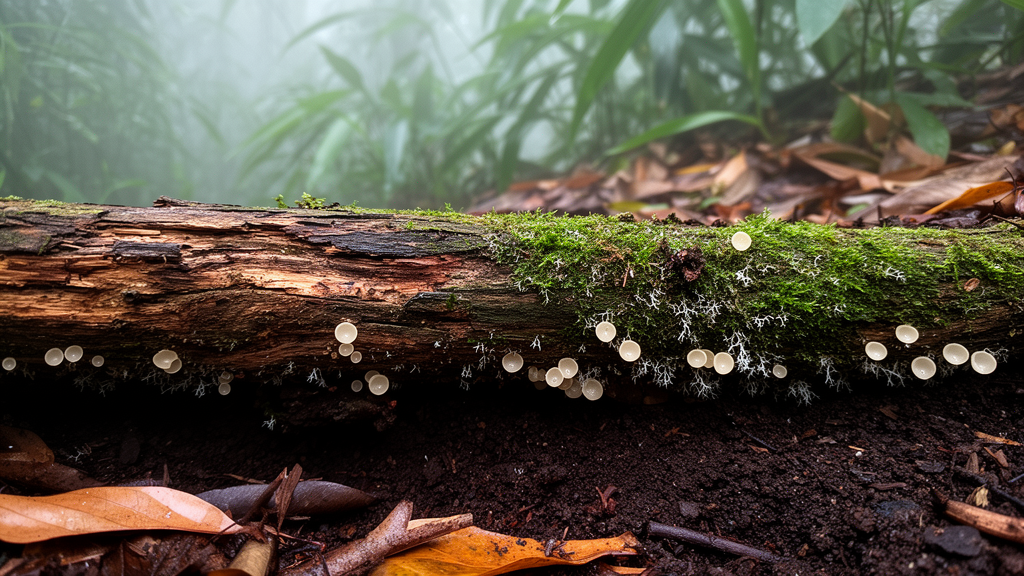
Deep in the forests of Yunnan Province in southwestern China, a team of mycologists has pulled seven previously undocumented or newly recorded fungi from the surfaces of dead branches, and five of them turn out to be entirely new to science. The discovery, published in the journal MycoKeys, combines painstaking microscopic examination with DNA-based family trees to formally name Anastomitrabeculia yunnanensis, Coryneum lincangense, Coryneum lancangense, Helicoma nixiense, and Sclerococcum xiaokongense as novel species, while adding two species already known elsewhere to China’s fungal inventory. The findings underscore just how much undiscovered fungal life may be hiding in one of the world’s great biodiversity hotspots.
Saprobic microfungi, the organisms that feed on dead organic matter, are the quiet workhorses of forest ecosystems. Colonizing fallen branches and twigs, they secrete enzymes capable of breaking down lignin and cellulose, the tough structural polymers that make wood so resistant to decay. In doing so, they drive nutrient cycling, release carbon locked in woody debris, and shape the chemical and physical properties of forest soils. Yet despite this ecological importance, the global diversity of these fungi remains grossly underestimated. Current estimates suggest the fungal kingdom could contain anywhere from 1.5 to 12 million species, but only around 155,000 have been formally described. Taxonomists add roughly 3,000 new species each year, while molecular ecologists routinely detect thousands of unidentifiable so-called dark fungi in environmental DNA samples that never get named.
Most previous surveys of wood-inhabiting fungi have focused on leaf litter, freshwater habitats, or the large, conspicuous wood-rotting mushrooms. Saprobic microfungi on decaying branches, trunks, and twigs have been conspicuously understudied across most of the world. That gap is precisely what drew researchers to Yunnan, a province whose complex topography and highly variable climates have made it a global biodiversity hotspot. Yunnan harbors more seed plant diversity than any other region of China, along with a wealth of endemic woody plants that provide ideal substrates for wood-decaying fungi. Scientists estimate the province may contain approximately 104,000 fungal species, yet only around 6,000 have been formally named, leaving a staggering gap between what exists and what is known.
Between 2019 and 2020, the research team conducted field surveys at several locations across Yunnan, including Kunming, Lincang, Lancang, Nixi, and Xishuangbanna. They collected decaying branches from mixed forest habitats, transported them to the laboratory in sterile bags, and examined them under stereomicroscopes to locate fungal fruiting bodies. Individual spores were then isolated onto nutrient agar to establish pure cultures, a technique called single-spore isolation that ensures each strain descends from a single reproductive cell. Voucher specimens were deposited in the Herbarium of Cryptogams at the Kunming Institute of Botany, and living cultures were preserved in the institute’s culture collection for future study.
To determine whether the isolated fungi represented known species or something entirely new, the researchers extracted genomic DNA from fresh mycelia and amplified five genetic loci: the internal transcribed spacer region (ITS), the large and small subunits of ribosomal RNA (LSU and SSU), translation elongation factor 1-alpha (tef1-α), and the second largest subunit of RNA polymerase II (rpb2). These markers are standard tools in fungal systematics because they evolve at rates that allow researchers to distinguish closely related species while still being comparable across broad taxonomic distances. The sequences were aligned, concatenated into a combined dataset, and analyzed using two complementary methods: maximum likelihood inference, which finds the tree most likely to have produced the observed data, and Bayesian inference, which calculates the probability of a tree given the data. Only when both approaches agreed, and when morphological differences were also evident, did the team conclude a species was genuinely new.
The five new species span four different classes within the phylum Ascomycota, revealing remarkable taxonomic breadth from a relatively limited sampling effort. Anastomitrabeculia yunnanensis, collected from decaying oak branches in Xishuangbanna, belongs to the Pleosporales and was identified by its sexual reproductive structures: clustered, black, flask-shaped ascomata embedded in the bark, containing elongate sacs called asci that produce muriform, brown ascospores wrapped in a gelatinous sheath. The species differs from its closest relatives by having substantially larger asci and distinct DNA sequence divergence, with base-pair differences of over 12 percent in the ITS region compared to its nearest known relative. Helicoma nixiense, found at 3,090 meters elevation in Diqing, represents a rare sexual species in a genus better known for its coiled, spiro-shaped asexual spores, and its elongate, 13-to-17-septate ascospores distinguish it from all six previously described sexual Helicoma species.
Two new Coryneum species were recovered from decaying branches of cinnamon and oak relatives in Lincang and Lancang. Coryneum is a large genus of over 200 described species, many of them plant pathogens, but only a handful have DNA sequence data available. The new species produce dark, cushion-shaped fruiting bodies called acervuli containing distinctive large, dark brown conidia marked by transverse distosepta, a type of septum in which the cross-wall is thickened and separated from the adjacent cell contents. Sclerococcum xiaokongense, collected from birch branches near Kunming, belongs to the Sclerococcales within the Eurotiomycetes and produces cup-shaped apothecia with black discs, a morphology that sets it apart from related species with different fruiting body shapes and dimensions.
The two new records also carry scientific weight. Dictyocheirospora rotunda, previously known only from freshwater habitats in China and Thailand, was found growing on decaying birch branches in a terrestrial setting, suggesting that some fungi previously regarded as strictly aquatic may occupy broader ecological niches than currently recognized. Even more notably, the team documented the first asexual morph of Proliferodiscus chiangraiensis, a species originally described from Thailand based solely on its sexual form. The asexual stage produces tiny, globose, multilocular fruiting bodies releasing minuscule cylindrical conidia, and its discovery represents only the second documented asexual morph in the entire genus Proliferodiscus, highlighting how incomplete our understanding of sexual-asexual life cycle connections remains in many saprobic microfungi.
The study also raised questions about fungal classification that extend beyond the new species themselves. Phylogenetic analysis showed that a genus called Camarographium, long considered of uncertain placement within the Pleosporales, clusters within Anastomitrabeculia, suggesting it may need to be reclassified. Similarly, the Helicoma phylogeny revealed two major clades that do not fully correspond to traditional morphological groupings based on how spores are produced, underscoring that accurate identification of these fungi must increasingly rely on molecular evidence rather than visual characteristics alone. Many historically recorded Helicoma species lack DNA sequence data entirely, leaving a chaotic taxonomic landscape that will require integrated morphological, molecular, and chemical approaches to resolve.
The disproportionate richness of fungal discoveries in Yunnan, with over 300 novel species reported in the past five years alone and the province accounting for more than a quarter of all new fungal species described in China between 2000 and 2020, suggests that a vast number of undescribed taxa still await discovery in the region. Yet this exceptional biodiversity faces mounting threats from habitat fragmentation, climate change, and human pressure. The researchers argue that continued taxonomic work is not merely an academic exercise but a foundation for biodiversity conservation and ecosystem monitoring. Every newly named species represents a piece of the ecological puzzle, and in forests where fungi orchestrate the decomposition of wood and the recycling of nutrients, losing unnamed species before they are even catalogued represents an irreversible loss to both science and ecosystem function.
Subject of Research: Taxonomy and phylogeny of saprobic microfungi from decaying branches in Yunnan Province, China
Article Title: Morphology and multigene phylogeny reveal five new species and two new records of saprobic microfungi from Yunnan, China
Article References: Ren, G.-C., Chen, W.-H., Gui, H., Chen, Z.-Y., Guo, C., Meng, Q.-F., & Tian, W.-Y. (2026). Morphology and multigene phylogeny reveal five new species and two new records of saprobic microfungi from Yunnan, China. MycoKeys, 140, 317-354. https://doi.org/10.3897/mycokeys.140.205151
Image Credits: AI Generated
DOI: 10.3897/mycokeys.140.205151
Keywords: fungi, Yunnan, new species, taxonomy, phylogenetics, Ascomycota, saprobic microfungi, biodiversity, dead branches, MycoKeys, China, fungal diversity
Cite Scienmag News
Roger Howard. (October 16, 2026). Five New Fungal Species Emerge From Yunnan’s Decaying Branches. Scienmag. https://scienmag.com/five-new-fungal-species-emerge-from-yunnans-decaying-branches/
Roger Howard. "Five New Fungal Species Emerge From Yunnan’s Decaying Branches." Scienmag, 16 October 2026, https://scienmag.com/five-new-fungal-species-emerge-from-yunnans-decaying-branches/. Accessed 16 October 2026.
Roger Howard. "Five New Fungal Species Emerge From Yunnan’s Decaying Branches." Scienmag. October 16, 2026. https://scienmag.com/five-new-fungal-species-emerge-from-yunnans-decaying-branches/


