


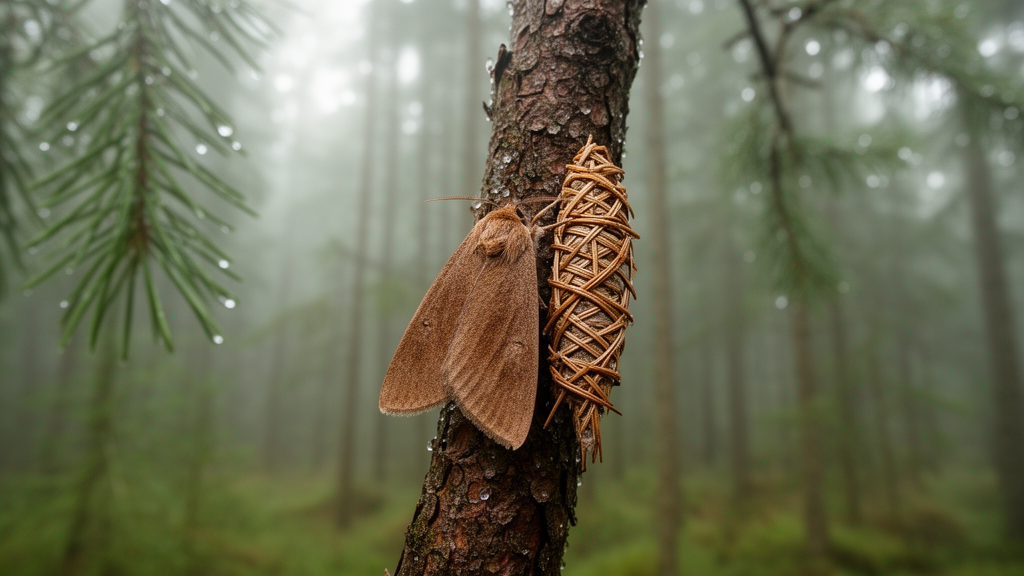
Deep in the industrial outskirts of Katowice and on forested slopes of the Bieszczady Mountains, three tiny populations of bagworm moths have been quietly puzzling Polish entomologists for nearly two decades. These moths belong to the genus Reisseronia, a group of psychid moths whose females are wingless and whose reproduction relies on parthenogenesis — females producing offspring without ever mating. Now, the first genetic study of Poland’s endemic Reisseronia populations has delivered a result that is as humbling as it is fascinating: the DNA barcode sequences of the three populations are nearly identical, raising the possibility that two species described as distinct may actually belong to a single, widespread parthenogenetic lineage.
…
The story of Reisseronia in Poland illustrates a broader challenge in modern taxonomy: the tension between molecules and morphology. When the first larvae were collected in Imielin in 2005, they were provisionally assigned to Reisseronia gertrudae, a species described from Austria. Only after careful comparison of adult structures, pupal morphology and life-history details did researchers conclude that the Upper Silesian population deserved status as a distinct species, R. imielinella, followed later by R. annae from the Janów district of Katowice. Both descriptions rested on anatomical differences that were subtle but consistent — the kind of differences that taxonomists have long used to separate closely related psychid moths. The new genetic data do not invalidate those observations; rather, they reveal that the mitochondrial barcode, the standard molecular yardstick for lepidopteran species, fails to register them.
The mitochondrial cytochrome c oxidase subunit I gene has become the workhorse of animal DNA barcoding for good reasons. It is present in high copy numbers, amplifies reliably with the standard Folmer primers used in this study, and typically shows enough variation between species while remaining relatively constant within them. The 658 base pair fragment at the 5′ end of the gene that was sequenced here is the same region used across tens of thousands of animal species, which makes comparisons with reference databases such as the Barcode of Life Data System straightforward. For most groups of moths, a divergence of two to three percent in Kimura two-parameter distance corresponds neatly to a species boundary, and divergences below that level usually signal either intraspecific variation or very recent speciation events.
The Polish Reisseronia results sit squarely in that ambiguous zone. A divergence of only 0.9 percent between R. imielinella, R. annae, the Komańcza population and R. gertrudae from Slovenia falls well below the conventional threshold, and the complete absence of differences between the Komańcza specimens and the R. gertrudae barcode is particularly striking. At the same time, distances to other members of the genus range from 3.4 percent for R. tarnierella to 13.7 percent for two undetermined Greek species, confirming that the barcode can clearly separate most Reisseronia lineages when they are genuinely distinct. The pattern therefore is not a failure of the method in general, but a specific case in which morphological differentiation has outpaced, or is not captured by, mitochondrial divergence.
Parthenogenesis offers a plausible biological explanation for this pattern. In parthenogenetic lineages, mitochondrial genomes are transmitted clonally along with the rest of the maternal genome, and the absence of sexual recombination removes one of the engines that normally accelerates the sorting of mitochondrial lineages between diverging populations. A parthenogenetic lineage that colonized new habitats could accumulate morphological differences through developmental plasticity, epigenetic changes, or selection on nuclear genes, while its mitochondrial genome remains essentially frozen. The brachypterous females of Reisseronia, which cannot fly, also mean that dispersal is likely passive — through wind-borne first-instar larvae or transport of larval cases — which would limit gene flow even further and make founder events the dominant mode of population establishment.
The geographic picture adds another layer of interest. R. gertrudae was described from South Styria in Austria, and its wider distribution was recently confirmed in neighboring regions. The Komańcza site in the Bieszczady Mountains lies in the southeastern corner of Poland, in the Carpathian foothills, a region with rich and distinctive Lepidoptera fauna. The two Upper Silesian sites, Imielin and Katowice-Janów, sit in a heavily industrialized landscape where remnant meadows and post-industrial habitats often harbor relict populations of specialist insects. If all three Polish populations indeed belong to R. gertrudae, the species’ known range extends significantly to the north and east, and the ecological amplitude of a supposedly narrowly endemic species widens considerably — from subalpine Styrian slopes to post-industrial Upper Silesian grasslands and Carpathian foothill meadows.
It is worth emphasizing what the barcode data cannot resolve. Mitochondrial introgression, in which the mitochondrial genome of one species replaces that of another through hybridization followed by backcrossing, is well documented in Lepidoptera and can produce species that look morphologically distinct yet share identical barcodes. Nuclear mitochondrial pseudogenes, which are copies of mitochondrial DNA that have migrated into the nucleus and can be co-amplified with the true mitochondrial target, represent another potential source of misleading similarity, although the clean chromatograms and consistent phylogenetic placement obtained here argue against this particular artifact. In parthenogenetic organisms, hybrid origins are also a common phenomenon — many asexual animal lineages arose through interspecific hybridization — and such origins can scramble the expected correspondence between mitochondrial lineage and morphological species.
The authors’ decision to retain the species status of R. imielinella and R. annae despite the barcode results reflects a defensible taxonomic philosophy. Morphological differences in female genitalia, leg structure, antennae and pupal head plates are the product of developmental programs encoded largely in the nuclear genome, and a growing body of lepidopteran research shows that morphological and mitochondrial variation frequently decouple. Cases in which genitalia vary within species, and in which externally similar species share barcodes, are numerous enough that DNA barcoding is now generally treated as one line of evidence among several rather than a definitive arbiter. For bagworm moths specifically, where males are often rare, elusive or entirely absent due to parthenogenesis, and where identification traditionally relies on genital morphology and wing scale shape, the integration of molecular and morphological data is still in its early stages.
The sample design of this study also deserves attention when interpreting the results. Eleven specimens were analyzed: four each from R. annae and R. imielinella, and three from the Komańcza population. The R. annae and R. imielinella samples included both fourth-instar larvae and freshly emerged adults, which demonstrates that DNA of sufficient quality can be recovered from larval stages preserved in ethanol — an important practical consideration for rare species where killing adults for genetic work may be undesirable. The comparison set of nineteen additional COI sequences from BOLD, spanning Slovenia, Greece, Bulgaria, Italy, Croatia, Germany and Serbia, provided a geographic breadth that would have been impossible to achieve through new fieldwork alone, and it is this reference framework that allowed the Polish specimens to be placed in context rather than treated in isolation.
What remains to be done is clear in outline. A larger sample of R. gertrudae from the type region in Austria would establish whether the Polish populations match the Austrian barcode exactly or show minor variation. Sampling additional nuclear markers, ideally genome-wide markers such as those generated by restriction-site associated DNA sequencing or whole-genome approaches, would reveal whether the nuclear genomes of the Polish populations diverge to the same degree as their morphology suggests, or whether they too are essentially identical. Such data would distinguish between two scenarios: one in which the Polish populations are recently derived morphological variants of a single parthenogenetic species, and another in which they are genuinely distinct lineages whose mitochondrial genomes have not yet had time to diverge, or whose mitochondrial similarity reflects a shared ancestral polymorphism retained through clonal reproduction.
The conservation implications are not trivial. If R. imielinella and R. annae are recognized as endemic Polish species, they carry conservation weight as national endemics with extremely restricted ranges, and the habitats they occupy — small patches of calcareous grassland and ruderal vegetation in an otherwise heavily transformed industrial region — gain a strong argument for protection. If they are synonymized with R. gertrudae, the local populations still represent genetically isolated, parthenogenetic lineages at the edge of the species’ range, and their vulnerability to habitat loss remains essentially unchanged. Either way, the small areas they occupy continue to deserve attention, and the study demonstrates that even seemingly settled taxonomic questions can be reopened by the first application of molecular tools to a neglected group.
More broadly, the Reisseronia case joins a growing catalogue of examples in which DNA barcoding has revealed unexpected genetic uniformity among morphologically differentiated organisms, particularly in groups with unusual reproductive systems. Parthenogenesis, hybridogenesis and other forms of asexual reproduction are known to produce patterns of genetic variation that do not map neatly onto species boundaries defined by morphology or reproductive isolation. As molecular surveys extend to more such lineages, taxonomists will increasingly need frameworks that can accommodate species whose genomes tell different stories in different compartments — a challenge that the Polish Reisseronia populations, small and inconspicuous as they are, help to bring into sharp focus.
Subject of Research: DNA barcoding of endemic Polish populations of the parthenogenetic bagworm moth genus Reisseronia
Article Title: DNA barcoding of the endemic Polish populations of the genus Reisseronia Sieder, 1956 ( Lepidoptera , Psychidae )
Article References: Domagała, P. J., & Larysz, A. (2025). DNA barcoding of the endemic Polish populations of the genus Reisseronia Sieder, 1956 (Lepidoptera, Psychidae). Nota Lepidopterologica, 48, 243-250. https://doi.org/10.3897/nl.48.162025
Image Credits: AI Generated
DOI: 10.3897/nl.48.162025
Keywords: Reisseronia, Psychidae, bagworm moths, DNA barcoding, COI, parthenogenesis, Lepidoptera, Poland, endemic species, molecular taxonomy, Kimura two-parameter, Bieszczady Mountains
Cite Scienmag News
Margaret Porter. (October 16, 2026). DNA Barcodes Reveal Hidden Puzzle in Poland’s Rare Parthenogenetic Bagworm Moths. Scienmag. https://scienmag.com/dna-barcodes-reveal-hidden-puzzle-in-polands-rare-parthenogenetic-bagworm-moths/
Margaret Porter. "DNA Barcodes Reveal Hidden Puzzle in Poland’s Rare Parthenogenetic Bagworm Moths." Scienmag, 16 October 2026, https://scienmag.com/dna-barcodes-reveal-hidden-puzzle-in-polands-rare-parthenogenetic-bagworm-moths/. Accessed 16 October 2026.
Margaret Porter. "DNA Barcodes Reveal Hidden Puzzle in Poland’s Rare Parthenogenetic Bagworm Moths." Scienmag. October 16, 2026. https://scienmag.com/dna-barcodes-reveal-hidden-puzzle-in-polands-rare-parthenogenetic-bagworm-moths/


