


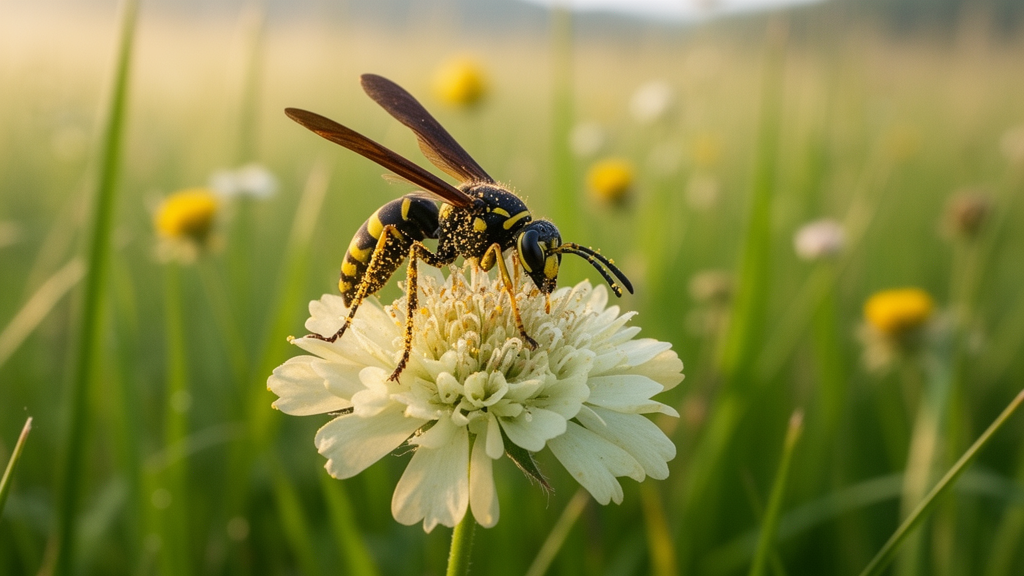
Deep in the semi-arid steppes of southeastern Georgia, a small wasp has been quietly going about its business, unnoticed by science in the country until now. Researchers have recorded the pollen wasp Celonites osseus Morawitz, 1888 for the first time in Georgia, expanding the known range of this elusive insect and offering rare glimpses into its behaviour, ecology, and evolutionary history. The discovery, published in the Journal of Hymenoptera Research, took place in the Vashlovani National Park, a protected area of transregional importance for the Caucasus region.
Celonites osseus belongs to the Masarinae, a fascinating subfamily of wasps commonly known as pollen wasps because, unlike most of their carnivorous vespid relatives, they feed their larvae on pollen and nectar rather than paralysed prey. Within the genus Celonites, the species is a member of the C. cyprius-group, a monophyletic clade nested within the subgenus Eucelonites. Based on morphological evidence, it is closely related to C. cagrii and C. ivanovi, with which it forms the C. osseus-complex. While C. cagrii and C. ivanovi are restricted to East Anatolia and the Caucasus, C. osseus has a broader distribution extending from Armenia through Azerbaijan and Iran to Turkmenistan. Despite this wider range, its biology had remained entirely unknown until the recent observations in Georgia.
The unexpected encounter occurred during a one-week expedition to Vashlovani National Park, an area characterised by continental steppe habitats that shelter flora and fauna of exceptional conservation value, including one of the last populations of the goitered gazelle (Gazella subgutturosa). The Hymenoptera fauna of the park has been barely studied to date, making the discovery all the more significant. The researchers found the wasps in a dried riverbed of the seasonal Mlashe-Tskali River, which also partially serves as an access road within the park, at coordinates 41.1694°N, 46.5678°E and an elevation of 286 metres above sea level.
The riverbed consisted of coarse gravel interspersed with small higher islands of gravel and washed-up material such as tree trunks. On these seasonal islands, two species of the plant genus Heliotropium were recorded: Heliotropium suaveolens and H. ellipticum. Along a 200-metre transect, approximately 30 individuals of C. osseus were observed, all of them females, mostly engaged in flower visits. The researchers spent 1.5 hours observing the wasps on 10 August 2025, between 9:45 am and 11:15 am local time, and collected nine females as physical records, two of which were immediately pinned and dried for DNA barcoding. On one occasion, a female was seen cleaning her body, wings, and legs while standing on a dried faecal pellet near a small aggregation of Heliotropium plants, a behaviour that lasted around 45 seconds.
What struck the observers most was the wasps’ strict floral fidelity. Females of C. osseus were exclusively observed visiting flowers of Heliotropium ellipticum, suggesting that the species is probably narrowly oligolectic on the plant genus Heliotropium, a pattern consistent with all other members of the C. cyprius-group whose flower associations are known. Remarkably, despite H. suaveolens being in bloom nearby, the wasps completely ignored it. The researchers suggest that differences in flower morphology between the two Heliotropium species may prevent the females from exploiting H. suaveolens flowers. Interestingly, 37.5% of the photo-documented visits occurred at flowers of H. ellipticum that were in a very early stage of anthesis, with their corollas still nearly closed. This phenomenon has also been reported for C. cyprius at flowers of H. europaeum and H. dolosum, and observed in C. ivanovi at H. styligerum. It is assumed that flowers in a very early stage of anthesis offer higher pollen rewards than older flowers, which would explain the preference.
The most captivating aspect of the discovery lies in the wasps’ pollen-harvesting technique. Unlike bees, pollen wasps cannot simply scrape pollen from anthers with their legs. Instead, the females of C. osseus remove pollen from the concealed anthers of H. ellipticum flowers using their proboscis, performing a highly stereotypic behavioural sequence that mirrors that of C. jousseaumei and all other members of the C. cyprius-group for which pollen uptake behaviour is known, namely C. rugiceps, C. cyprius, and C. ivanovi. This sequence consists of three distinct phases: pollen removal, pollen transfer to the foretarsi, and pollen ingestion.
During pollen removal, a female grips the flower or adjacent parts of the inflorescence with her mid- and hindlegs, positioning her head above the corolla opening with her foretarsi resting on the corolla surface postero-laterally to the sides of her head. She then rapidly protrudes her proboscis and inserts it into the corolla tube, where it is partially protracted and retracted at high frequency, accompanied by up-and-down movements of the head. Immediately afterwards, pollen is transferred from the proboscis to the foretarsi by moving the forelegs characteristically in parallel downwards from the lower part of the head towards the corolla opening along the simultaneously retracting proboscis. After a few cycles of pollen removal and transfer, the female switches to pollen ingestion, placing her foretarsi parallel to the sides of her head and alternately drawing the distal ends of her forelegs backwards through her opened mandibles, from the proximal end of the tibiae towards the distal end of the tarsi, consuming the accumulated pollen with her mouthparts.
The high similarity of this complex behavioural sequence with that of other members of the C. cyprius-group and C. jousseaumei suggests that it is homologous, having evolved only once in the stem-line of the clade comprising C. jousseaumei and the C. cyprius-group. C. osseus appears to have inherited this behaviour from the ground-pattern of that lineage. To investigate the species’ phylogenetic position, the researchers generated DNA barcode sequences of the mitochondrial cytochrome oxidase I (COI) gene for the two newly collected females and combined them with previously generated barcodes from 32 Celonites specimens collected in the Mediterranean region and the Middle East, along with nine additional COI sequences from other projects. In total, 43 COI barcode sequences were analysed using Maximum Likelihood reconstruction with the Kimura 2-parameter model and 1000 bootstrap replicates, with C. jousseaumei and C. crenulatus serving as outgroup references.
The phylogenetic analysis confirmed that C. osseus is deeply nested within the C. cyprius-group, congruent with previous morphological investigations. The identified monophyletic clade comprising C. cagrii, C. ivanovi, and C. osseus, previously described as the C. osseus-complex, is further supported by similarities in most morphological characters, including the apomorphic structure of sternum VIII of the males. Within this complex, C. osseus was identified as the sister species to C. ivanovi. Additionally, the analysis indicated that C. crenulatus is nested within the C. cyprius-group as the sister group to C. rugiceps, supporting the hypothesis that the C. crenulatus-clade is more closely related to the C. cyprius-group than to C. jousseaumei, based on synapomorphic structures of the male genitalia and mesosoma. However, the researchers note that a more detailed resolution of phylogenetic relationships will require the inclusion of nuclear marker genes and a greater number of individuals.
This discovery not only extends the known distribution of C. osseus into Georgia but also fills a significant gap in our understanding of the ecology and evolutionary history of this remarkable group of pollen wasps. The finding underscores how much remains to be learned about the Hymenoptera fauna of the Caucasus region, particularly in understudied protected areas such as Vashlovani National Park. As researchers continue to explore these habitats, further populations of C. osseus along seasonal riverbeds throughout the park seem likely, offering promising avenues for future research into the behaviour, ecology, and conservation of this fascinating insect.
Subject of Research: First record of the pollen wasp Celonites osseus in Georgia, its flower association with Heliotropium ellipticum, and phylogenetic placement within the Celonites cyprius-group
Article Title: First record of Celonites osseus Morawitz, 1888 ( Hymenoptera , Vespidae , Masarinae ) from Georgia, with notes on its flower association and phylogenetic position
Article References: Geisendörfer, P., Mauss, V., Fateryga, A. V., & Sann, M. (2026). First record of Celonites osseus Morawitz, 1888 (Hymenoptera, Vespidae, Masarinae) from Georgia, with notes on its flower association and phylogenetic position. Journal of Hymenoptera Research, 99, 723-731. https://doi.org/10.3897/jhr.99.196254
Image Credits: AI Generated
Keywords: Celonites osseus, pollen wasps, Vespidae, Masarinae, Georgia, Vashlovani National Park, Heliotropium, flower visiting behaviour, DNA barcoding, phylogenetics, COI gene, Caucasus biodiversity
Cite Scienmag News
Gavin Prescott. (October 16, 2026). Rare Pollen Wasp Seen for the First Time in Georgia Reveals Its Secret Flower Ritual. Scienmag. https://scienmag.com/rare-pollen-wasp-seen-for-the-first-time-in-georgia-reveals-its-secret-flower-ritual/
Gavin Prescott. "Rare Pollen Wasp Seen for the First Time in Georgia Reveals Its Secret Flower Ritual." Scienmag, 16 October 2026, https://scienmag.com/rare-pollen-wasp-seen-for-the-first-time-in-georgia-reveals-its-secret-flower-ritual/. Accessed 16 October 2026.
Gavin Prescott. "Rare Pollen Wasp Seen for the First Time in Georgia Reveals Its Secret Flower Ritual." Scienmag. October 16, 2026. https://scienmag.com/rare-pollen-wasp-seen-for-the-first-time-in-georgia-reveals-its-secret-flower-ritual/


