


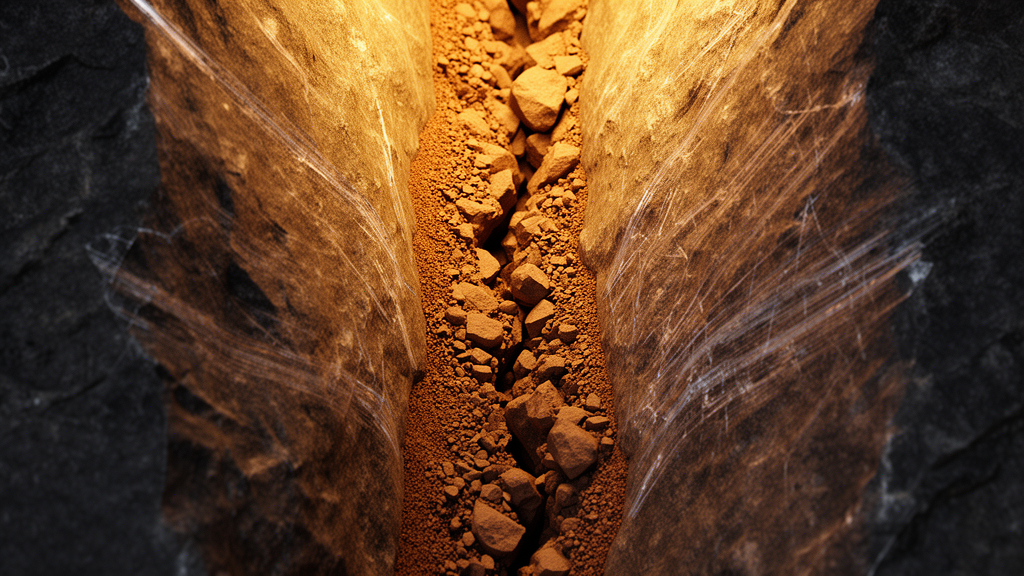
Deep beneath Earth’s surface, the rocks that line active faults are slowly ground to pieces. Every slip of a fault crushes and abrades the mineral grains caught between its rough walls, producing ever finer debris known as fault gouge. A new study published in Nature Communications by Nathalie Casas, Guilhem Mollon and Marco Maria Scuderi shows that this relentless grinding, called comminution, is not just a by-product of fault slip. According to the researchers, fragmentation actively builds the internal architecture of a fault zone and provides a structural framework for the dramatic weakening that allows earthquakes to nucleate.
The team approached the problem with discrete element method simulations, a computational technique that models a material as thousands of individual particles interacting through contact forces. Their virtual laboratory consisted of quartz-rich gouge, a close analogue of the crushed quartz that fills many natural faults. Crucially, the simulated grains were angular rather than rounded, and they were allowed to fragment dynamically as stresses built up during shearing. This combination let the researchers watch, grain by grain, how a granular material evolves from an initial assembly of sharp fragments into a mature, localized slip zone.
One of the central results is a robust strain–damage law: damage in the gouge accumulates in a predictable way as grains are progressively consumed by fragmentation. In other words, the mechanical state of the fault material can be tracked by how much of its original grain population has already broken apart. This finding matters because it offers a local fragmentation state variable, a quantity that constitutive laws, the mathematical descriptions engineers and geophysicists use to predict fault friction, can incorporate directly. Instead of treating grain-size evolution as a secondary detail, the new framework makes it a first-order ingredient in models of fault strength.
The simulations revealed that grain size plays a decisive role in shaping where and when deformation localizes. As shearing proceeds, the initially distributed damage begins to concentrate, and the geometry and timing of this localization depend on the size distribution of the grains. Fragmentation also enhances compaction, squeezing the gouge into a denser, more tightly packed fabric. Together, these processes promote the emergence of a dominant Principal Slip Zone, a narrow band within the fault core where most of the relative motion between the fault walls ultimately concentrates. Identifying how such a slip zone self-organizes from grain-scale crushing provides a mechanical bridge between microphysics and the macroscopic behavior of faults.
Perhaps the most striking insight concerns what happens as comminution approaches a saturation state, the point at which grains have been reduced close to a minimum achievable size. Once the gouge can no longer fragment much further, the simulations show that localization can migrate away from the established slip zone into competing bands. This migration offers a mechanical explanation for a puzzle that field geologists and experimentalists have long observed: overprinted shear fabrics, the superimposed layers of aligned, deformed material seen both in laboratory experiments and in rocks retrieved from natural faults. Rather than being oddities, these overprinted fabrics may be the natural record of a fault’s slip zone wandering as its grain population exhausted its capacity for further breakage.
The implications reach to the heart of earthquake physics. Fault weakening, the drop in frictional resistance that allows a fault to accelerate into an earthquake, is thought to depend on processes concentrated in the slip zone, including grain-size reduction, thermal pressurization of pore fluids, and the formation of slip-parallel fabrics. By linking fragmentation, porosity evolution and shear localization within a single framework, the study provides a structural underpinning for these weakening mechanisms. The porosity changes tracked in the simulations are especially relevant, since compaction of gouge controls how fluids pressure up during rapid slip, one of the leading candidates for dynamic fault weakening during large earthquakes.
The work also speaks to a long-standing question in fault zone architecture: why do natural fault cores so often display a hierarchy of structures, from broad damage zones down to ultracomminuted slip surfaces only millimeters thick? The simulation results suggest that this hierarchy is not imposed from outside but emerges spontaneously from the coupling between grain crushing and strain localization. Grain size dictates the geometry of localization, and localization in turn concentrates further crushing into narrow bands, a feedback loop that progressively refines the fault’s internal structure with accumulated slip.
Methodologically, the study demonstrates the power of dynamically fragmenting discrete element models for tectonics research. Earlier granular simulations often treated particles as indestructible, which limited their ability to capture the evolving grain-size distributions that characterize real gouge. By allowing angular grains to break according to the stresses they experience, the researchers could reproduce the full trajectory of gouge evolution, from initial fragmentation-dominated deformation to the saturation regime where localization migrates. The approach turns numerical experiments into a bridge between laboratory rock mechanics experiments, which operate on limited time and grain-size scales, and the vast spatial and temporal scales of natural faults.
For earthquake hazard research, the promise of a fragmentation state variable is considerable. Constitutive laws that couple grain-size evolution to fault strength could improve how scientists model the nucleation conditions for earthquakes, potentially sharpening estimates of when and where faults are primed to slip. The research was supported by the European Research Council through the HYQUAKE project, an effort aimed at unraveling the physics of earthquake nucleation, along with funding from the Italian PRIN Giovani PREVENT program and the French National Research Agency. As seismic networks and laboratory facilities generate ever richer observations of fault materials, frameworks like the one proposed by Casas and colleagues offer a way to translate grain-scale crushing into predictions about the largest earthquakes.
The study, published open access in Nature Communications, ultimately reframes fault gouge not as passive debris but as an active, evolving structure that records and enables the weakening of faults. Every shattered grain, every compacted pore and every migrating shear band contributes to the architecture that governs how faults store and release tectonic stress. In connecting the microscopic fate of individual quartz grains to the macroscopic conditions for earthquake nucleation, the research adds a structural dimension to the physics of fault weakening, one written in the broken fragments of the rocks themselves.
Subject of Research: Grain-scale fragmentation and its role in fault zone architecture and earthquake-related fault weakening
Article Title: From fragmentation to fault zone architecture as a structural framework for fault weakening
Article References: Casas, N., Mollon, G., & Scuderi, M. M. (2026). From fragmentation to fault zone architecture as a structural framework for fault weakening. Nature Communications. https://doi.org/10.1038/s41467-026-78254-w
Image Credits: AI Generated
DOI: 10.1038/s41467-026-78254-w
Keywords: fault gouge, fragmentation, comminution, earthquake nucleation, fault weakening, discrete element simulations, shear localization, Principal Slip Zone, grain size, porosity, fault zone architecture, quartz
Cite Scienmag News
Violet Maxwell. (October 16, 2026). How Grinding Grains Inside Faults Set the Stage for Earthquakes. Scienmag. https://scienmag.com/how-grinding-grains-inside-faults-set-the-stage-for-earthquakes/
Violet Maxwell. "How Grinding Grains Inside Faults Set the Stage for Earthquakes." Scienmag, 16 October 2026, https://scienmag.com/how-grinding-grains-inside-faults-set-the-stage-for-earthquakes/. Accessed 16 October 2026.
Violet Maxwell. "How Grinding Grains Inside Faults Set the Stage for Earthquakes." Scienmag. October 16, 2026. https://scienmag.com/how-grinding-grains-inside-faults-set-the-stage-for-earthquakes/


