


Along the low-lying coast of Guyana, where roughly ninety percent of the population lives on a narrow plain that sits largely below sea level, the fight against marine plastic pollution has long been a losing battle against rain, tides and floods. Now, a team of researchers at the University of Guyana reports that a systematic, prevention-focused strategy built on circular economy principles has delivered measurable results, intercepting more than 113 tonnes of waste from drainage canals in a single monitoring season and shifting how entire communities think about the plastic they throw away.
The findings, published in Frontiers in Ocean Sustainability, come from the Guyana pilot of the Prevention of Marine Litter in the Caribbean Sea, or PROMAR, project, an initiative funded by the German Federal Ministry for the Environment, Climate Action, Nature Conservation and Nuclear Safety and implemented by adelphi in partnership with the United Nations Environment Programme’s Cartagena Convention Secretariat. Led by Temitope D. Timothy Oyedotun and colleagues at the University of Guyana’s Faculty of Earth and Environmental Sciences, the pilot targeted four flood-prone communities along the East Coast Demerara corridor: Mon Repos, De Endragt, Good Hope and Lusignan. These settlements sit amid an extensive network of drainage canals and sluices that discharge directly into nearshore Atlantic waters, making them critical chokepoints where land-based plastic can be caught before it reaches the ocean.
What makes the Guyana pilot scientifically notable is not any single device but the integrated design. The researchers adopted a mixed-methods, systems-based framework grounded in the source-pathway-receptor model, combining household material flow analysis, knowledge-attitudes-practices surveys, physical waste interception, beach litter assessments and participatory stakeholder engagement across four sequential phases: baseline diagnostics, intervention deployment, monitoring and evaluation, and synthesis of policy lessons. A stratified random sample of 417 households, drawn from the 2022 national census enumeration districts and yielding a 95 percent confidence level with a margin of error of plus or minus 4.8 percent, provided the behavioral backbone of the study. Survey instruments, adapted from UNEP guidelines and validated through expert review and pilot testing, achieved strong internal consistency, with reliability coefficients ranging from 0.78 to 0.85 across the knowledge, attitudes and practice scales.
The material flow analysis revealed a portrait of consumption and disposal that explains why Guyana’s beaches are so heavily polluted. Nearly 77 percent of surveyed households regularly used 19-liter plastic water jugs, 46.5 percent consumed four or more plastic beverage bottles per week, and more than half reported using plastic cooking oil containers. Meanwhile, waste management remained strikingly inadequate: 42 percent of respondents practiced no waste separation at all, only 6.7 percent used a professional garbage collection service, and roughly one in ten households either dumped garbage regularly or burned it weekly. Guyana ranks among the top ten countries globally for per-capita mismanaged plastic waste entering the ocean, with an estimated leakage rate of approximately 1.59 kilograms per person per year.
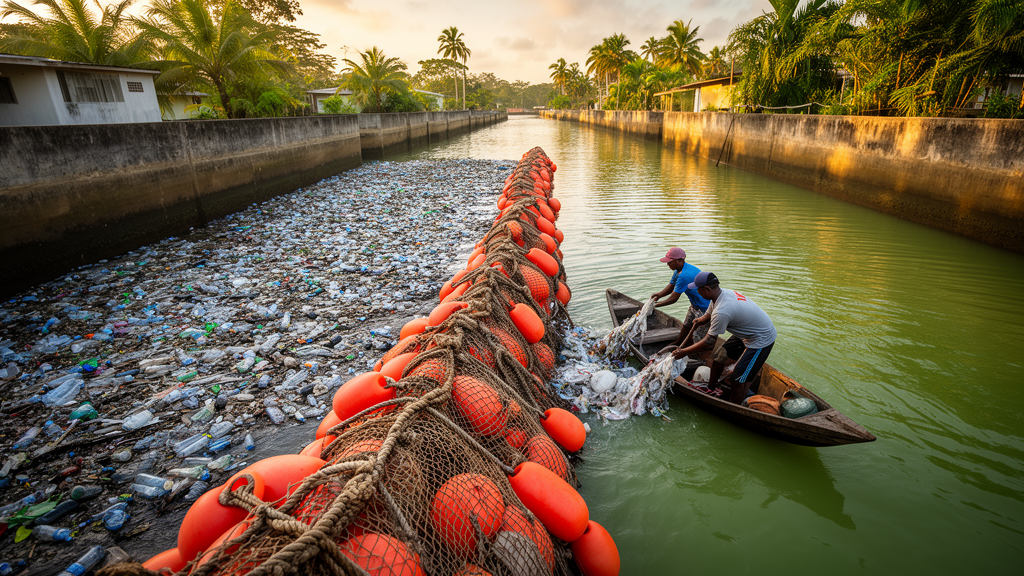
To quantify the leakage directly, the team built low-cost floating waste booms from locally sourced materials, including 40-millimeter polypropylene rope and HDPE shrimp netting, and installed them at three major drainage catchments. The booms extended 8 to 12 meters across canal widths, angled at 45 degrees to the flow to reduce hydraulic drag, and were checked daily. Between March and November 2025, the traps collected 113,399 kilograms of waste, of which plastics accounted for 59,466 kilograms, or 52.4 percent. The composition matched the household survey data almost exactly: plastic bags and films made up 31.5 percent of intercepted plastics, mixed packaging 39 percent, HDPE containers 16 percent and PET bottles 13.5 percent. The Mon Repos/Good Hope site, positioned where two large drainage channels converge near a pumping station, proved the most productive, capturing 94,432 kilograms overall, including a remarkable 26,540 kilograms during a single high-rainfall event in June 2025.
Statistical analysis confirmed what the raw numbers suggested. Interception efficiency varied significantly across sites, and monthly interception volumes showed a strong positive trend tied to precipitation patterns, with a Spearman correlation of 0.71 between rainfall and plastic mass intercepted. Boom efficiency ranged from 1.8 to 4.3 kilograms per meter of canal width per day, peaking during the June and November discharge periods. Perhaps most strikingly, the researchers found that these simple prototypes, built from rope, netting, bamboo and elastic anchors, outperformed more expensive mechanical collection systems in several instances, while avoiding the risks such machines can pose to aquatic fauna. Because the traps can be deployed and maintained by community groups or neighborhood councils, the team argues they offer a genuinely sustainable path for data-poor coastal states.
The circular economy component of the pilot translated diagnosis into action. Four decentralized waste-to-value hubs, one in each community, were established to collect, sort and aggregate recyclable plastics, which were then processed at the University of Guyana’s Circular Economy Innovation Lab using shredders, injection molds and additive manufacturing. A waste-for-token exchange scheme allowed residents and schools to trade sorted plastics for non-cash rewards such as school supplies and household items. The researchers found that this incentive mechanism, modest though it was, stabilized material flows into the processing stage and reinforced consistent sorting behavior, consistent with behavioral economics research showing that visible infrastructure and non-monetary nudges can reshape everyday choices. While proceeds from recyclables and souvenir sales do not yet cover the cost of rewards and logistics, the team expects that growing volumes and improved sorting efficiency will eventually bring the scheme toward cost recovery.
The behavioral results were equally striking. Three major coastal cleanups between April and September 2025 mobilized 173 volunteers and removed roughly 1,306 kilograms of debris from Unity Beach, the Kingston Seawall and No. 63 Beach. Post-activity surveys of 121 participants at the largest event revealed mean understanding scores of 10 out of 10 for marine litter and its impacts, unanimous agreement that the problem demands immediate action, and strong intentions to change daily habits, with mean scores of 9.6 for behavioral change and future participation. Across the full study, a significant positive point-biserial correlation between knowledge-attitudes-practices scores and regular hub visits confirmed that improved awareness translates into action. School programs reached 133 students across three schools, where 97 percent of children identified themselves as ocean helpers after participating in waste-sorting games.
The policy dimension may prove the most consequential. The project delivered a national policy brief on marine litter prevention to Guyana’s Environmental Protection Agency, drafted an Extended Producer Responsibility framework and a draft national deposit-refund scheme for plastic bottles and packaging, and contributed technical input to the review of Guyana’s Solid Waste Management Bill. A National Dialogue on Marine Litter Prevention in May 2025 brought together government agencies, civil society and technical partners, while a collaboration with UNEP-GRID Geneva and the University of Geneva is building a regional marine litter monitoring platform. Because PET, HDPE and other packaging plastics dominate the intercepted waste streams, the researchers argue that upstream instruments such as EPR, which shifts responsibility for post-consumer waste from municipalities to producers, are essential for sustaining and scaling prevention efforts.
The Guyana pilot offers a replicable model for coastal states across the Caribbean and beyond, where shoreline litter densities of 2,000 to 3,900 items per kilometer far exceed global averages. Its central lesson is that drainage systems are leverage points where small technological investments yield large reductions in leakage, that community-anchored incentives can sustain participation even where money is scarce, and that technical fixes succeed only when woven into education, behavioral change and multi-actor governance. The authors acknowledge limitations, including a short monitoring window and reliance on self-reported behavior, and caution that long-term success depends on stable financing, regulatory support and inclusive stakeholder participation. But the evidence from this flood-prone coastline suggests something quietly revolutionary: that marine litter prevention is both technically feasible and socially achievable when communities are equipped not just with bins and booms, but with ownership of the solution itself.
Subject of Research: Circular economy-based prevention of land-based marine plastic litter in Guyana's coastal communities
Article Title: Systematic-based approach to marine litter prevention in coastal environment: lessons and successes from the PROMAR project implementation in Guyana
Article References: Oyedotun, T. D. T., Hamer, S., Persaud, C., & Johnson-Bhola, L. (2026). Systematic-based approach to marine litter prevention in coastal environment: lessons and successes from the PROMAR project implementation in Guyana. Frontiers in Ocean Sustainability, 4, Article 1859998. https://doi.org/10.3389/focsu.2026.1859998
Image Credits: AI Generated
DOI: 10.3389/focsu.2026.1859998
Keywords: marine litter, plastic pollution, circular economy, Guyana, Caribbean, PROMAR, waste interception, Extended Producer Responsibility, community engagement, drainage canals, behavioral change, coastal management
Cite Scienmag News
Violet Maxwell. (October 16, 2026). Rope, Nets and Nudges: How Guyana’s Cheap Canal Booms Are Stopping Plastic Before It Reaches the Sea. Scienmag. https://scienmag.com/rope-nets-and-nudges-how-guyanas-cheap-canal-booms-are-stopping-plastic-before-it-reaches-the-sea/
Violet Maxwell. "Rope, Nets and Nudges: How Guyana’s Cheap Canal Booms Are Stopping Plastic Before It Reaches the Sea." Scienmag, 16 October 2026, https://scienmag.com/rope-nets-and-nudges-how-guyanas-cheap-canal-booms-are-stopping-plastic-before-it-reaches-the-sea/. Accessed 16 October 2026.
Violet Maxwell. "Rope, Nets and Nudges: How Guyana’s Cheap Canal Booms Are Stopping Plastic Before It Reaches the Sea." Scienmag. October 16, 2026. https://scienmag.com/rope-nets-and-nudges-how-guyanas-cheap-canal-booms-are-stopping-plastic-before-it-reaches-the-sea/


