


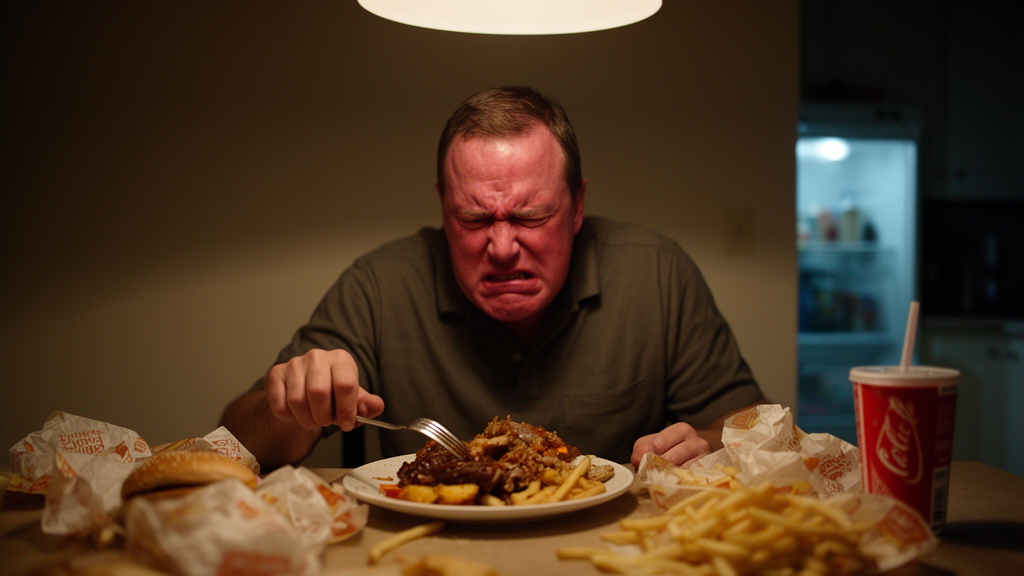
Scientists studying why some people feel unable to control their eating have turned their attention to an emotion that rarely features in diet research: anger. A new analysis of more than 1,100 adults in Germany suggests that people with a stronger general tendency to feel angry also report more symptoms of food addiction, a pattern that persists even after accounting for age, sex, social support, alcohol use and the broad architecture of personality itself. The finding, drawn from the population-based LIFE-Adult Study in Leipzig and published in the Journal of Eating Disorders, positions trait anger as an emotional correlate of problematic eating that stands apart from better-established psychological risk factors.
Food addiction is a contested but increasingly studied construct. It describes a cluster of experiences that mirror substance addiction in an eating context: powerful cravings for certain foods, consumption in larger amounts than intended, repeated failed attempts to cut down, continued overeating despite negative consequences, and withdrawal-like states or distress when consumption is curtailed. Researchers typically measure it with symptom counts rather than a simple yes-or-no diagnosis, which allows the severity of the pattern to be graded across a population. The condition has been linked to pathological eating behaviour, obesity and a range of adverse mental health outcomes, yet the emotional underpinnings of the syndrome remain incompletely mapped. Depression and anxiety have received considerable attention; anger, by contrast, has been largely unexplored in this context.
The research team, led by Felix S. Hussenoeder of Leipzig University’s Institute of Social Medicine, Occupational Health and Public Health, set out to close that gap with an unusually rigorous design. Rather than simply asking whether angry people eat more compulsively, they asked whether trait anger, the stable disposition to experience angry feelings across situations, predicts food addiction symptoms independently of the Big Five personality traits: openness, conscientiousness, extraversion, agreeableness and neuroticism. This distinction matters because trait anger is conceptually entangled with neuroticism and low agreeableness, and a naive analysis could mistake a general personality vulnerability for a specific emotional signal.
The data came from 1,138 adults aged 20 to 79 who participated in the LIFE-Adult Study, a cohort drawn from the general population of Leipzig between 2011 and 2014. Participants completed established questionnaires assessing trait anger along with three dimensions of how anger is handled: anger expression-in, which reflects suppressing angry feelings and directing them inward; anger expression-out, which reflects directing anger toward other people or objects in the environment; and anger control, which reflects attempts to restrain angry feelings before they are expressed. Food addiction symptoms were quantified as symptom counts, and the team used sequential Poisson regression, a statistical approach suited to count outcomes, to build models of increasing complexity.
The analytical strategy was deliberately layered. The researchers first examined the association between trait anger and food addiction symptoms on its own, then progressively adjusted for sociodemographic characteristics such as age and sex, for social support, for alcohol use, for the anger expression and regulation dimensions, and finally for the Big Five personality traits. This stepwise approach allowed them to see which associations survived as the statistical company grew more crowded, a technique that helps separate genuine independent signals from correlations that merely ride on other variables.
The results were striking in their selectivity. Higher trait anger was associated with higher food addiction symptom counts, and the association remained statistically significant even after adjustment for the anger expression and regulation dimensions and for sociodemographic characteristics. In the fully adjusted model, four factors emerged as independently associated with higher symptom counts: trait anger, lower social support, higher neuroticism and lower conscientiousness. Notably, the specific dimensions of anger expression and regulation, the inward suppression, the outward venting and the deliberate control of anger, were no longer significant once trait anger and personality were taken into account.
That pattern carries a theoretical implication. It suggests that what matters for food addiction is not so much how a person manages or expresses their anger, but rather the underlying propensity to feel angry in the first place. In other words, the emotional disposition itself, rather than its behavioural outlets, appears to be the relevant correlate of difficult-to-control eating. This framing aligns with broader models of addiction in which negative affect serves as a trigger for compulsive consumption: anger, like other aversive emotional states, may prompt eating as a form of self-regulation or escape, and a person who experiences anger frequently and intensely may accumulate more such triggers over time.
The independent contributions of social support and personality fit coherently into this picture. Lower social support has long been associated with poorer self-regulation and with using food as a coping resource in the absence of interpersonal ones. Higher neuroticism, the tendency toward negative emotionality and emotional instability, is a well-replicated correlate of addictive and compulsive behaviours, and lower conscientiousness, which reflects reduced impulse control and planning, plausibly weakens the behavioural brakes on overconsumption. That trait anger retains its association alongside these established markers suggests it captures something they do not, a specific hot emotional propensity rather than a general tendency toward distress or poor self-discipline.
The authors are careful about what the study cannot show. Because anger and food addiction symptoms were measured at a single point in time, the cross-sectional design cannot establish whether trait anger causes food addiction, whether compulsive eating amplifies angry feelings, or whether both arise from a shared underlying vulnerability. Temporal ordering and causality remain open questions, and longitudinal follow-up would be needed to disentangle them. The study also relies on self-report questionnaires, which are subject to recall and reporting biases, and the sample, while population-based, comes from a single German city.
Even with those caveats, the findings carry practical weight. If trait anger is confirmed as a relevant emotional correlate of food addiction, it could inform screening and intervention: clinicians working with disordered eating might consider assessing anger proneness alongside depression and anxiety, and emotion-focused treatments that address anger specifically might complement existing approaches. For the public, the study adds nuance to a familiar narrative. Food addiction is not simply a matter of willpower or the seductive engineering of ultra-processed foods; it is entangled with temperament, emotional life and social circumstances. A stable tendency to feel angry, the research suggests, may be one thread in that web, quietly shaping why some people find eating far harder to control than others.
Subject of Research: The association between trait anger, anger expression and regulation, and food addiction symptoms in adults
Article Title: Associations of trait anger and the anger expression and regulation dimensions with food addiction in the LIFE-adult study
Article References: Hussenoeder, F. S., Conrad, I., Luppa, M., Löbner, M., Pabst, A., Engel, C., Reyes, N., Yahiaoui-Doktor, M., Glaesmer, H., Hinz, A., Witte, V., Schroeter, M. L., Medawar, E., Kirsten, T., Loeffler, M., Villringer, A., & Riedel-Heller, S. G. (2026). Associations of trait anger and the anger expression and regulation dimensions with food addiction in the LIFE-adult study. Journal of Eating Disorders. https://doi.org/10.1186/s40337-026-01802-8
Image Credits: AI Generated
DOI: 10.1186/s40337-026-01802-8
Keywords: food addiction, trait anger, anger expression, anger control, emotion regulation, personality, neuroticism, conscientiousness, social support, eating disorders, LIFE-Adult Study, mental health
Cite Scienmag News
Ophelia Keating. (October 16, 2026). Angry Personalities May Face Higher Risk of Food Addiction, German Study Finds. Scienmag. https://scienmag.com/angry-personalities-may-face-higher-risk-of-food-addiction-german-study-finds/
Ophelia Keating. "Angry Personalities May Face Higher Risk of Food Addiction, German Study Finds." Scienmag, 16 October 2026, https://scienmag.com/angry-personalities-may-face-higher-risk-of-food-addiction-german-study-finds/. Accessed 16 October 2026.
Ophelia Keating. "Angry Personalities May Face Higher Risk of Food Addiction, German Study Finds." Scienmag. October 16, 2026. https://scienmag.com/angry-personalities-may-face-higher-risk-of-food-addiction-german-study-finds/


