


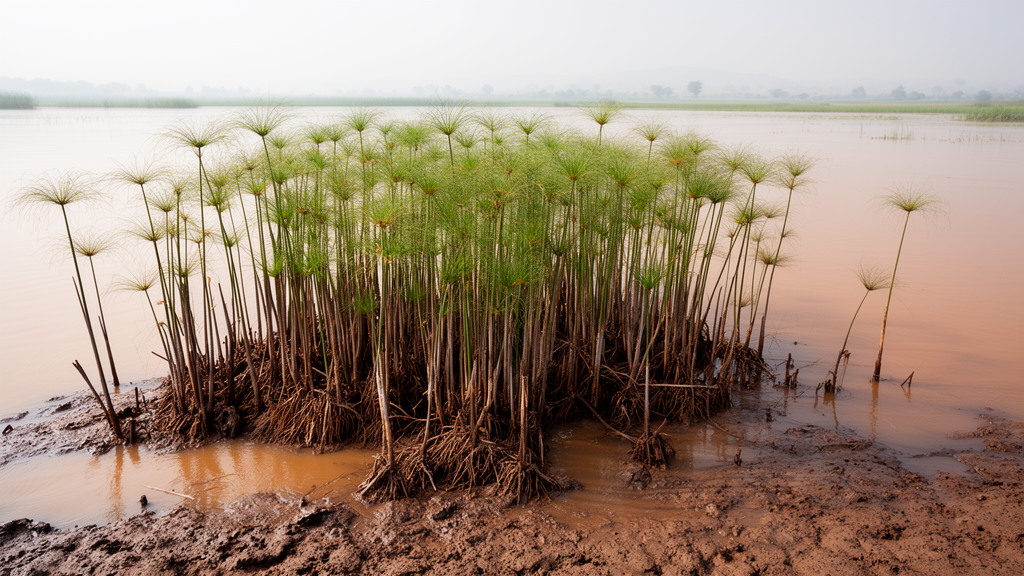
The papyrus swamps fringing Lake Tana, the largest lake in Ethiopia and the primary source of the Blue Nile, are quietly losing ground to an invisible adversary: sediment. A new controlled experiment conducted at Bahir Dar University’s Maritime Academy campus on the lakeshore has provided some of the most direct evidence yet that excessive sediment deposition measurably stunts the growth of Cyperus papyrus, the towering sedge that anchors the lake’s buffer zone. The findings, published in the journal BioRisk, arrive at a moment when the wetlands surrounding Lake Tana are already under severe pressure from deforestation and intensive agriculture in the surrounding highland watershed.
Papyrus is far more than a botanical curiosity in this region. The dense stands of this giant sedge act as living filters, trapping sediments and pollutants before they reach open water, buffering the lake against eutrophication and sustaining a web of ecological and economic services for local communities. Earlier quantitative work in the basin found that catchments whose papyrus swamps had been disturbed yielded roughly three times more sediment than those with intact vegetation, underscoring how tightly the wetland’s fate is bound to what happens on the land above it. Yet until now, surprisingly little experimental research had examined how different depths of accumulating sediment actually affect the plant’s growth, structure, and long-term viability.
To close that gap, researchers constructed twelve experimental wetland beds, each measuring one by two meters and lined with geomembrane, on the shore of Lake Tana. The beds were filled with a clay-dominated composite substrate and planted with papyrus rhizomes collected from the nearby Legdiya littoral wetland at a standardized density of thirty rhizomes per two square meters. After a one-month acclimation period, the beds were assigned to four sediment treatments: a control receiving no additional sediment, and three treatments receiving one, five, or ten centimeters of extra sediment, levels chosen to mirror the range of siltation observed in the lake itself, from deeper sections with less than twenty centimeters of accumulated sediment to shallow zones where nearly a meter has built up.
Over the five-month growing season from May to October 2020, the team monitored the plants every two weeks, marking individual culms and tracking height, stem diameter, new shoot recruitment, culm density, mortality, and both above-ground and below-ground biomass. The sediment used in the experiment was collected from the Gilgel Abay river and nearby wetlands, and laboratory analysis confirmed it was clay-rich, with a pH of 5.86 and modest nutrient content. Water levels were maintained at twenty centimeters throughout, and the beds were left open to the elements rather than housed in a greenhouse, so that temperature, light, and rainfall reflected genuine lakeside conditions.
The results were striking. Plants buried under ten centimeters of sediment grew significantly shorter than those under one centimeter, with statistically significant differences confirmed by non-parametric analysis. Stem diameter told a similar story: the medium sediment treatment actually produced the thickest stems, averaging 17.70 millimeters measured above the sediment, but the high sediment treatment lagged far behind at just 12.06 millimeters, compared with 16.90 millimeters in the control beds. The pattern suggests a nuanced response in which a modest layer of sediment may stimulate growth, while heavy deposition crosses a threshold beyond which the plant’s physiology begins to fail.
Culm density and shoot recruitment revealed the demographic toll of sedimentation most clearly. Control beds supported the highest density of culms, averaging 67 per two square meters, while high sediment beds held only 35. New shoot recruitment peaked early in the experiment, when freshly added sediment released a pulse of nutrients, but declined sharply in the high sediment treatment, where only about one new shoot per two square meters appeared at the peak compared with six in the low sediment beds. Sediment depth showed a strong positive correlation with new shoot numbers in the control and low treatments, but that relationship broke down entirely in the medium and high treatments, indicating that deep burial disrupts the clonal dynamics on which papyrus regeneration depends.
Biomass measurements reinforced the picture of decline. Wet above-ground biomass fell from 9.0 kilograms per two square meters in the control beds to just 3.7 kilograms under high sediment, while wet below-ground biomass dropped from 21.5 to 7.9 kilograms over the same gradient. Dry biomass followed the same trajectory. The researchers note that the root system, the major biomass component of many wetland plants, bore a disproportionate share of the damage, which matters because papyrus depends on robust below-ground reserves to sustain shoot production and recover from disturbance.
The mechanisms behind these effects are physiological as much as physical. Excessive sediment compacts the substrate and reduces pore space, restricting oxygen diffusion to the roots and inducing hypoxia, a condition that impairs root respiration and promotes the accumulation of toxic compounds such as sulphides and ethanol in anaerobic sediments. Oxygen starvation also degrades the plant’s ability to take up nitrogen, phosphorus, and iron, undermining chlorophyll synthesis and photosynthesis. Sediment can further smother fine root hairs responsible for nutrient absorption, obstruct light penetration for submerged tissues, and physically bury young shoots before they establish. Although papyrus possesses aerenchyma tissue that channels oxygen internally, the study’s authors conclude that persistent heavy sedimentation can overwhelm these adaptations, weakening the species’ competitive ability and potentially allowing more tolerant plants to take over, with cascading consequences for community structure and ecosystem function.
Not every effect was negative, and the study captures an important nuance. Shallow burial of one centimeter sometimes performed comparably to the control, echoing earlier findings that light sediment deposition under waterlogged conditions can stimulate seedling growth and dry mass accumulation in other wetland macrophytes, partly because deposited sediment delivers nutrients and moderates temperature fluctuations. Seasonal flooding that carries modest sediment loads may therefore help sustain papyrus productivity, even as chronic, heavy siltation erodes it. The authors also caution that factors outside their experimental design, including shading by taller plants, termite damage, and climatic variation, may have contributed to culm mortality and warrant further investigation.
The practical implications are urgent. The researchers argue that sediment management in the Lake Tana buffer zone must become a central pillar of wetland conservation and restoration, and they call for long-term, multi-year monitoring of papyrus populations to establish ecological thresholds and recovery patterns under sustained sedimentation stress. Detailed characterization of sediment properties, including particle size, organic matter, and nutrient content, could sharpen management strategies further. As the papyrus swamps of Lake Tana continue to shrink under mounting anthropogenic pressure, this experiment offers a clear quantitative warning: without deliberate control of sediment loads, the ecological cornerstone of Ethiopia’s most important lake may slowly be buried by the very soils stripped from its watershed.
Subject of Research: Effects of sediment load on the growth of Cyperus papyrus in the Lake Tana buffer zone
Article Title: Impact of sediment load on Cyperus papyrus growth in Lake Tana buffer zone, Northwest Ethiopia
Article References: Mulat, K., Wondie, A., & Mingist, M. (2026). Impact of sediment load on Cyperus papyrus growth in Lake Tana buffer zone, Northwest Ethiopia. BioRisk, 24, 1-16. https://doi.org/10.3897/biorisk.24.175866
Image Credits: AI Generated
DOI: 10.3897/biorisk.24.175866
Keywords: Cyperus papyrus, Lake Tana, sedimentation, wetland ecology, Ethiopia, buffer zone, biomass, root hypoxia, wetland restoration, Blue Nile, soil erosion, macrophytes
Cite Scienmag News
Violet Maxwell. (October 16, 2026). Sediment Overload Stunts Papyrus Growth in Lake Tana’s Buffer Wetlands. Scienmag. https://scienmag.com/sediment-overload-stunts-papyrus-growth-in-lake-tanas-buffer-wetlands/
Violet Maxwell. "Sediment Overload Stunts Papyrus Growth in Lake Tana’s Buffer Wetlands." Scienmag, 16 October 2026, https://scienmag.com/sediment-overload-stunts-papyrus-growth-in-lake-tanas-buffer-wetlands/. Accessed 16 October 2026.
Violet Maxwell. "Sediment Overload Stunts Papyrus Growth in Lake Tana’s Buffer Wetlands." Scienmag. October 16, 2026. https://scienmag.com/sediment-overload-stunts-papyrus-growth-in-lake-tanas-buffer-wetlands/


