


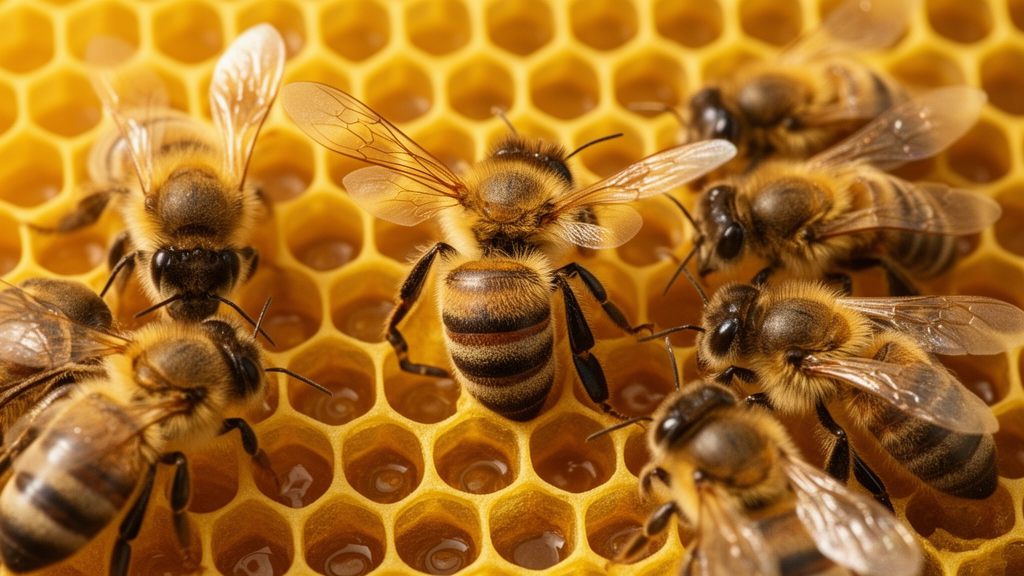
Deep inside a honey bee hive, on a crowded dance floor, a forager bee jostles through a figure-of-eight pattern and shakes her body energetically in a waggle run. For nearly a century, this famous performance has been celebrated as one of the most sophisticated communication systems in the animal kingdom, a living broadcast that tells nestmates both the direction and the distance of a profitable flower patch. Yet for all the attention lavished on the dance itself, remarkably little has been known about the network that the dance creates: who actually receives the message, who passes it on, and how information flows from bee to bee through a colony of thousands. A new field experiment, published in Frontiers in Bee Science, has now mapped real waggle dance recruitment networks in vivo, and the picture that emerges is strikingly different from what intuition might predict.
The research team, led by Laura C. McHenry of Virginia Tech and The Pennsylvania State University, together with Roger Schürch, Lindsay E. Johnson, Bradley D. Ohlinger, and Margaret J. Couvillon, worked with two fully-marked experimental colonies of approximately 3,000 workers each. Every bee carried a unique identifier: a colored, numbered disc tag glued to the thorax combined with a colored paint stripe on the abdomen, yielding 3,000 distinct identity values per colony. The colonies were housed in clear-walled observation hives at the Prices Fork Research Center in Blacksburg, Virginia, with the dance floor filmed continuously by two Canon camcorders positioned on either side of the comb. This setup allowed the researchers to track, frame by frame, which bees followed which dances and which bees subsequently appeared at an artificial feeder in the field.
To generate recruitment events worth mapping, the team trained an initial cohort of foragers, the so-called origin bees, to collect 2 M sucrose solution from an artificial feeder. The feeder was moved stepwise across an open field in increments of 10 to 15 meters until it reached 215 meters in the first trial and 315 meters in the second. During the experimental phase, the feeder was replenished with unscented sucrose solution, a deliberate choice that forced newly recruited bees to rely as much as possible on waggle dance information rather than olfactory cues. Four researchers participated in data collection: two monitored foraging visits at the feeder, while two others observed and filmed waggle dances at the observation hive, one on either side of the colony so as to monitor both sides of the dance floor at once. All feeder visits and dances were logged on Samsung tablets running ODK Collect, recording each bee’s unique identifier and the event’s timestamp.
From the video data, the researchers matched each experimental phase recruit with the dancer who had recruited her. The criterion for dance following was being within antennal contact distance with the dancer during a waggle run. By searching the video in the minutes preceding each bee’s first recorded feeder visit, they identified the last waggle dance where she followed at least one waggle run before arriving at the feeder. These dancer-follower relationships were then assembled into a directed network using the igraph R package, with each edge pointing from dancer to follower along the flow of information. Each node representing an experimental phase recruit thus had one inbound tie representing the receipt of feeder location information, but could have any number of outbound ties depending on how many nestmates she herself went on to recruit.
The first major finding concerns network density, the proportion of observed ties relative to the maximum number possible. The researchers recognized that the conventional baseline, a complete graph in which every node is connected to every other node, would be biologically meaningless for honey bee recruitment, since no real-world scenario exists in which every bee recruits every other bee to the same food source. Instead, they simulated a biologically-informed complete graph using a deterministic compartmental model of the susceptible-infected family, reimagined in the context of waggle dance communication. In this model, infected bees are those with knowledge of a food resource, susceptible bees are nestmates that follow dance communications, and an infection represents a successful recruitment. By setting the infection probability to 1, the simulation represents what the recruitment network might look like if bees were 100 percent effective at recruiting every nestmate they contacted while dancing.
Against this biologically-informed upper bound, the observed networks were extraordinarily sparse. For the first trial, the classical network density was 3.60 x 10^-5, while the corrected density calculated with the simulated complete graph was 3.68 x 10^-2. For the second trial, the classical density was 1.50 x 10^-5 and the corrected density was 1.55 x 10^-2. In both cases, the biologically-informed density values differed from the classical values by a factor of 1,000, yet even the corrected values indicate that each individual recruited up to only 3.5 percent as many nestmates as predicted by the maximally-efficient model. In other words, the pool of origin bees recruited only a small fraction of the nestmates they might have, if they had a perfect recruitment record.
The researchers attribute this sparseness to what they describe as a leaky pipeline of recruitment. For successful recruitment to occur, a potential receiver bee must first be within perceptive range of a waggle dance, usually 18 to 27 millimeters from the dancer. Even if she is within range, she may not choose to follow the dance. If she does, she must closely observe multiple waggle runs, on average between 8 and 23 runs depending on the study, without being bumped off-course by nestmates. Having done this, she must then weigh this social information against any private information she may possess. Approximately 75 to 88 percent of dance-following interactions result in reactivation to a known foraging site rather than recruitment to the advertised food source. Finally, 60 to 80 percent of bees who do set out to find the advertised resource will fail to do so. Considering all these steps together, perhaps such sparse network densities are unsurprising.
The second major finding concerns burstiness, a measure of the temporal clustering of events in a time series. Of the 63 bees that performed waggle dances during the experimental phase, 53 performed more than one dance and were thus eligible for burstiness analysis. Overall, bees danced steadily, not burstily, with a mean burstiness coefficient of -0.05 and a 95 percent confidence interval of -0.12 to 0.015. Burstiness values close to zero indicate high inter-event homogeneity, meaning that once bees begin to dance, they keep up a regular rhythm of dance bouts. The researchers note that this regularity might be overstated compared to a natural foraging scenario, where bees must visit, probe, and collect nectar from many flowers dispersed patchily across the landscape, which would translate to a more irregular rhythm of waggle dance bouts.
The third and perhaps most intriguing finding concerns individuality in waggle dance calibrations. Each forager bee measures the real-world distance she has flown and scales it down to a waggle run duration according to a calibration that is particular unto herself. As a result, different bees advertising the same location may produce different waggle run durations, and these individual calibrations can lead to calibration mismatch between dancers and followers. If the dancer’s calibration is longer than the follower’s, the follower would interpret a farther distance than intended and would be likely to overshoot the resource, a condition the researchers call positive mismatch. In their bees’ communication networks, 76 percent of recruitment events occurred between dyads where the dancer’s calibration was longer than the follower’s, with 23 ties out of 30 matching this criterion. This frequency was higher than would be predicted by chance based on a permuted null distribution, yielding a p-value of 0.008. As a result of this phenomenon, chains of recruitment generally showed a trend of successively lower calibration values, suggesting that information flows more readily down what the researchers call the calibration gradient.
Beyond its implications for bee biology, the study offers the first empirical and biologically-informed descriptive statistics for honey bee waggle dance networks, and the researchers hope these results may inform the parameterization of bio-inspired computing models. Honey bee colonies have already inspired a wide variety of algorithms seeking to refine strategies for managing complexity, from computing networks and informatics to the management of big data with artificial intelligence. A critical concern in stream-based computing is achieving low latency coupled with high throughput, and recent attention has focused on testing parameterization conditions of bee-inspired algorithms, including various network density conditions. The researchers suggest it would now be interesting to test the behavior of stream-based computing models when parameterized according to the density and burstiness properties observed in real bee networks, asking whether bee-inspired parameterizations would offer good latency and throughput or result in inefficient networks, as one might predict based on the famous inefficiency of the waggle dance itself. The work also acknowledges its limitations: results reflect recruitment networks formed under particular experimentally controlled conditions, with fewer replicates than typical in the field, two instead of three, due to the extreme labor demands of creating fully-marked colonies. Future work with greater replication and in different biological contexts will provide fruitful insights into the role of social networks in the lives of bees, and into the collective regulation of the honey bee colony superorganism.
Subject of Research: Animal Behavior and Social Networks
Article Title: Dancing on the edge: honey bee recruitment networks are sparse and affected by individuality in waggle dance behavior
Article References: McHenry, L. C., Schürch, R., Johnson, L. E., Ohlinger, B. D., & Couvillon, M. J. (2025). Dancing on the edge: honey bee recruitment networks are sparse and affected by individuality in waggle dance behavior. Frontiers in Bee Science, 3, Article 1654032. https://doi.org/10.3389/frbee.2025.1654032
Image Credits: AI Generated
DOI: 10.3389/frbee.2025.1654032
Keywords: honey bee, waggle dance, recruitment network, network density, burstiness, individuality, social network analysis, bio-inspired computing, Dancing, edge, honey, recruitment
Cite Scienmag News
Kristina Jarvis. (October 16, 2026). Honey Bee Waggle Dance Networks Are Surprisingly Sparse, and Individuality Helps Information Flow. Scienmag. https://scienmag.com/honey-bee-waggle-dance-networks-are-surprisingly-sparse-and-individuality-helps-information-flow/
Kristina Jarvis. "Honey Bee Waggle Dance Networks Are Surprisingly Sparse, and Individuality Helps Information Flow." Scienmag, 16 October 2026, https://scienmag.com/honey-bee-waggle-dance-networks-are-surprisingly-sparse-and-individuality-helps-information-flow/. Accessed 16 October 2026.
Kristina Jarvis. "Honey Bee Waggle Dance Networks Are Surprisingly Sparse, and Individuality Helps Information Flow." Scienmag. October 16, 2026. https://scienmag.com/honey-bee-waggle-dance-networks-are-surprisingly-sparse-and-individuality-helps-information-flow/


