


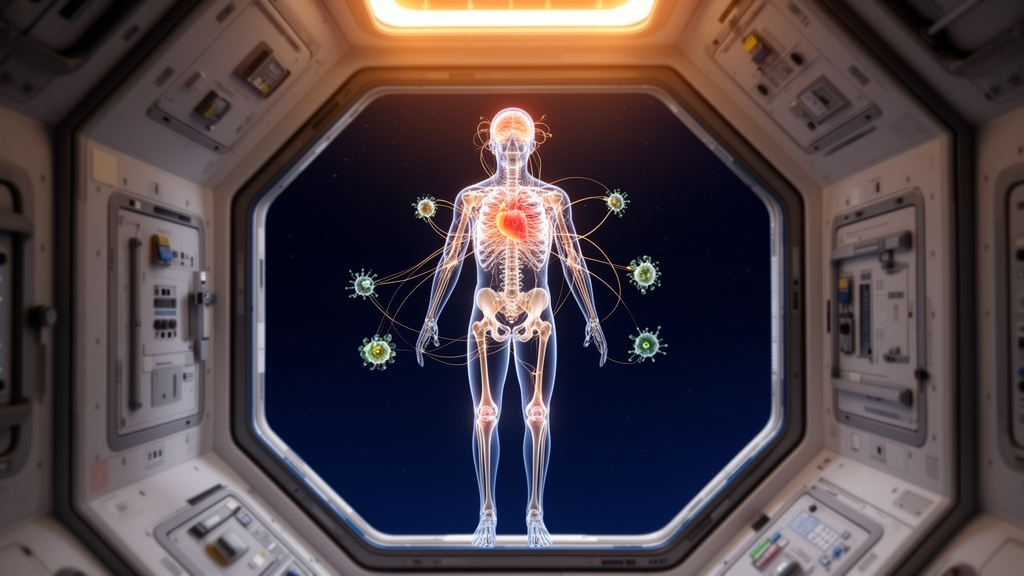
When astronauts leave Earth’s gravity behind, their bodies begin a transformation that is far stranger and more consequential than any single organ problem. A new narrative mini review published in Frontiers in Network Physiology argues that the well-known spaceflight afflictions—shrinking muscles, thinning bones, a sluggish heart—are not isolated failures but symptoms of a deeply interconnected, multi-system deconditioning response. The review, authored by Rashmi Neginhal and Rebecca Rejo George of Fatima College of Health Sciences in the United Arab Emirates, synthesizes six decades of evidence from human spaceflight missions, ground-based analog studies, and cellular experiments, and then reframes them through the lens of network physiology: the study of how organ systems dynamically coordinate, and how perturbations in one node of that network cascade into dysfunction elsewhere.
The physiological stakes are enormous. On Earth, gravity is not merely a background condition; it is the mechanical anchor for fluid distribution, mechanotransduction in bone and muscle, vestibular calibration, and the hydrostatic gradients that govern vascular tone. Remove it, and the body launches into a cascade of adaptations that are appropriate for the short term but become clinically significant over months or years. The International Space Station has provided an invaluable platform for characterizing these changes, with emerging one-year mission data illuminating longer-term deconditioning trajectories. Ground-based analogs—head-down bed rest, dry immersion, and rodent hindlimb unloading—allow controlled mechanistic investigations that are not feasible in orbit, and together with advances in multi-omics and computational physiology they have generated an increasingly integrated picture of what weightlessness actually does to a human being.
The musculoskeletal system is the most visibly vulnerable target. Skeletal muscle is exquisitely sensitive to mechanical loading, and its removal rapidly initiates a catabolic program: anabolic signaling is suppressed, the ubiquitin-proteasome and autophagy-lysosome proteolytic cascades are upregulated, and myofibers are progressively lost. Syntheses of spaceflight and bed-rest data show rapid atrophy, reduced cross-sectional area, fiber-type transitions from slow to fast twitch, impaired mitochondrial function, insulin resistance, and diminished strength and endurance. Japanese Aerospace Exploration Agency investigations confirmed marked atrophy of antigravity muscles, particularly the soleus, with upregulated protein degradation pathways that explicitly parallel age-related sarcopenia. Perhaps most striking is the finding from a systematic review of 318 healthy adults undergoing 5 to 120 days of bed rest: the ratio of strength loss to atrophy was approximately 4.2 to 1 at day 5, declining to 1.9 to 1 after 35 days. That disproportionate early strength loss implicates neural contributions—impaired motor unit recruitment and altered neuromuscular drive—before structural atrophy becomes dominant.
Bone tells a similar story of mechanical dependence. Astronauts lose approximately 1 to 2 percent of bone mineral density per month, predominantly at weight-bearing sites such as the proximal femur, femoral neck, and lumbar spine, driven by increased osteoclast-mediated resorption and suppressed osteoblast function, with trabecular microarchitectural recovery remaining incomplete for months to years after return. A murine study aboard the ISS exposed female C57BL/6J mice to 37 days of spaceflight and demonstrated site-specific bone loss exclusively at weight-bearing sites: femoral head bone volume fraction fell 27 percent, distal femoral epiphyseal bone volume fraction dropped 55 percent, and midshaft cortical thickness declined 8 percent, whereas lumbar vertebral bone showed no significant loss. That pattern provides strong evidence that mechanical unloading, not ionizing radiation, is the primary driver of bone loss during low-Earth orbit missions. Current ISS exercise countermeasures—principally the Advanced Resistive Exercise Device combined with aerobic modalities—mitigate but do not fully prevent this deconditioning, and promising adjuncts such as blood flow restriction training, neuromuscular electrical stimulation, and artificial gravity still face unresolved dosing and sex-specific response questions.
The cardiovascular system undergoes a biphasic response. Acutely, 1 to 2 liters of blood redistribute toward the head, transiently elevating cardiac preload; compensatory diuresis then contracts plasma volume by 10 to 15 percent, normalizing cardiac output at the cost of reduced circulating volume. Over longer durations, myocardial atrophy and reduced left ventricular mass develop, alongside endothelial dysfunction, cytoskeletal reorganization, altered vascular permeability, coagulation abnormalities, and calcium-handling dysregulation that increases arrhythmia susceptibility. A meta-analysis integrating 62 studies and 963 participants confirmed increased heart rate, reduced stroke volume and cardiac output, decreased systolic blood pressure, jugular venous distension, carotid artery remodeling, and impaired heart rate variability across spaceflight and simulated microgravity conditions. Post-flight orthostatic intolerance—the inability to maintain blood pressure upon standing—affects a substantial proportion of astronauts returning from long-duration missions, and research in 27 astronauts and 19 bed-rest participants demonstrated that weakened neural blood pressure-to-heart rate coupling underlies this intolerance, with females showing lower neural-mechanical causality, suggesting a need for sex-specific countermeasure protocols.
The neurovestibular system confronts a fundamentally altered afferent environment: otolith organs evolved to sense the 1 g gravitational vector must recalibrate in its absence. Comparisons across head-down bed rest, dry immersion, parabolic flight, and unilateral lower-limb suspension document altered proprioception, balance deficits, gait instability, and vestibular disturbances across all models, with differences in magnitude and time course. Cephalad fluid redistribution also elevates intracranial pressure and impairs cerebral autoregulation, contributing to Spaceflight-Associated Neuro-Ocular Syndrome, a condition in which visual acuity and ocular structural changes emerge during long missions. The immune system fares no better: macrophage cytoskeletal compromise, altered adhesion molecule expression, and dysregulated macrophage polarization impair inflammatory responses, while microgravity-induced thymic involution reduces naïve T-cell output, increasing susceptibility to novel pathogens and diminishing vaccine responses. Even microbes adapt: Enterobacter cloacae undergoes significant proteomic changes under simulated low-shear microgravity, potentially shifting from commensal to pathogenic behavior in immunocompromised hosts.
The gut microbiome has emerged as a central regulator of systemic physiology in space. Microgravity-associated dysbiosis is characterized by an elevated Firmicutes-to-Bacteroidetes ratio, increased lipopolysaccharide promoting systemic inflammation, elevated p-cresol and secondary bile acids, and reduced abundance of the cardioprotective bacterium Akkermansia muciniphila. In a particularly compelling experiment, mice exposed to simulated microgravity via a 3D-clinostat underwent 16S rRNA sequencing, non-targeted serum metabolomics, and fecal microbiota transplantation. The transplanted microbiota alone recapitulated hepatic and brain metabolic changes in recipient animals, confirming that dysbiosis per se—not other aspects of microgravity—mediates liver-brain metabolic dysfunction, with valeric acid emerging as a candidate gut-derived mediator. Endocrine shifts, including insulin resistance, cortisol dysrhythmia, and hypercalciuria, constitute what the review describes as an interrelated metabolic syndrome of spaceflight rather than isolated perturbations.
The review’s central conceptual contribution is to insist that these changes do not occur in isolation. Myokine-osteokine crosstalk, inflammatory amplification across the muscle-bone-gut axis, and gut-derived metabolites disrupting liver-brain metabolism represent proposed mechanisms of network-level deconditioning propagation. Yet the authors are careful to draw a sharp distinction between molecular cross-talk and true dynamic coupling. Network physiology, as pioneered by Bashan and colleagues, quantifies time-varying, directional interactions between the output signals of physiological systems—cardiorespiratory coupling, intermuscular network coordination, and information flow from brain rhythms to cardiac and locomotor systems—using methods such as phase synchronization, amplitude-amplitude cross-frequency coupling, time-delay stability analysis, and transfer entropy. Critically, the authors identify a fundamental research gap: dynamic inter-organ coupling during actual spaceflight has never been directly measured. The propositions that microgravity degrades coupling strength, alters network topology, or reduces network flexibility remain biologically motivated hypotheses, not established findings, and the review explicitly frames its proposed network reconfiguration framework as hypothetical.
Terrestrial network physiology provides both the analytical methods and specific empirical precedents for future spaceflight investigations. Studies of intermuscular coordination networks during exercise have shown that aging is associated with a significant breakdown in coupling strength across frequency bands between agonist-antagonist and bilateral muscle pairs, predictive of functional decline beyond what single-muscle assessments detect—a phenotype that closely parallels the sarcopenia linked to spaceflight. A follow-up case report demonstrated that a 12-week structured exercise program produced roughly a 400 percent increase in average intermuscular network link strength, indicating that these coupling metrics are sensitive to intervention-induced recovery in ways conventional assessments may not be. The authors suggest that reanalysis of existing spaceflight cardiovascular time-series using transfer entropy or time-delay stability methods could provide an initial retrospective estimate of in-flight coupling changes without requiring new data collection, with head-down bed rest and dry immersion serving as ideal controlled first steps.
The implications extend well beyond astronaut health. Parallels between spaceflight deconditioning and aging, immobilization syndrome, and critical illness are numerous and mechanistically coherent, meaning insights from space physiology could advance rehabilitation medicine, gerontology, and critical care. The review calls for integrated, sex-specific, network-aware countermeasure design and multi-omics biomarker development for long-duration exploration missions, noting that the majority of spaceflight data derive from male astronauts while evidence for meaningful sex differences in orthostatic intolerance, bone loss susceptibility, neuro-ocular syndrome, and reproductive effects is accumulating. As missions transition from six-month ISS rotations to multi-year Mars-class voyages with no option for early return, the authors argue that physiological modeling frameworks capable of predicting individual deconditioning trajectories and therapeutic tipping points are urgently needed. In the network physiology view, the human body in space is not a collection of independently failing organs but a single, dynamically coupled system whose coordination itself is the target of gravity’s absence—and understanding that coordination may be the key to keeping future explorers healthy on the journey to Mars and beyond.
Subject of Research: Multi-system physiological deconditioning in microgravity viewed through network physiology
Article Title: Microgravity- induced organ and system-level deconditioning: a network physiology perspective
Article References: Neginhal, R., & George, R. R. (2026). Microgravity- induced organ and system-level deconditioning: a network physiology perspective. Frontiers in Network Physiology, 6, Article 1931834. https://doi.org/10.3389/fnetp.2026.1931834
Image Credits: AI Generated
DOI: 10.3389/fnetp.2026.1931834
Keywords: microgravity, network physiology, spaceflight deconditioning, muscle atrophy, bone loss, orthostatic intolerance, gut microbiome, immune dysfunction, SANS, countermeasures, ISS, Mars missions
Cite Scienmag News
Morgan Morrow. (October 16, 2026). How Microgravity Rewires the Human Body as One Interconnected Network. Scienmag. https://scienmag.com/how-microgravity-rewires-the-human-body-as-one-interconnected-network/
Morgan Morrow. "How Microgravity Rewires the Human Body as One Interconnected Network." Scienmag, 16 October 2026, https://scienmag.com/how-microgravity-rewires-the-human-body-as-one-interconnected-network/. Accessed 16 October 2026.
Morgan Morrow. "How Microgravity Rewires the Human Body as One Interconnected Network." Scienmag. October 16, 2026. https://scienmag.com/how-microgravity-rewires-the-human-body-as-one-interconnected-network/


