


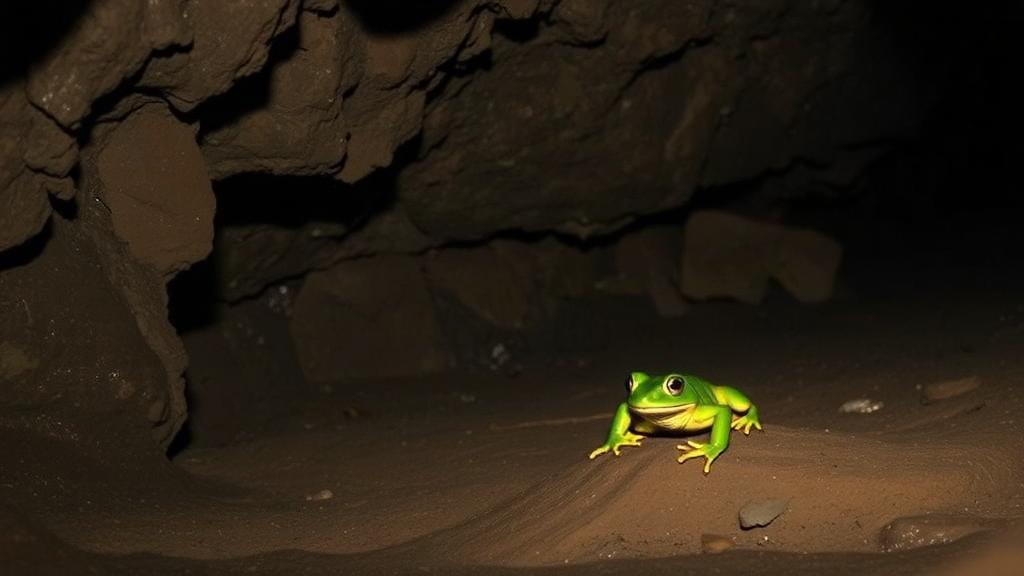
Deep inside limestone and sandstone caves across Brazil, a surprising cast of amphibians has been quietly recorded by researchers for decades. A new systematic review, published in Neotropical Biology and Conservation, has now pulled together those scattered observations into the first macroecological synthesis of frog and toad occurrences in Brazilian caves. The verdict: the animals slipping into these dark, humid chambers are overwhelmingly widespread, ecologically flexible species classified as Least Concern by the International Union for Conservation of Nature, rather than rare or threatened cave specialists. Caves, the study concludes, function less as exclusive habitats and more as opportunistic refuges and complements to life on the surface.
Anurans, the order that includes frogs and toads, are famously sensitive vertebrates. Their permeable skin demands moisture, their life cycles are tightly coupled to both aquatic and terrestrial conditions, and their distributions are strongly shaped by environmental stability. Yet these same vulnerabilities make caves attractive. Natural subterranean environments offer high and relatively stable humidity, reduced temperature fluctuations, and near-total darkness, conditions that shield amphibians from desiccation and from visually oriented predators. Caves frequently host abundant invertebrate prey and often contain watercourses suitable for reproduction, making them potential all-purpose shelters for animals that are predominantly nocturnal to begin with.
To understand which anurans actually exploit these environments, the researchers compiled 177 occurrence records covering 54 species from the scientific literature, drawing on Google Scholar, Scopus, and the Web of Science following PRISMA guidelines for systematic searches. Only records with complete species-level identification were retained, and nomenclature was verified against the authoritative Amphibian Species of the World database. Each species was then characterized by its conservation status under both the IUCN Red List and the Brazilian Ministry of the Environment, its geographic distribution, endemism, and a suite of life-history traits including activity period, body size, habitat, and breeding site.
The statistical centerpiece of the study was a redundancy analysis, a multivariate technique that relates a matrix of explanatory variables to a matrix of response variables. Before running the model, the team checked for multicollinearity among predictors using variance inflation factors, keeping all variables below the conventional threshold of 10.0. The analysis revealed that three variables tied to conservation status and geography, namely IUCN status, distribution area, and endemism, best explain which anurans turn up in Brazilian caves. These three predictors accounted for 27.0 percent of the total variance explained by the model, with the first two ordination axes capturing 31.1 percent of the variance, and the overall model was statistically significant at p = 0.001.
The dominance of Least Concern species was striking. Of all occurrence records compiled, 94.3 percent corresponded to species classified as Least Concern under both the IUCN and the Brazilian national list. Threatened categories were marginal by comparison: Vulnerable species made up 3.5 percent of IUCN-classified records and Endangered species 1.5 percent, while the national classification included Near Threatened at 3.5 percent and Endangered at 1.5 percent, with 0.7 percent of records not evaluated. Eight species were strongly associated with the conservation-status variable, including the poison frog Adelphobates galactonotus, the rocket frog Allobates marchesianus, the striped poison frog Ameerega flavopicta, several hylid tree frogs of the genera Boana and Bokermannohyla, and the cycloramphid Cycloramphus eleutherodactylus. Only one species, Bokermannohyla martinsi, carried a Vulnerable designation.
Why would common, wide-ranging species dominate cave records? The authors argue that broad geographic distributions signal low niche specificity. Species capable of occupying heterogeneous environments, from leaf litter to stream margins to rock crevices, possess the ecological plasticity to treat caves as one more available microhabitat. Ameerega flavopicta, Cycloramphus eleutherodactylus, and Boana boans, for example, already use rock crevices, holes in slopes, tree trunks, and bromeliad rosettes, microhabitats whose microclimatic conditions resemble those inside caves. Such surface habits provide indirect evidence that these animals can tolerate, and potentially exploit, subterranean conditions when the need arises.
Geographic distribution and endemism carved the species into three distinct biogeographic patterns. Scinax ruber and Scinax x-signatus are non-endemic and widely distributed, hylid tree frogs that thrive in everything from anthropized open areas to preserved forest interiors, a versatility that favors opportunistic cave occupation as temporary shelter. Thoropa miliaris and Thoropa taophora are endemic but relatively widespread within their regions, often associated with disturbed or heterogeneous environments, and may enter caves seasonally during periods of surface water or thermal stress. Finally, Thoropa megatympanum stands apart as endemic with a restricted range, confined to the rupestrian landscapes of the Serra do Espinhaço in Minas Gerais. Its presence in caves appears less tied to generalism and more to the availability of humid rocky microhabitats, since the genus deposits eggs on wet surfaces and its tadpoles are adapted to water films on rock, demanding high humidity stability.
Perhaps the most counterintuitive finding was what did not matter. Life-history variables, including activity period, body size, habitat, habits, and breeding site, contributed little to the model’s explained variance and were not selected as determinants of cave presence. The authors suggest this reflects both ecological reality and methodological limitations: life-history traits for many Neotropical anurans are incompletely or inconsistently reported, weakening their statistical power. The result implies that cave occupation depends less on physiological or behavioral specialization and more on the geographic and ecological context of each species, reinforcing the interpretation of caves as complementary microhabitats open to a broad range of ecologically distinct species.
The study also exposes a regulatory blind spot. Under Brazilian environmental legislation governing subterranean environments, anurans are classified as accidental fauna, a category for animals that wander into caves without the capacity to sustain themselves there. Because of this designation, there is no legal obligation to record or collect anurans during cave studies, in contrast to bats, fish, and invertebrates, which are explicitly covered and have driven much subterranean research since Federal Decree 6640 in 2008. This legal gap has left herpetofauna marginal in biospeleological research, producing sporadic records and regional sampling biases that the authors caution should temper interpretation of macroecological patterns drawn from published data.
The implications for conservation are concrete. The researchers recommend systematically incorporating anuran surveys into environmental licensing procedures and speleological inventories, since these animals are currently overlooked in many cave monitoring programs. They also point to emerging tools, acoustic monitoring, environmental DNA detection, and genetic comparisons between cave and surface populations, as promising avenues for clarifying habitat use, detectability, and population connectivity in subterranean ecosystems. For now, the message is clear: Brazilian caves are not frog fortresses of rare endemics but flexible refuges serving the generalists, and protecting them means recognizing that even common species depend on the stability these dark chambers provide.
Subject of Research: Macroecology of anuran habitat use in Brazilian caves
Article Title: Opportunistic habitat use: widespread and non-threatened anurans in Brazilian caves
Article References: Sperandei, V. D. F., Vaz-Silva, W., Pereira, C. C., & Tejerina-Garro, F. L. (2026). Opportunistic habitat use: widespread and non-threatened anurans in Brazilian caves. Neotropical Biology and Conservation, 21(1), 31-48. https://doi.org/10.3897/neotropical.21.e184592
Image Credits: AI Generated
DOI: 10.3897/neotropical.21.e184592
Keywords: anurans, Brazilian caves, cave ecology, amphibians, redundancy analysis, IUCN conservation status, endemism, ecological plasticity, Neotropical biodiversity, subterranean habitats, trogloxenes, systematic review
Cite Scienmag News
Margaret Porter. (October 16, 2026). Brazilian Caves Serve as Opportunistic Refuges for Common Frogs, Study Finds. Scienmag. https://scienmag.com/brazilian-caves-serve-as-opportunistic-refuges-for-common-frogs-study-finds/
Margaret Porter. "Brazilian Caves Serve as Opportunistic Refuges for Common Frogs, Study Finds." Scienmag, 16 October 2026, https://scienmag.com/brazilian-caves-serve-as-opportunistic-refuges-for-common-frogs-study-finds/. Accessed 16 October 2026.
Margaret Porter. "Brazilian Caves Serve as Opportunistic Refuges for Common Frogs, Study Finds." Scienmag. October 16, 2026. https://scienmag.com/brazilian-caves-serve-as-opportunistic-refuges-for-common-frogs-study-finds/


