


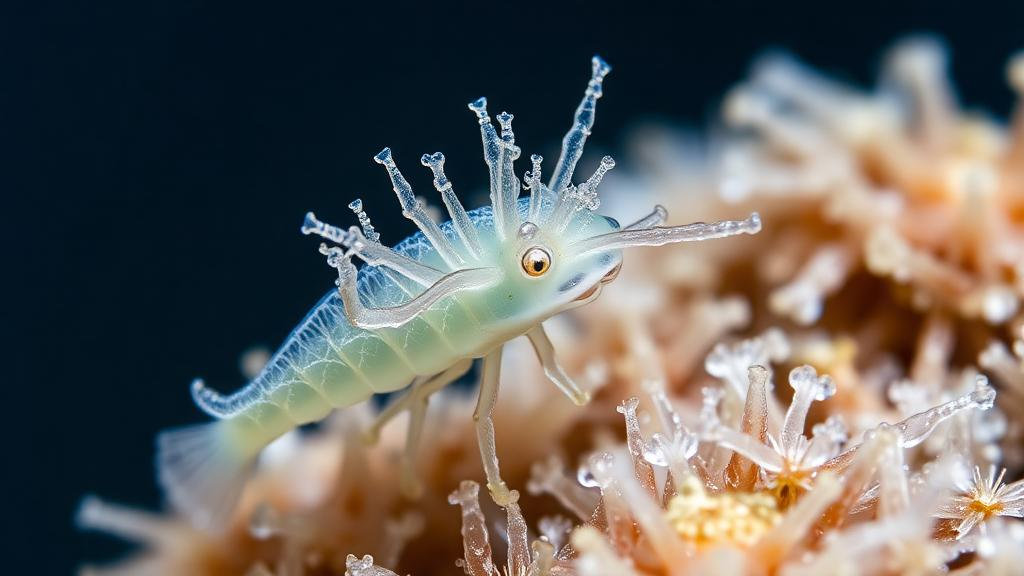
On a clear January morning in 2020, researchers surveying zooplankton off Kavaratti Island in India’s Lakshadweep archipelago noticed something extraordinary: the sunlit sea surface appeared to sparkle with intense blue-green points of light, as if the water itself had been scattered with jewels. The phenomenon, described in a recent short communication in the journal Estuarine Management and Technologies, turned out to be caused by a swarm of male copepods of the species Sapphirina ovatolanceolata, tiny marine crustaceans famously known as sea sapphires. The observation provides one of the rare live, in-situ documentations of this dazzling optical display in the Southeastern Arabian Sea, and it adds a new regional record for a species whose presence had not previously been confirmed in Lakshadweep waters.
Sapphirina copepods are small pelagic crustaceans in the order Cyclopoida and the family Sapphirinidae, and their reputation rests almost entirely on the males. Adult male S. ovatolanceolata measure roughly 2.5 to 3 millimeters in length, yet they can produce a metallic sheen so brilliant that aggregations of them near the surface have been described as jeweled water. The effect is a textbook example of structural coloration: rather than relying on pigments, the males pack their integument with thin, multilayered hexagonal platelets of guanine crystal. When sunlight strikes these stacked layers, interference and reflection of specific wavelengths produce vivid colors that shift with viewing angle, ranging across the genus from red to blue and violet. Females lack these reflective structures entirely and remain transparent throughout their lives.
The physics behind the display is precise. Each guanine platelet acts as a thin-film reflector, and the spacing between layers determines which wavelengths interfere constructively and are reflected back to the observer. In S. ovatolanceolata, laboratory spectral measurements reported by Chae and Nishida in 1999 found major reflectance peaks between approximately 430 and 600 nanometers, with peak reflectivity around 506 nanometers, corresponding to a blue-green hue. The Lakshadweep observation closely corroborates those laboratory data, confirming that the copepod’s structural reflector produces its intended blue-green signal under natural sunlight and that the phenomenon is not an artifact of laboratory conditions.
The field encounter began around 8:30 in the morning, when multiple bright blue-green flashes were noticed in the upper water column from the surface down to roughly 10 meters. The flashes were highly angle-dependent and transient: as the viewing angle shifted with wave action, individual copepods alternated between shining bright turquoise and vanishing from sight entirely. The researchers targeted these patches with a standard Bongo plankton net fitted with a 200-micrometer mesh, a mouth area of 0.25 square meters, and a calibrated flowmeter, towing obliquely from about 10 meters depth to the surface. Remarkably, even after retrieval, the plankton sample itself continued to exhibit visible iridescent flashes as the copepods swam in the collection container.
Environmental conditions at the time were ideal for the display. A Sea-Bird Electronics SBE 911 conductivity-temperature-depth profiler recorded a sea surface temperature averaging 29.8 degrees Celsius, a salinity of about 35.1 practical salinity units, and dissolved oxygen near 5.0 milliliters per liter at a station roughly 40 meters deep. Clear, sunny skies provided strong illumination at the surface, the prerequisite for the interference colors to register in the eye of an observer above the water.
Morphological examination confirmed the identity of the shimmering animals as adult male S. ovatolanceolata. The specimens ranged from 2.30 to 3.19 millimeters in total length including the caudal rami, and they possessed a semi-transparent, elongated body that is dorsoventrally depressed, meaning flattened from top to bottom. The cephalosome is wider than it is long with a distinctly pointed frontal margin, and notably the species lacks the dorsal eye lenses or cuticular lenses visible on the head in some other Sapphirina species, a useful diagnostic trait. The five-segmented antennules and elongated ovate caudal rami that give the species its name completed the identification, which matched published descriptions. Every visibly iridescent individual in the sample was an adult male; no iridescence was observed from any female.
The fragility of the optical system became apparent almost immediately. After a few minutes in the container, and particularly after fixation in buffered formaldehyde, the living blue-green flashes faded and the copepods became essentially transparent. This agrees with the understanding that the reflective guanine platelets require intact cellular spacing and hydration to function, and that the colors vanish upon death or desiccation. Live specimens were photographed briefly in a tray of seawater before preservation, capturing both the transparent and iridescent states, and preserved specimens were retained in the reference collection of the Marine Biology Museum of Cochin University of Science and Technology.
Why would an animal evolve the ability to flash like a gemstone in waters where visibility cuts both ways? The leading hypothesis is that the iridescence serves mate recognition and intraspecific communication. Chae and Nishida proposed that the spectral properties of each species’ iridescence may be adapted to the lighting environment where that species typically resides, increasing the distance over which individuals can visually detect one another for mating. For S. ovatolanceolata, a blue-green signal is well suited to clear, blue oceanic waters, especially a few tens of meters below the surface where blue-green light predominates. At the same time, the ability to switch to near-invisibility by changing orientation or adjusting the iridescence provides an antipredator strategy against visually hunting fish. Transparency is arguably the best camouflage in sunlit surface waters, and Sapphirina males appear to exploit a dynamic strategy: they can sparkle like a sapphire when they want to be seen and disappear when they need to hide.
Timing may matter as much as color. Related work on Sapphirina nigromaculata documented that live males display vivid iridescence during the daytime but become essentially invisible at night, a daily cycle that likely maximizes mating signals when sunlight is available and minimizes predation risk after dark. Some sapphirinid copepods even exhibit reverse diel vertical migration, with males ascending toward the surface in daytime to signal to mates despite increased visibility to predators. The occurrence of multiple S. ovatolanceolata males near the surface during morning hours, when light intensity is high, aligns with this strategy and suggests the males may have been positioning themselves for maximal visual communication. The researchers also noted that several males were present simultaneously in a small area, which could imply an aggregation event possibly related to mating, although no overt interactions or females were observed, and the exact cause of the clustering remains uncertain.
Across the genus, each species carries its own optical signature. Sapphirina angusta and S. opalina produce predominantly violet-blue reflections with spectral peaks around 420 nanometers, while S. auronitens and S. gastrica are known for golden or yellow-green iridescence with dominant reflection at wavelengths longer than about 500 nanometers. Sapphirina metallina exhibits multiple color variants with a broader range of reflective peaks. These differences are attributed to variations in the structure and spacing of the guanine crystal layers in the cuticle, and in some species a secondary long-wavelength peak beyond 750 nanometers may arise from a thin layer of red pigment beneath the reflector or a second-order interference effect. Such diversity suggests each species has tuned its signal to its preferred depth range or to the visual sensitivity of its intended audience.
The Lakshadweep sighting is a reminder of how little of the open ocean plankton community is directly observed. Brief events like these can easily go unnoticed, yet they may play subtle roles in marine ecosystems. Sapphirinid copepods are known to prey on gelatinous zooplankton such as salps and doliolids, and the function of the bright signals in such interactions remains an open question. What is certain is that these tiny crustaceans have evolved a structural coloration mechanism comparable to that of butterflies or peacock feathers, deployed in clear seawater where both being seen and not being seen can be a matter of life and death. Future studies integrating behavioral observations, optical measurements, and genetic analyses promise to illuminate how these sea sapphires make such a brilliant splash in the ocean’s tapestry.
Subject of Research: Structural iridescence and live field observation of the iridescent copepod Sapphirina ovatolanceolata in Lakshadweep waters
Article Title: The enigmatic blue-green iridescence of Sapphirina ovatolanceolata (Dana, 1849) ( Crustacea , Copepoda , Sapphirinidae ): a live observation from the Lakshadweep waters
Article References: Radhika, R., Jayachandran, P. R., Santu, K. S., & Bijoy Nandan, S. (2025). The enigmatic blue-green iridescence of Sapphirina ovatolanceolata (Dana, 1849) (Crustacea, Copepoda, Sapphirinidae): a live observation from the Lakshadweep waters. Estuarine Management and Technologies, 2, 141-149. https://doi.org/10.3897/emt.2.176870
Image Credits: AI Generated
DOI: 10.3897/emt.2.176870
Keywords: Sapphirina ovatolanceolata, copepods, iridescence, structural color, guanine crystals, Lakshadweep, Kavaratti Island, Arabian Sea, zooplankton, marine biology, camouflage, mate recognition
Cite Scienmag News
Denise Maddox. (October 16, 2026). Sea Sapphire Copepods Turn Lakshadweep Waters Into Living Jewels. Scienmag. https://scienmag.com/sea-sapphire-copepods-turn-lakshadweep-waters-into-living-jewels/
Denise Maddox. "Sea Sapphire Copepods Turn Lakshadweep Waters Into Living Jewels." Scienmag, 16 October 2026, https://scienmag.com/sea-sapphire-copepods-turn-lakshadweep-waters-into-living-jewels/. Accessed 16 October 2026.
Denise Maddox. "Sea Sapphire Copepods Turn Lakshadweep Waters Into Living Jewels." Scienmag. October 16, 2026. https://scienmag.com/sea-sapphire-copepods-turn-lakshadweep-waters-into-living-jewels/


