


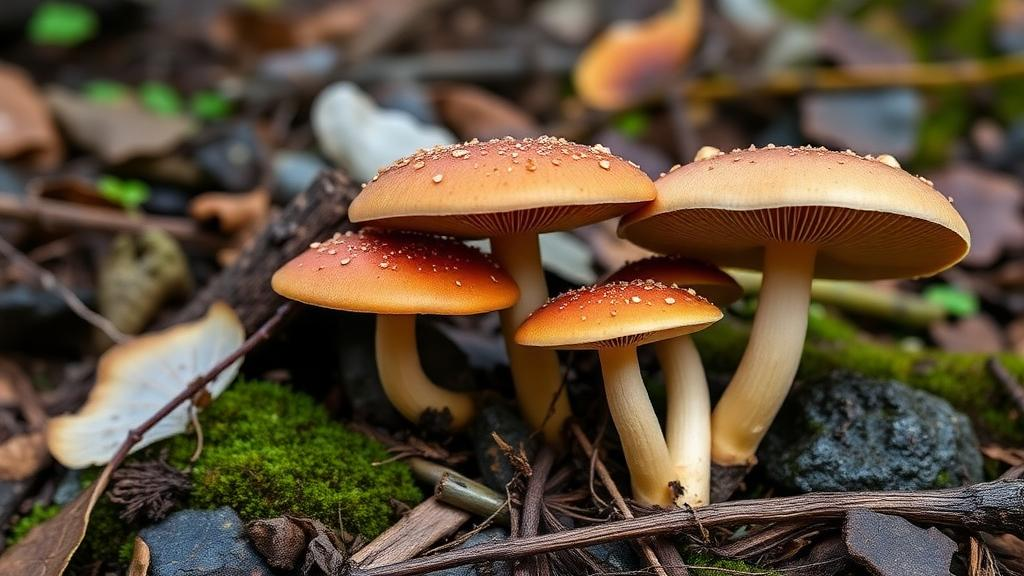
Deep in the subalpine forests of western Sichuan, China, where fir, spruce, and rhododendron forests climb the slopes of the Hengduan Mountains toward the Qinghai-Tibet Plateau, mycologists have uncovered a hidden branch of fungal diversity. A new study published in MycoKeys describes three previously unknown species of the mushroom genus Inosperma, a group of ectomycorrhizal fungi that live in intimate partnership with the roots of trees. The discovery, based on both painstaking morphological examination and multigene DNA analysis, fills a conspicuous gap in the fungal record of one of the world’s most biodiverse mountain regions.
Inosperma belongs to the family Inocybaceae, a lineage of mushrooms notorious among field mycologists for their small, drab, fibrous-capped fruiting bodies and their deceptive similarity to one another. The genus was originally proposed in 1980 as a subgenus of Inocybe to accommodate smooth-spored species lacking pleurocystidia, the specialized cells found on gill faces of many relatives. Molecular phylogenetics later revealed that Inosperma represents an evolutionarily independent lineage, and it was elevated to full genus rank in 2020. Today the genus encompasses 94 recorded species names distributed across Africa, Asia, Australasia, Europe, and North America, with 19 of those species already documented from various regions of China.
What makes the new find remarkable is that western Sichuan, despite its complex topography and favorable climate for fungal life, had never yielded a single documented Inosperma species. The region sits at the intersection of the Hengduan Mountains and the southeastern margin of the Qinghai-Tibet Plateau, an ecological setting dominated by potential host trees including firs, birches, spruces, pines, yews, larches, rhododendrons, willows, and oaks. These plants form the ectomycorrhizal partnerships upon which Inosperma depends, making the absence of records all the more puzzling. The new study demonstrates that the genus was simply waiting to be found.
The three new species, Inosperma fibrifugum, I. glomerisquamulosum, and I. lilacinifolium, were collected during fieldwork in subalpine forests at elevations ranging from roughly 2,900 to nearly 4,000 meters. Fresh specimens were photographed in their natural habitat, dried at 45 degrees Celsius, and deposited in the Mycological Herbarium of Hunan Normal University in Changsha. Each species was then subjected to a dual interrogation: detailed microscopic analysis of spores, cystidia, and tissue structures, alongside DNA sequencing of three genetic markers.
The molecular approach targeted the internal transcribed spacer (ITS) region, the nuclear ribosomal large subunit (nrLSU), and the gene encoding the second largest subunit of RNA polymerase II (rpb2). In total, the researchers assembled a dataset of 247 sequences from 84 taxa, including 30 newly generated sequences from the Sichuan collections. The sequences were aligned with MAFFT software, concatenated into a combined matrix spanning 502, 885, and 731 base pairs respectively, and analyzed using both Bayesian inference and maximum likelihood methods. The resulting phylogenetic trees placed the three new species into distinct, strongly supported subclades within the genus, confirming that each represents an independent evolutionary lineage rather than a variant of a known species.
Inosperma fibrifugum, collected on Mengbi Mountain in Xiaojin County at 3,685 meters among pines, spruces, and camellias, is distinguished by a fibrillose to scaly, fuscous brown cap whose scales slough off with age, persisting only on the central umbo at maturity. Its most striking trait is a context that bruises reddish-brown when damaged, a feature it shares with its closest phylogenetic relative, the North American species I. mucidiolens. However, I. fibrifugum produces larger fruiting bodies, narrower cheilocystidia, and lacks the distinctive odor of fresh corn that characterizes its sister species. The species falls squarely within the Cervicolores clade, a group typically defined by pronounced reddening of the flesh and very slender basidia.
Inosperma glomerisquamulosum, found in the Daocheng Yading Scenic Area at 3,930 meters among oak, larch, spruce, rhododendron, willow, and rose, presents a very different profile. Its fruiting bodies are small, with a yellowish-brown cap covered in distinctive clustered, appressed scales that give the species its name, derived from the Latin for clustered scales. Unlike its relative I. fibrifugum, its context does not change color when bruised, its stipe base lacks any bluish-green tinge, and it produces notably larger basidiospores measuring 13.0 to 15.5 by 6.5 to 8.0 micrometers. The absence of caulocystidia, specialized cells on the stipe surface, further separates it from morphologically similar species. Phylogenetically, it sits as sister to the Spanish species I. turietoense within the Cervicolores clade, though it lacks the reddening reaction typical of many members of that group.
The third new species, Inosperma lilacinifolium, was collected in the Shenxianchi Scenic Area of Jiuzhaigou County at 2,905 meters among firs, willows, junipers, birches, and apples. It belongs to the Maculatum clade rather than the Cervicolores group, and its defining features include a radially fibrillose, grayish-brown cap with a prominent umbo, lilac-tinted gills in young specimens, and remnants of an arachnoid, or cobweb-like, veil on the young cap and near the stipe apex. Its closest phylogenetic relatives are I. quietiodor from Europe and I. shawarense from Pakistan, but I. lilacinifolium differs from both in its larger spores, larger cheilocystidia and caulocystidia, and the absence of the flour-like or farinaceous odor characteristic of I. quietiodor.
The phylogenetic analysis resolved Inosperma into six major lineages: the Cervicolores and Maculatum clades, the I. misakaense and I. africanum lineages, and two Old World Tropical clades. All received strong statistical support except the Maculatum clade, which showed poor bootstrap values and posterior probabilities. Notably, recently described Chinese species have been concentrated in the Cervicolores, Maculatum, and Old World Tropical 1 clades, suggesting that these lineages have undergone significant diversification in East Asian mountain systems. The finding that I. glomerisquamulosum lacks the reddening reaction typical of the Cervicolores clade adds nuance to the morphological definition of that group, indicating that the trait is not as universally diagnostic as previously thought.
Beyond their scientific interest, the discovery carries practical weight. Some Inosperma species contain the neurotoxins muscarine, ibotenic acid, and muscimol, compounds capable of causing serious mushroom poisoning. Precise taxonomic identification is therefore critical for public health in China, where wild mushroom consumption remains widespread and poisoning cases are a persistent concern. The researchers also provide an updated identification key to all 22 Inosperma species now known from China, incorporating the three new additions. As exploration of the Hengduan Mountains continues, the region’s fungal diversity is likely to yield further surprises, underscoring how much remains to be discovered in the world’s mountain biodiversity hotspots.
Subject of Research: Taxonomy and phylogenetics of three new Inosperma mushroom species from western Sichuan, China
Article Title: Three new species of Inosperma ( Inocybaceae , Agaricales ) from western Sichuan, China, based on morphological and multigene phylogenetic evidence
Article References: Wu, R., Duan, P.-P., Lai, M.-M., He, Z.-M., & Chen, Z.-H. (2026). Three new species of Inosperma (Inocybaceae, Agaricales) from western Sichuan, China, based on morphological and multigene phylogenetic evidence. MycoKeys, 141, 1-22. https://doi.org/10.3897/mycokeys.141.200822
Image Credits: AI Generated
DOI: 10.3897/mycokeys.141.200822
Keywords: Inosperma, Inocybaceae, new species, western Sichuan, mycology, phylogenetics, ectomycorrhizal fungi, Hengduan Mountains, taxonomy, fungal diversity, China, subalpine forests
Cite Scienmag News
Roger Howard. (October 16, 2026). Three New Mushroom Species Unearthed in the Subalpine Forests of Western Sichuan. Scienmag. https://scienmag.com/three-new-mushroom-species-unearthed-in-the-subalpine-forests-of-western-sichuan/
Roger Howard. "Three New Mushroom Species Unearthed in the Subalpine Forests of Western Sichuan." Scienmag, 16 October 2026, https://scienmag.com/three-new-mushroom-species-unearthed-in-the-subalpine-forests-of-western-sichuan/. Accessed 16 October 2026.
Roger Howard. "Three New Mushroom Species Unearthed in the Subalpine Forests of Western Sichuan." Scienmag. October 16, 2026. https://scienmag.com/three-new-mushroom-species-unearthed-in-the-subalpine-forests-of-western-sichuan/


