


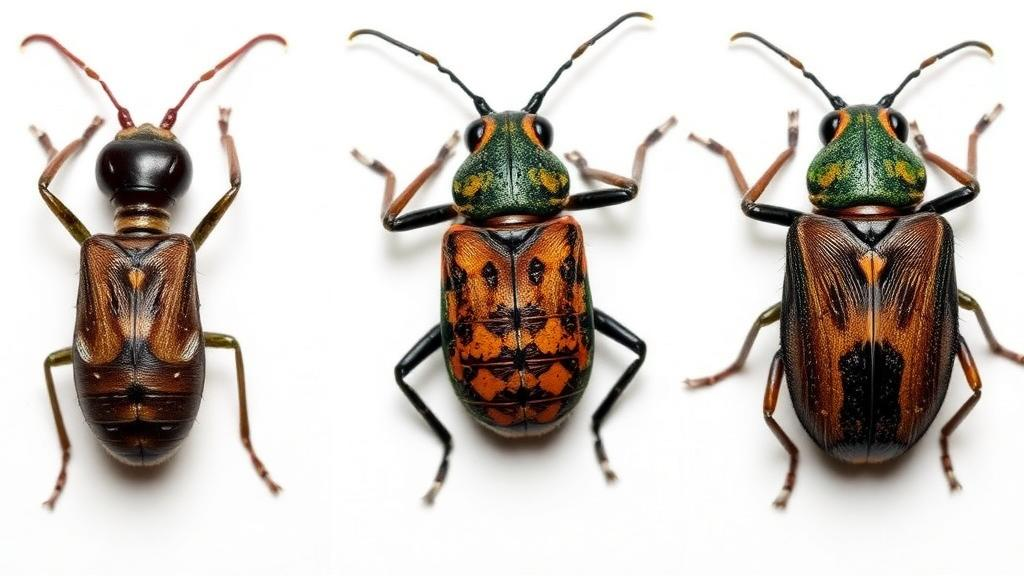
Deep in the bark crevices of oak and other beech-family trees across southern China, a group of vividly red, rarely seen scale insects has been quietly diversifying away from scientific attention. A new taxonomic study published in the Deutsche Entomologische Zeitschrift has now described three species of the genus Kuwania that are new to science, redescribed a fourth known species to modern standards, and provided the first-ever descriptions of the adult male and intermediate-stage female nymph of one of them. With these additions, the genus now comprises ten recognized species worldwide, four of which are known only from the Oriental region of southern China.
Kuwania species, commonly known as oak red scale insects, are among the more enigmatic members of the scale insect family Kuwaniidae. Adult females are elongate, red in life, and range from 1.4 to 6 millimeters in length. They live concealed under bark or within bark crevices of their host plants, which are predominantly members of the Fagaceae family, including oaks and stone oaks. This secretive lifestyle has meant that specimens are infrequently collected, and the genus has remained poorly understood since its establishment more than a century ago.
The taxonomic history of the group reflects this obscurity. MacGillivray proposed Kuwaniinae as a subfamily in 1921, which was later treated as the tribe Kuwaniini by Handlirsch in 1925. Morrison placed Kuwaniini within the subfamily Margarodinae of the family Margarodidae in 1928. It was not until Koteja’s morphological studies of mouthparts in 1974 and 1996 that Kuwaniini was elevated to full family status as Kuwaniidae. Today, the family contains just two extant genera: Kuwania and Neosteingelia. Adult females of Kuwaniidae are diagnosed by a distinctive combination of features, including nine-segmented antennae positioned close together on the head apex, well-developed legs, thoracic spiracles with sclerotized bars and multilocular disc pores within the atrium, and a simple anal opening situated subapically on the dorsum.
The three new species were described by Zheng and Wu based on specimens collected from Yunnan, Guizhou, Zhejiang, and Hainan provinces in southern China. All were found under bark or in bark crevices of Fagaceae hosts. The specimens were prepared for bright-field compound microscopy using standard slide-mounting methods, and morphological examination was performed using stereomicroscopes and compound light microscopes. The type material is deposited in the Insect Collection at the Department of Forestry Protection, Beijing Forestry University, and the Institute of Entomology, Guizhou University in Guiyang.
The first new species, Kuwania clandestina, was collected at Meizi Lake in Puer City, Yunnan Province, at an altitude of 1,369 meters. Its specific epithet derives from the Latin word meaning hidden, a reference to its concealed microhabitat. Adult females measure 2.4 to 4.1 millimeters long and 0.9 to 1.3 millimeters wide, with a membranous derm and distinct segmentation. The species is similar to K. pasaniae in having six pairs of abdominal spiracles and large simple pores, but differs in having a tuft of seven or eight capitate setae at the distal end of the tibia, compared with 13 to 30 in K. pasaniae, and in having small simple pores present on the dorsum, which are restricted to the venter in the latter species. The intermediate-stage female nymph is almost circular, 0.7 to 1.7 millimeters long, with antennae reduced to small plate-like structures and six pairs of abdominal spiracles.
The second new species, Kuwania hainanensis, was collected on Lithocarpus handelianus at Shuiman Township in Wuzhishan City, Hainan Province. Notably, all adult females were dissected out from third-instar female nymphs and mounted on the same slides as their corresponding nymphs, providing an unusually complete picture of the life stage transition. Adult females measure 3.2 to 4.1 millimeters long, with antennae each 700 to 710 micrometers long. The species shares with K. clandestina the presence of simple pores of two sizes and six pairs of abdominal spiracles, but can be distinguished by having three to five multilocular disc pores within the atrium of each abdominal spiracle, compared with one or two in K. clandestina, and by having 15 to 18 capitate setae at the distal end of the tibia. The third-instar female nymph is approximately 2 millimeters long and 1.5 millimeters wide, covered by white wax in life, with legs absent and antennae much reduced.
The third new species, Kuwania hiemalis, was collected on Quercus aliena at Jiuyao Mountain in Hangzhou City, Zhejiang Province, and on Quercus acutissima in the Guizhou Botanical Garden in Guiyang. Its epithet derives from the Latin word for winter, referring to the emergence of adult females during the winter season. Adult females are the largest of the three new species, measuring 2.9 to 5.8 millimeters long and 1.4 to 2.3 millimeters wide. The species is similar to K. pasaniae in having six pairs of abdominal spiracles and 12 to 17 capitate setae at the distal end of each tibia, but differs in having abdominal spiracles with an irregularly swollen atrium containing a ring of four to eight multilocular disc pores, compared with the regularly swollen atrium bearing mostly one or two pores in K. pasaniae. It also differs from K. hainanensis in having four to eight multilocular disc pores within each abdominal spiracular atrium and in the distribution of simple pores.
In addition to the three new species, the study provides a redescription of Kuwania pasaniae Borchsenius, 1960, originally described from specimens collected on Pasania, now Lithocarpus, in Yunnan Province. The redescription is based on specimens from Guangdong and Guangxi provinces, collected on Lithocarpus glauca and other Fagaceae. Several differences from the original 1960 description were noted, including the number of multilocular disc pores near thoracic spiracular openings and the distribution of simple pores. Importantly, the adult male and intermediate-stage female nymph of K. pasaniae are described for the first time, representing only the second recorded male description in the entire genus. The adult male is small and slender, 1.6 to 1.9 millimeters long, with a bright red body and fore-wing anterior margin, prominent compound eyes containing 82 to 92 ommatidia each, ten-segmented filiform antennae, large broad fore-wings, and a posterior abdomen bearing a tuft of long wax filaments in life.
The adult male of K. pasaniae displays a suite of detailed morphological features that distinguish it from the previously described male of K. bipora. These include a reticular pattern on the head derm between the midcranial ridge and preocular ridges, numerous sclerotized sclerites with reticular patterns across the prescutum, scutum, basisternum, and mesepisternum, and a higher count of tubular ducts on abdominal segments VI and VII, with 12 to 18 ducts per segment compared with 5 to 11 in K. bipora. The fore-wings measure 1.6 to 1.9 millimeters long and 0.6 to 0.7 millimeters wide, with a sclerotized costal thickening, a subcosta that disappears approximately three-fifths along the wing length, and approximately 12 circular sensoria along the radius.
To facilitate future identification, the authors provide an updated identification key to the adult females of all ten known Kuwania species, building on the previous key by Wu and colleagues from 2013. The key separates species based on the number of abdominal spiracle pairs, the presence and arrangement of simple pores on the abdominal venter, the number of capitate setae at the tibial apex, and the structure of the abdominal spiracular atria. With four species now endemic to the Oriental region of southern China and high richness concentrated in Yunnan, the genus represents a striking example of regional diversification in a group of insects that spend their lives hidden from view. The study also highlights how much remains to be discovered about scale insect diversity in the biodiverse forests of southern and southwestern China, where additional undescribed species may still await collection beneath the bark of familiar trees.
Subject of Research: Taxonomy and morphology of newly discovered Kuwania scale insect species from China
Article Title: Three new species of Kuwania Cockerell ( Hemiptera , Coccomorpha , Kuwaniidae ) from China and redescription of K. pasaniae Borchsenius
Article References: Zheng, X., Li, Y.-A., Xing, J., & Wu, S.-A. (2026). Three new species of Kuwania Cockerell (Hemiptera, Coccomorpha, Kuwaniidae) from China and redescription of K. pasaniae Borchsenius. Deutsche Entomologische Zeitschrift, 73(1), 255-273. https://doi.org/10.3897/dez.73.177625
Image Credits: AI Generated
Keywords: Kuwania, scale insects, Hemiptera, Kuwaniidae, new species, China, taxonomy, entomology, Fagaceae, bark crevices, morphology, biodiversity
Cite Scienmag News
Gavin Prescott. (October 16, 2026). Three Hidden Scale Insect Species Discovered in Southern China’s Oak Bark. Scienmag. https://scienmag.com/three-hidden-scale-insect-species-discovered-in-southern-chinas-oak-bark/
Gavin Prescott. "Three Hidden Scale Insect Species Discovered in Southern China’s Oak Bark." Scienmag, 16 October 2026, https://scienmag.com/three-hidden-scale-insect-species-discovered-in-southern-chinas-oak-bark/. Accessed 16 October 2026.
Gavin Prescott. "Three Hidden Scale Insect Species Discovered in Southern China’s Oak Bark." Scienmag. October 16, 2026. https://scienmag.com/three-hidden-scale-insect-species-discovered-in-southern-chinas-oak-bark/


