


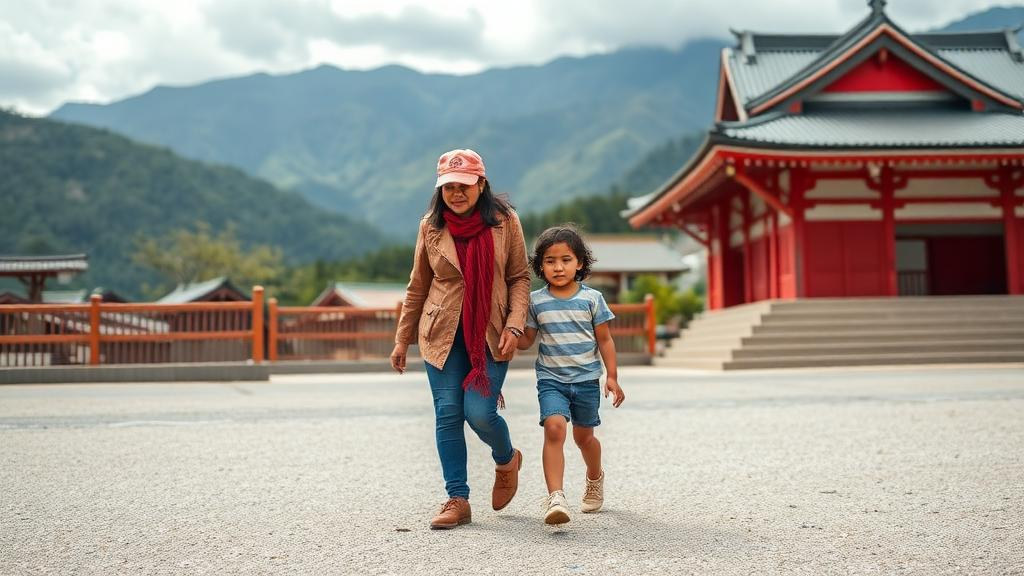
When a Peruvian mother who spent her childhood under strict curfews watches her six-year-old walk alone to a Japanese school, she is not simply adapting to a new country. She is renegotiating what it means to be a good mother. A new qualitative study published in Frontiers in Sociology examines how long-term Peruvian migrant mothers in Japan rework their maternal identities across more than three decades of settlement, revealing a spectrum of strategies that defy the simple narrative of cultural assimilation. The research, conducted by Katia Sara Huaman Palomino and Yoshitsugu Hirata of Okayama University, interviewed 21 Peruvian mothers who had lived in Japan for 17 to 35 years and identified four distinct identity positions that these women occupy as they navigate the collision between inherited protective scripts and Japanese norms of childhood autonomy.
The study is rooted in a specific historical moment. Japan’s 1990 revision of its Immigration Control and Refugee Recognition Act opened a legal pathway for second- and third-generation descendants of Japanese emigrants, known as Nikkeijin, to live and work in the country. At the same time, Peru was gripped by hyperinflation and the political violence of the Shining Path insurgency, creating powerful push-pull dynamics that carried thousands of Peruvians toward Japan. Most participants in the study, 76.2 percent, migrated between 1990 and 1994, fleeing not only financial precarity but also physical danger. This background of living under a state of emergency, internal displacement, and armed conflict provides essential context for understanding the mistrust, or recelo, that many of these mothers carry with them and the protective, surveillant maternal identity they reconstruct in Japan.
The central metaphor that emerged from the interviews is that of the Mamá Gallina, the Mother Hen. For these women, maternal identity is built around an uncompromising commitment to protection, sustained through a level of vigilance that persists despite Japan’s recognized safety. The researchers found that this protective identity is not simply a reaction to the host environment but a transnational carry-over of learned practices and traumatic experience rooted in the Peruvian past. Participants described childhoods governed by strict parental control, with restricted mobility and early curfews. One participant, P16, used the image of a butterfly in a glass case to convey her own mother’s supervision, and acknowledged replicating those same suffocating measures with her own children in Japan, even over her husband’s objections, because they matched her internalized sense of moral duty.
The researchers describe this phenomenon as transnational hyper-vigilance and reterritorialized fear. Personal trauma from Peru remains cognitively active in Japan, shaping parenting decisions long after the original danger has passed. One mother forbade sleepovers and unsupervised socializing after witnessing parental neglect in Peru. Another, P17, described an armed robbery in Peru as a turning point that hardened her distrust of public space and drove her definitive return to Japan with her adult daughters. Even though her daughters are now 30 and 25, she identifies as a Mother Hen because she is always looking out for them. Transnational flows of information reinforce this pattern: negative news from Peru about abuse within youth organizations led one mother to withhold her children from the Boy Scouts in Japan, preferring to keep them at home.
The study also reveals a critical distinction within the Mother Hen category that depends on when and where the mothers were socialized. First-generation mothers engage in what the researchers call Ideological Protection, replicating the strict intergenerational scripts inherited from their parents in Peru. In contrast, 1.5-generation mothers, those whose childhood and education took place mainly in Japan, engage in Trauma-Informed Protection. Their fears are not a cultural carry-over but a direct response to specific Japanese risks, chiefly the ijime, or psychological bullying, they experienced during their own socialization in the Japanese school system. One participant described this bullying as dirty and mental, noting that perpetrators do not hit you but mentally attack you, especially at primary and secondary school age. These stories circulate among mothers with younger children, leading them to distrust a Japanese educational system that, in their view, obliges them to fall back on inherited notions of hyper-vigilance.
Notably, the researchers found no consistent pattern dividing Nikkei and non-Nikkei mothers in their protective scripts. Japanese ancestry did not confer distinct knowledge or cultural advantages regarding mothering in Japan. Instead, the primary axis of divergence was the location of formative socialization, contrasting first-generation mothers with 1.5-generation mothers. This finding cautions against treating ancestry itself as evidence of cultural familiarity and suggests that the lived experience of socialization, rather than ethnic lineage, shapes how these mothers respond to the demands of raising children in Japan.
The collision between Peruvian protective scripts and Japanese institutional expectations produces what the researchers call socio-cultural dissonance. Japanese schools expect children to walk to school alone from the age of six and to manage complex social hierarchies without parental intervention. For mothers who grew up where child abduction, street violence, and political instability were tangible threats, such expectations can feel deeply unsafe. The Japanese practice of mimamoru, watching over from a distance while deliberately withholding direct intervention, is developmentally appropriate in its own setting but can read as neglect from a Peruvian vantage point. When mothers encounter the bosei shinwa, the myth of maternal love that demands self-sacrificial devotion, and the ryōsai kenbo ideology that locates women’s contribution in the domestic sphere, they are confronting not merely unfamiliar parenting techniques but a fundamentally different philosophy of the mother-child bond.
Institutional encounters compound this dissonance. Mothers described a sense of impotence when their protective instincts ran up against Japanese legal and social systems. One participant noted that Japanese law does not allow adults to put themselves on the same level as teenagers, forcing mothers to restrain themselves from direct intervention. Another described how her daughter returned home with bruises and undone braids while the school offered only a repetitive and hollow gomen nasai, an apology that never translated into corrective action. These accounts of institutional misrecognition help explain why some mothers returned to Peru temporarily or permanently, and they illustrate how the failure of schools to act as effective recognizers of maternal concern deepens the sense of isolation and mistrust.
Yet the study also documents remarkable agency and adaptation. Through a process the researchers call Reflexive Continuity, mothers actively observe, compare, and evaluate inherited scripts against Japanese norms rather than absorbing or rejecting them wholesale. Some mothers undergo a softening process, gradually allowing their children greater autonomy as they recognize the social necessity of peer integration. Others deliberately assimilate, citing Japanese philosophies such as nanakorobi yaoki, fall down seven times, get up eight, to reject what they see as Peruvian overprotection and build mental and emotional strength in their children. Still others construct a hybrid Third Space, blending Peruvian devotion with Japanese independence in ways that are neither one nor the other. One mother merged the moral framework of Peruvian Catholicism with the animistic worldview of Japanese Shinto-Buddhist culture, teaching her children that all life must be respected and that the weakest must always be protected.
The findings carry significant implications for policy and practice. The researchers argue that migrant mothers’ apparent overprotectiveness should not be pathologized or dismissed but understood as a reasoned response to intergenerational trauma and transnational risk perception. School outreach that addresses migrant mothers’ concerns directly, offers transparent information about safety, and creates opportunities for intercultural dialogue between Peruvian and Japanese parents may build more trusting relationships. The study also challenges Japan’s fiction of temporariness in immigration policy, noting that the myth of temporality that shaped initial migration decisions continues to influence maternal identity decades later. As Japan’s population ages and its birth rate declines, the experiences of these Peruvian mothers offer broader lessons about how migrant families build belonging and identity in societies that do not fully acknowledge their permanence, and about the invisible labor of cultural translation that mothers perform in raising the next generation across cultural boundaries.
Subject of Research: Maternal identity negotiation among long-term Peruvian migrant mothers in Japan
Article Title: Navigating inherited “intensive surveillance” within Japan's structural norms of autonomy: maternal identity negotiation among long-term Peruvian migrant mothers (1990–2025)
Article References: Navigating inherited “intensive surveillance” within Japan's structural norms of autonomy: maternal identity negotiation among long-term Peruvian migrant mothers (1990–2025). (n.d.). https://doi.org/10.3389/fsoc.2026.1944754
Image Credits: AI Generated
DOI: 10.3389/fsoc.2026.1944754
Keywords: Peruvian migration, Japan, maternal identity, intensive mothering, acculturation, Nikkei diaspora, mimamoru, ijime, Third Space, transnational motherhood, Reflexive Continuity, immigrant integration
Cite Scienmag News
Gavin Prescott. (October 16, 2026). Peruvian mothers in Japan walk a tightrope between protective love and childhood independence. Scienmag. https://scienmag.com/peruvian-mothers-in-japan-walk-a-tightrope-between-protective-love-and-childhood-independence/
Gavin Prescott. "Peruvian mothers in Japan walk a tightrope between protective love and childhood independence." Scienmag, 16 October 2026, https://scienmag.com/peruvian-mothers-in-japan-walk-a-tightrope-between-protective-love-and-childhood-independence/. Accessed 16 October 2026.
Gavin Prescott. "Peruvian mothers in Japan walk a tightrope between protective love and childhood independence." Scienmag. October 16, 2026. https://scienmag.com/peruvian-mothers-in-japan-walk-a-tightrope-between-protective-love-and-childhood-independence/


