


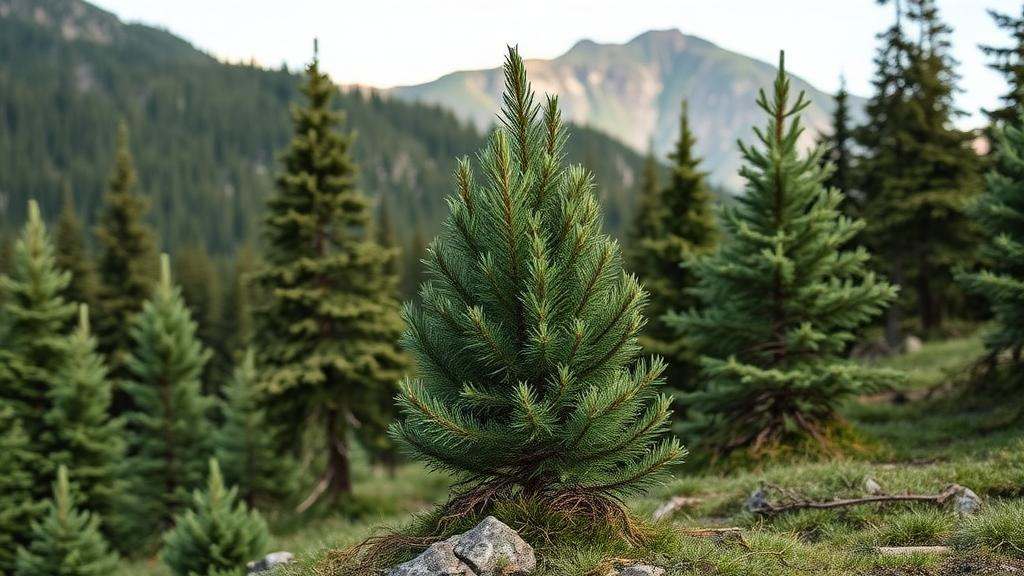
Deep in the upper Brembana Valley of the Orobic Alps, botanists have documented something that has never been recorded before: the endangered Serbian spruce, a conifer whose entire native range covers barely 10,000 square kilometres along the Drina River between Serbia and Bosnia-Herzegovina, has established a self-sustaining population in Italy. The discovery, published in Italian Botanist, reports roughly 50 to 60 trees of varying ages growing across a single hectare of wood pasture at 1,760 to 1,790 metres above sea level, within the Orobie Bergamasche Regional Park in Lombardy. It is the first documented case of Picea omorika naturalising anywhere outside its Balkan homeland.
The story of how these trees arrived reads like a botanical detective novel. Dendrochronological analysis of 12 trees, sampled with a Pressler increment borer at breast height, revealed an uneven-aged stand rather than the even-aged cohort typical of forestry plantations. The oldest individual, at 54 years measured at breast height, grows directly beside the Armentarga hut, a small building erected in 1950 to house workers constructing the dam of Lake Fregabolgia and later converted into a private alpine refuge managed by the Penne Nere Alpine Group of Bergamo. The researchers conclude that this solitary tree was almost certainly planted for ornamental purposes in the late 1960s, and that every other Serbian spruce in the valley descends from its seeds. Municipal and mountain-community records confirm that no reforestation involving the species has ever taken place in the area.
What makes the finding remarkable is that Serbian spruce has been planted extensively across European gardens and parks for over a century, prized for its slender columnar silhouette and the silvery undersides of its flattened needles, yet it has never before been shown to reproduce without human help. According to the criteria of Richardson and colleagues, a naturalised species must reproduce consistently and maintain self-sustaining populations over multiple generations without direct human intervention. The Brembana Valley population, with seedlings only a few years old growing alongside mature trees more than three decades old, clearly meets that definition, even though its spread remains confined to roughly one hectare.
The ecological conditions that allowed this establishment are strikingly specific. The site sits on a podzol developed over acidic Lower Permian rocks of the Collio formation, under a suboceanic pre-Alpine climate receiving more than 1,700 millimetres of precipitation annually, concentrated in the equinoctial periods and summer months. Applying Ellenberg indicator values to the surrounding vegetation showed that the community occupies moderately moist, nutrient-poor, slightly acidic soils under cold temperatures and abundant light. These parameters closely match the soil-moisture requirements assigned to Picea omorika in its native range, although the Italian site is colder and brighter than the shaded Balkan forests where the species usually persists.
That discrepancy carries real scientific weight. In Serbia and Bosnia-Herzegovina, Serbian spruce grows on steep slopes between 800 and 1,700 metres, competing with broadleaved trees, particularly the shade-casting beech Fagus sylvatica, a more thermophilous competitor that thrives at lower elevations in the Brembana Valley and is entirely absent from the study site. The authors argue that the species’ realised niche in its homeland is strongly compressed by biotic competition relative to its fundamental niche, meaning the Ellenberg values derived from Balkan vegetation may underrepresent the plant’s true eco-physiological capabilities. They recommend updating those values to incorporate the environmental characteristics of the Italian site, refining our understanding of the conditions under which this glacial relict can actually survive and reproduce.
Palaeobotany adds a layer of poignancy to the story. During the Tertiary period, a closely related spruce, Picea omorikoides, was widespread across central and southern Europe, including the Alps. Climatic oscillations during the glacial and post-glacial eras drove it extinct in the region, probably as suitable habitats shrank and more adaptable conifers outcompeted it. The reappearance of its modern descendant in the Alps, even as a garden escape, offers an unplanned experiment in what the species can do when freed from Balkan competition, and hints at why it clings so precariously to existence in its native mountains, where fragmentation and low connectivity among populations raise concerns about genetic diversity and regeneration.
To assess invasion risk, the team applied Grime’s competitor, stress tolerator, ruderal framework using the StrateFy procedure on 50 leaves collected from 10 individuals. Every leaf yielded identical values: zero competitiveness, 100 percent stress tolerance, zero ruderal strategy. This strictly stress-tolerant profile explains both the species’ affinity for cold, nutrient-poor environments and its low invasive potential. Over three decades, only a few dozen individuals have established within a limited area, and the species shares its strategy with the native Norway spruce, which shows the same 0-100-0 profile, while the neighbouring larch is nearly as stress-tolerant at 99.2 percent. Invasive alien plants in southern Europe typically display high competitive values associated with productive habitats, which is precisely what Picea omorika lacks.
Phytosociological surveys across three 100-square-metre relevés identified 58 plant species, of which the Serbian spruce was the only non-native. The community tells a story of secondary succession in progress: species of nutrient-poor subalpine pastures belonging to the Nardion strictae alliance mingle with meadow plants, shrubs of forest margins, and indicators of mature oro-boreal coniferous forests of the Piceion excelsae alliance. The analysis suggests the site is transitioning from abandoned pastures towards the high-montane Norway spruce forests that constitute the potential natural vegetation of the region, with the Serbian spruce embedding itself into this successional trajectory rather than derailing it. Among the natives is Sanguisorba dodecandra, an endemic of the Orobic Alps, which the researchers note is widespread and abundant enough that the shade cast by the young conifers poses no threat to its persistence.
The authors contrast this benign case with a cautionary parallel: Monterey pine, Pinus radiata, native to a tiny Californian coastal strip, has become aggressively naturalised from plantations in New Zealand, Chile and South Africa, modifying native ecosystems and demonstrating that even narrowly endemic trees can become invasive under the right conditions. This comparison underlines the need for caution with exotic species, even within conservation actions aimed at rare and threatened plants. In the Brembana Valley, however, the researchers recommend against eradication. Given that Picea omorika is classified as Endangered on the IUCN Red List, is legally protected in both Serbia and Bosnia-Herzegovina, and currently shows no invasive behaviour, they suggest the population could even be considered for carefully evaluated translocation efforts, while stressing that conservation should primarily focus on the native range through botanical gardens, nurseries and clonal orchards, strategies already proven with the endangered Sicilian fir, Abies nebrodensis.
Future work will track whether the Serbian spruce shapes the floristic character of the maturing forest, define the syntaxonomic framework of the community it may eventually form, and apply species distribution models to predict its potential expansion across the Alps. Monitoring within the Orobie Bergamasche Regional Park, a protected area rich in endemics, will inform management decisions, including whether any intervention becomes necessary under ongoing climate change. For now, the lone ornamental tree by the Armentarga hut has quietly rewritten the range map of one of Europe’s rarest conifers, adding a new chapter to the alien flora of Italy, which currently counts 1,782 naturalised taxa, and offering scientists an unexpected living laboratory for studying how a glacial relict behaves when given a second chance far from home.
Subject of Research: Naturalisation of the endangered Serbian spruce (Picea omorika) in the Italian Alps
Article Title: Picea omorika ( Pinaceae ): an endangered endemic species from Serbia and Bosnia-Herzegovina, locally naturalised in the Brembana Valley (Orobic Alps, Italy)
Article References: Giupponi, L., Alberto, A., Sala, S., & Giorgi, A. (2026). Picea omorika (Pinaceae): an endangered endemic species from Serbia and Bosnia-Herzegovina, locally naturalised in the Brembana Valley (Orobic Alps, Italy). Italian Botanist, 21, 59-79. https://doi.org/10.3897/italianbotanist.21.178574
Image Credits: AI Generated
DOI: 10.3897/italianbotanist.21.178574
Keywords: Picea omorika, Serbian spruce, naturalisation, Orobic Alps, invasive species, CSR strategy, Ellenberg indicator values, dendrochronology, phytosociology, IUCN Red List, secondary succession, alpine ecology
Cite Scienmag News
Margaret Porter. (October 16, 2026). Endangered Serbian spruce quietly naturalises in the Italian Alps. Scienmag. https://scienmag.com/endangered-serbian-spruce-quietly-naturalises-in-the-italian-alps/
Margaret Porter. "Endangered Serbian spruce quietly naturalises in the Italian Alps." Scienmag, 16 October 2026, https://scienmag.com/endangered-serbian-spruce-quietly-naturalises-in-the-italian-alps/. Accessed 16 October 2026.
Margaret Porter. "Endangered Serbian spruce quietly naturalises in the Italian Alps." Scienmag. October 16, 2026. https://scienmag.com/endangered-serbian-spruce-quietly-naturalises-in-the-italian-alps/


