


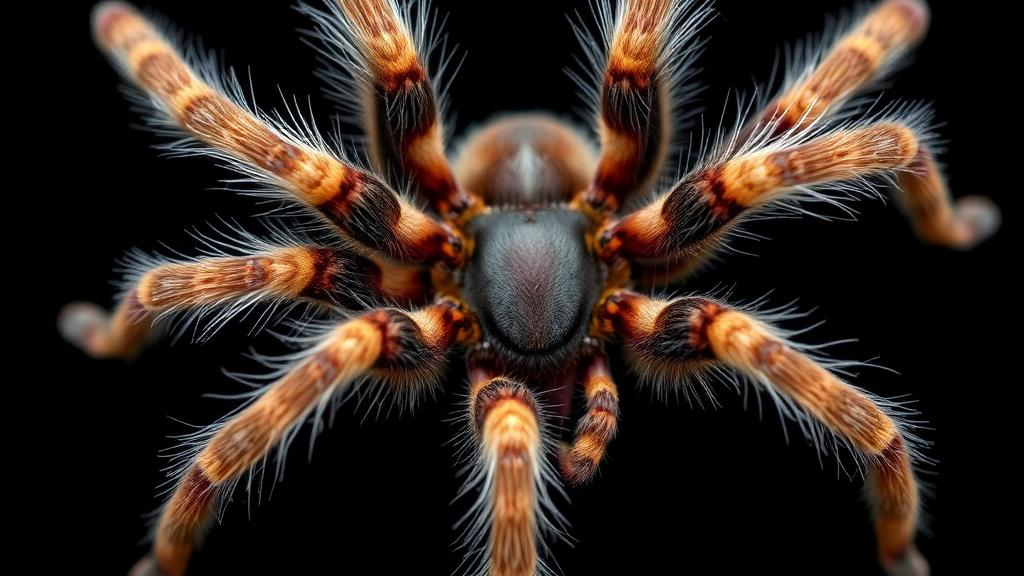
Tarantulas are among the most recognizable spiders on Earth, yet the science that names and classifies them has barely changed in centuries. A sweeping new review published in Frontiers in Arachnid Science examines 260 years of Theraphosidae systematics and finds a field in the midst of an explosive second wave of species discovery, one that is nonetheless still dominated by old-fashioned, morphology-only approaches. The analysis, conducted by Ethan J. Briggs and Chris A. Hamilton at the University of Idaho, reveals that only about 10 percent of tarantula species described between 2010 and 2024 incorporated DNA data, and just five of 37 newly erected genera were supported as distinct, monophyletic lineages by genetic evidence.
The review traces the history of tarantula taxonomy from its slow beginnings in 1758 through two great surges of descriptive activity. The first wave crested in 1897, when 38 species were described in a single year, before declining through the mid-twentieth century. During the roughly 200 years from 1758 to 1960, just 57 author combinations described 508 species that remain valid today, accounting for nearly half of all currently recognized tarantula diversity. That early era was overwhelmingly European and North American in character, with 20 of the top 21 most prolific tarantula taxonomists hailing from those two regions. Only the Brazilian arachnologist Cândido Firmino de Mello-Leitão, with 36 species, broke into that elite company, while Reginald Pocock and Eugène Simon described 96 and 90 valid species respectively.
The second wave, which began in the 1980s and continues today, is even more remarkable. From 1961 to April 2024, arachnologists described 592 currently valid species, more than half of all known tarantula diversity. In 2023 alone, 58 new theraphosid species were formally named. Perhaps most striking is the democratization of the field: roughly half of the species described over the last 60 years came from 204 author combinations, an almost 400 percent increase compared with the 57 authors who worked across the previous two centuries. Critically, many of these researchers live and work on the same continents as the spiders they describe, a shift that contrasts sharply with the broader crisis in taxonomy, where employment and funding for taxonomic positions continue to decline worldwide.
Tarantula diversity is far from evenly distributed across the planet. Australia has only six described species, and European tarantulas cling to the fringes of the Mediterranean. Africa hosts roughly 150 species and Asia around 200, but the Americas dwarf them all with approximately 650 described species. Brazil, Mexico, and Peru alone contain about 210, 100, and 80 species respectively, together representing roughly 35 percent of all described Theraphosidae. The authors suggest this disparity may reflect a combination of taxonomic bias, geological history, and evolutionary innovation. The development of urticating hairs, an effective anti-predator defense found in two American subfamilies, may have driven increased diversification or reduced extinction within the species-rich Theraphosinae.
At the genus level, the classification reveals troubling patterns. Of the 167 recognized genera, an astounding 25 percent are monotypic, meaning they contain only a single species. Most of these sit within Theraphosinae, the dominant lineage throughout the Americas. Conversely, just 11 genera with at least 20 species account for nearly 29 percent of described diversity. The two largest genera, Aphonopelma with 54 species and Selenocosmia with 40, are both likely non-monophyletic according to molecular studies and will probably be split into multiple genera in future revisions. The subfamily Ischnocolinae has historically served as a dumping ground for species that fit nowhere else, a practice that may inflate certain genera without reflecting natural evolutionary lineages.
The core problem, the review argues, is that contemporary tarantula taxonomy has remained largely static while the rest of biology has raced ahead. Since 2010, 38 theraphosid genera have been described, yet only five, Lasiocyano, Parvicarina, Tekoapora, Tliltocatl, and Urupelma, used genetic data to confirm they represent distinct monophyletic lineages. Four of those five were published in 2023. The remaining 33 genera are essentially untested hypotheses. Similarly, only 10.8 percent of the 369 species described between 2010 and 2024 were delimited using DNA, and that figure is heavily skewed by bursts of molecular work in 2016 and 2017. From 2020 to 2022, not a single new tarantula species was described with the aid of DNA.
Only 10 percent of new species were described under an explicitly stated species concept, despite the fact that species concepts provide the theoretical framework for testing boundaries between organisms. Historically, theraphosid taxonomy has relied on an unstated morphological species concept, essentially a typological viewpoint that treats visible differences as evidence of distinct species. This approach is particularly problematic for mygalomorph spiders, whose copulatory organs are structurally simple and provide few reliable characters for comparison. Small intraspecific variation in these structures can easily be misinterpreted as interspecific differences, leading to over-splitting. The scale of the problem is evident in the synonymy statistics: 36.9 percent of all available generic names and 20.9 percent of all available species names in Theraphosidae are junior synonyms, alongside two genera and 141 species considered nomina dubia.
The review also highlights how convergent evolution has repeatedly misled morphologists. The African arboreal genera Stromatopelma and Heteroscodra were shuffled between the subfamilies Aviculariinae, Eumenophorinae, and their own Stromatopelminae over decades of morphological debate. Only when molecular data were applied was their independent position, sister to Harpactirinae, finally confirmed. Similarly, molecular work on the North American genus Aphonopelma revealed significant over-splitting and resulted in 33 synonymies, demonstrating where morphology alone had failed to accurately delimit species as independently evolving lineages. The authors stress that these are not criticisms of morphology itself but reflections of funding inequities, since researchers in the biodiverse regions where most new species are found often lack access to molecular resources.
Beyond Theraphosidae, the boundaries between tarantulas and their closest relatives remain deeply uncertain. The brush-footed trapdoor spiders of the family Barychelidae, the sister lineage to Theraphosidae, share many characteristics including claw tufts and dense tarsal scopulae, yet recent phylogenetics suggest the family may not even be monophyletic. Ten barychelid genera have been transferred to Theraphosidae at various points between the 1970s and 2023, sometimes moving back and forth, but only a handful of species have been confirmed as theraphosids by molecular data. No new barychelid genera have been erected since 1995, in stark contrast to the 38 new theraphosid genera described since 2010. The enigmatic Paratropididae presents similar problems, with the genus Melloina recently moved to Theraphosidae based on morphological cladistic analyses that conflict with molecular phylogenies.
The path forward, the authors argue, requires a fundamental shift toward integrative taxonomy that combines morphology, DNA, ecology, and explicit hypothesis testing. Sequencing holotypes, whether from newly described species or historical museum specimens, is now more feasible than ever thanks to high-throughput sequencing methods, and would add critical stability by allowing confident identification regardless of life stage or sex. Of the 40 species delimited with DNA since 2010, only 29 had their holotypes sequenced, and in several cases it was unclear from published phylogenies whether the holotype was even included. Global collaboration, the review concludes, offers the best mechanism to balance resource inequities and elevate the standard of tarantula systematics. With less than 5 percent of known tarantula diversity sampled in molecular phylogenies, and countless undescribed species likely sitting in natural history collections, the second wave of tarantula taxonomy is far from over, but whether it produces a stable, testable classification depends on embracing the tools of modern biology.
Subject of Research: History and contemporary practices of Theraphosidae (tarantula) systematics and taxonomy
Article Title: What does the history of Theraphosidae systematics tell us about the future of tarantula taxonomy?
Article References: Briggs, E. J., & Hamilton, C. A. (2024). What does the history of Theraphosidae systematics tell us about the future of tarantula taxonomy?. Frontiers in Arachnid Science, 3, Article 1445731. https://doi.org/10.3389/frchs.2024.1445731
Image Credits: AI Generated
DOI: 10.3389/frchs.2024.1445731
Keywords: tarantulas, Theraphosidae, taxonomy, systematics, mygalomorph spiders, species delimitation, DNA barcoding, phylogenomics, integrative taxonomy, Barychelidae, Paratropididae, biodiversity
Cite Scienmag News
Margaret Porter. (October 16, 2026). Tarantula Taxonomy at a Crossroads: 260 Years of Naming Reveal a Science Stuck in the Past. Scienmag. https://scienmag.com/tarantula-taxonomy-at-a-crossroads-260-years-of-naming-reveal-a-science-stuck-in-the-past/
Margaret Porter. "Tarantula Taxonomy at a Crossroads: 260 Years of Naming Reveal a Science Stuck in the Past." Scienmag, 16 October 2026, https://scienmag.com/tarantula-taxonomy-at-a-crossroads-260-years-of-naming-reveal-a-science-stuck-in-the-past/. Accessed 16 October 2026.
Margaret Porter. "Tarantula Taxonomy at a Crossroads: 260 Years of Naming Reveal a Science Stuck in the Past." Scienmag. October 16, 2026. https://scienmag.com/tarantula-taxonomy-at-a-crossroads-260-years-of-naming-reveal-a-science-stuck-in-the-past/


