


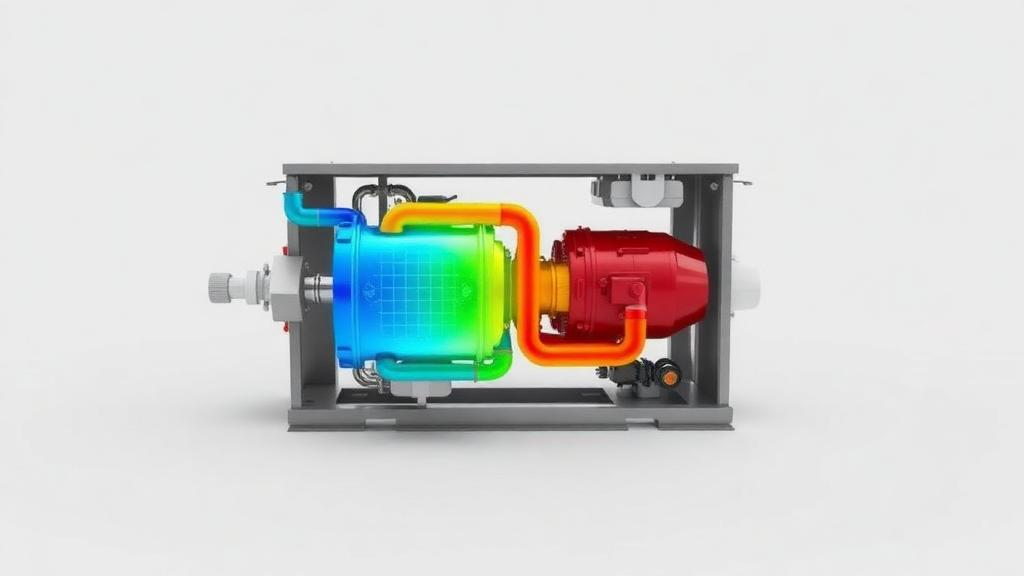
Heat pumps have quietly become one of the most consequential technologies in the global push to decarbonize buildings, yet the fin-and-tube heat exchangers at their heart remain stubbornly difficult to simulate in real time. A research team at the University of Modena and Reggio Emilia has now unveiled a dynamic, segment-by-segment model of these components that achieves something long thought out of reach: engineering-grade accuracy at a computational speed fast enough for live control systems and digital twins. The work, published in Results in Engineering, was led by Roberto Sedoni together with Paolo E. Santangelo and Diego Angeli, and its entire source code has been released in a public repository.
The challenge the researchers set out to solve is rooted in physics. Inside a heat pump, the refrigerant constantly shifts between liquid, two-phase mixture, and vapor, and the boundaries between those regions slide back and forth during every startup, shutdown, and capacity change. Detailed computational fluid dynamics can track these phenomena with high fidelity, but a single operating condition can demand hours or even days of computation, making CFD useless for real-time applications. At the other extreme, simple lumped-parameter models run quickly but assume uniform temperatures and pressures within each control volume, which badly distorts their predictions precisely where it matters most: during phase change.
Between those poles sit two established families of low-order models. Moving-boundary formulations divide the exchanger into subcooled, two-phase, and superheated zones and track the interfaces between them, offering a reasonable compromise, but their structure is rigidly tied to predefined flow regimes and they approximate wall temperatures too coarsely. That shortcoming becomes critical in winter, when accurate local surface temperatures are essential for predicting frost formation on the coil. Segment-by-segment, or finite-volume, models reconstruct the refrigerant state along the entire flow path and capture local heat transfer coefficients and pressure drops with precision, but they typically need many control volumes, and the best-known implementations, such as NIST’s EVAP-COND and CoilDesigner, are built for steady-state design rather than transient simulation, are closed-source, and are too slow for control integration.
The new model threads this needle by discretizing the refrigerant side into a chain of finite control volumes along the flow direction, each governed by one-dimensional mass, momentum, and energy balances. Crucially, the formulation explicitly accounts for the dynamic compressibility of the refrigerant, its thermal inertia, and the thermal inertia of the exchanger wall, so transient mass accumulation and shifting phase boundaries are captured rather than averaged away. The framework was written natively in the Simscape language within the Simulink environment, giving it a white-box architecture in which every governing equation and empirical correlation is transparent and directly coupled to control algorithms without cumbersome co-simulation interfaces.
One of the model’s most elegant tricks concerns the mathematical discontinuities that plague phase-change simulation. Heat transfer correlations for single-phase flow, such as the Gnielinski correlation for turbulent liquid or vapor, differ sharply from two-phase correlations like Cavallini-Zecchin for condensation and Shah for evaporation. Switching abruptly between them produces jumps in the heat transfer coefficient that can destabilize a solver. Instead of tracking flow regimes with expensive algorithms, the team applies a cubic Hermite spline over narrow vapor-quality intervals near zero and one, smoothly blending the correlations and eliminating artificial discontinuities. The same blending strategy is applied to pressure-drop modeling, where the Lockhart-Martinelli separated-flow correlation is merged with a simpler homogeneous-flow model at the vapor-quality extremes, where the well-mixed assumption actually becomes more valid.
On the air side, the model handles the moist-air physics that dominates real heat pump operation. When the wall surface temperature falls below the dew point, water vapor condenses on the coil, releasing latent heat; the model switches automatically between dry and wet heat transfer using the saturation humidity ratio at the wall. Bulk-flow condensation, which prevents the simulated air from exceeding 100 percent relative humidity, is governed by a condensation time constant, and a sensitivity analysis showed that values of 10 milliseconds or larger introduce errors of up to 103 watts in total heat flow and more than 12 percentage points in outlet relative humidity during rapid transients. The team settled on 0.1 milliseconds, which restores thermodynamic equilibrium almost instantly without numerical stiffness. Air-side friction and heat transfer are computed with established correlations from Wang and colleagues for plain and louvered fins, evaluated segment by segment so that multidimensional flow effects are folded into the one-dimensional framework.
Validation proceeded on two fronts. First, the team compared steady-state predictions against EVAP-COND 5.0, the industry-standard tool from NIST, for a three-row, fifteen-tube-per-row exchanger with two parallel refrigerant circuits running R32. Under condenser conditions, the converged model deviated from the reference by only about 2.7 percent, or 85 watts. Under evaporator conditions, the total capacity error shrank to just 0.36 percent, a mere 9 watts, because a 2.4 percent underprediction of sensible heat was nearly cancelled by a 6.8 percent overprediction of latent heat. A sensitivity analysis traced that latent discrepancy to the different empirical correlations used for refrigerant-side heat transfer: simply raising the coefficient by 20 percent cut the latent error from 6.8 percent to 1.1 percent.
Perhaps the most practically valuable insight emerged from a grid convergence study. The transition from two-phase flow to superheated vapor occurred within the second tube row of the evaporator, creating a steep wall-temperature gradient that made latent heat transfer acutely sensitive to spatial resolution there, while the first and third rows barely mattered. By refining only the rows with sharp thermodynamic gradients, the researchers achieved convergence with nine segments instead of the fourteen required by uniform discretization, cutting computational cost by roughly 36 percent. The strategy is generalizable: selectively refining only where phase transitions occur offers a systematic route to efficiency across different operating scenarios.
The speed figures are where the work becomes genuinely striking. EVAP-COND 5.0 needed 5.8 seconds to reach a steady-state solution, and even its coarsest setting saved only 0.2 seconds. The new dynamic model, by contrast, simulated 2000 seconds of transient operation in about 1.20 seconds for the condenser and 1.77 seconds for the evaporator on an Intel Core Ultra 7-265K processor, corresponding to run-to-simulation time ratios below one millisecond per simulated second. A dynamic model, which must solve time-dependent balances at every step, outpacing a dedicated steady-state design tool underscores just how far the numerical optimization has gone, and confirms suitability for hardware-in-the-loop testing and system-level digital twins.
Experimental validation completed the picture. Drawing on a prior system-level study of an exhaust air heat pump, the team imposed the exact measured air-side and refrigerant-side boundary conditions from 21 steady-state summer test cases onto standalone component models. Predictions for both evaporator and condenser fell largely within a plus-or-minus 10 percent error band, with mean absolute percentage errors of 6 percent for the evaporator and 5 percent for the condenser, and root-mean-square percentage errors of 7 and 6 percent respectively. Those figures are comparable to published validation results for EVAP-COND itself, which showed deviations of roughly 7 to 8 percent, and better than the EVSIM software, whose errors reached 12 percent. With the code openly available and future work targeting transient experimental validation and a frost-formation module for winter operation, the model positions itself as a building block for the next generation of intelligent, self-optimizing heat pump systems.
Subject of Research: Dynamic low-order modeling of fin-and-tube heat exchangers for real-time heat pump simulation
Article Title: An accurate low-order model of a fin-and-tube heat exchanger for the dynamic simulation of heat pumps
Article References: Sedoni, R., Santangelo, P. E., & Angeli, D. (2026). An accurate low-order model of a fin-and-tube heat exchanger for the dynamic simulation of heat pumps. Results in Engineering, 32, Article 113465. https://doi.org/10.1016/j.rineng.2026.113465
Image Credits: AI Generated
DOI: 10.1016/j.rineng.2026.113465
Keywords: heat pumps, heat exchangers, fin-and-tube, digital twins, model predictive control, two-phase flow, finite volume model, condensation, evaporation, HVAC, Simscape, real-time simulation
Cite Scienmag News
Mallory Mcbride. (October 16, 2026). Open-Source Heat Exchanger Model Brings Real-Time Digital Twins to Heat Pumps. Scienmag. https://scienmag.com/open-source-heat-exchanger-model-brings-real-time-digital-twins-to-heat-pumps/
Mallory Mcbride. "Open-Source Heat Exchanger Model Brings Real-Time Digital Twins to Heat Pumps." Scienmag, 16 October 2026, https://scienmag.com/open-source-heat-exchanger-model-brings-real-time-digital-twins-to-heat-pumps/. Accessed 16 October 2026.
Mallory Mcbride. "Open-Source Heat Exchanger Model Brings Real-Time Digital Twins to Heat Pumps." Scienmag. October 16, 2026. https://scienmag.com/open-source-heat-exchanger-model-brings-real-time-digital-twins-to-heat-pumps/


