


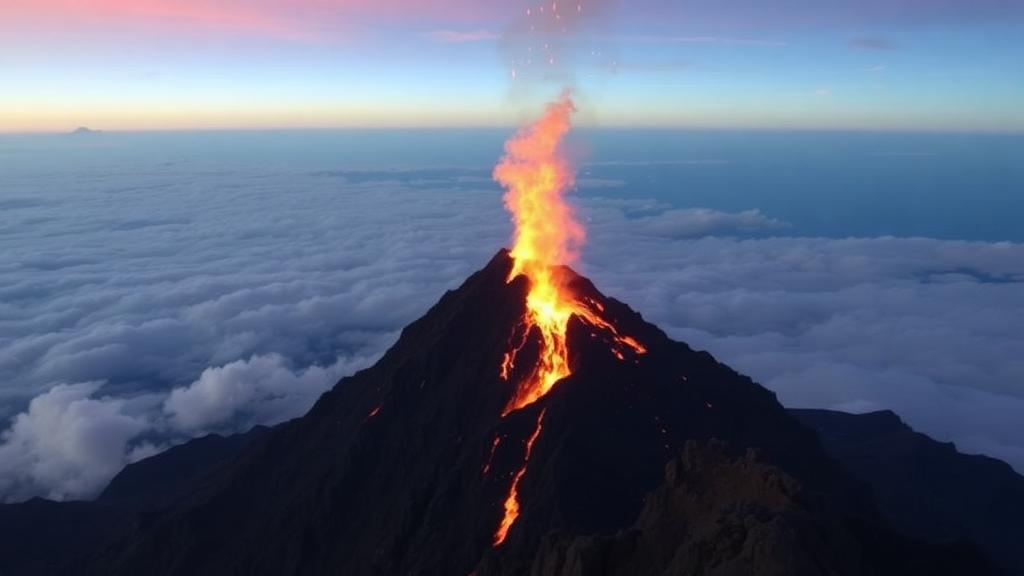
On 4 May 2023, an expedition team crossing the plateau of Mount Roraima in Venezuela noticed the smell of smoke drifting across one of the most isolated landscapes on Earth. Within minutes, they reached a rocky overhang near the center of the summit where spots of ground were still smoldering and radiating heat. Around the perimeter lay a layer of fresh ash, scorched rock, and the blackened remains of plants found nowhere else in such combination. According to a new report published in the journal BioRisk, this was the first recorded fire on the top of Roraima-tepui, a tabletop mountain whose summit has been considered effectively fireproof for as long as scientists have been documenting it.
Roraima-tepui is one of the great tabular sandstone plateaus of the Guiana Shield, rising between roughly 1,500 and 2,995 meters above sea level and separated from the surrounding lowlands by quasi-vertical cliffs. Its summit belongs to the Pantepui biogeographic zone, a mosaic of shrublands, meadows, and peat wetlands bathed in a perhumid climate. Between 1986 and 1999, the power company CVG-EDELCA ran a fire registry across the Upper Caroní River basin, where the mountain sits, and not a single fire was recorded on any high-tepui summit. That long absence of fire is precisely what makes the 2023 observation so alarming to ecologists, park guards, and Indigenous community leaders alike.
The team, traveling north toward a depression known as El Foso, first assumed the smell came from savanna fires burning near the base of the mountain and carried upward by the wind. Instead, they found a burned patch at the base of a rock wall, estimated at approximately 160 square meters, where shrubland on sandy substrate had been consumed. Among the damaged plants were species characteristic of the high-tepui flora: Bonnetia shrubs, the bromeliad-like Connelia augustae, the epiphytic Tillandsia turneri, the orchid Epidendrum alsum, and Cyrilla racemiflora. The most heavily affected zone, right against the escarpment, was covered in ankle-deep ash, and burn marks and heat discoloration were clearly visible on scattered rocks.
Notably, the fire stopped at the edge of a wetland meadow dominated by Stegolepis, a plant community rooted in waterlogged peat where water flows over the underlying rock. This sharp boundary between burned shrubland and untouched wet meadow illustrates the fine fuel dynamics of the summit: the fire burned only where vegetation had dried enough to carry flames, and it could not penetrate the wettest, peat-forming parts of the plateau. Several days without precipitation before the visit likely dried the vegetation, and strong winds at the summit supplied abundant oxygen. What remained missing was a heat source, and the authors argue that natural ignition is improbable.
The fire site itself offers a clue. It lies at the base of a vertical rock face with an opening sheltered by an overhang that keeps off the rain, making it an ideal camping spot. The researchers speculate that one or several people camped there, lit a fire, and left it burning when they departed. After nearly two centuries of exploration by scientists and adventurers, there are still no reliable reports of lightning-ignited or otherwise spontaneous fires on high-tepui summits, and lightning strikes tend to occur during the rainy season when vegetation is wet. Human activity, by contrast, is the common thread in nearly every documented tepui fire.
History offers a sobering precedent. In April 1926, at the end of the unusual mega-drought of 1925 to 1926, a great fire burned for several days through the forests on the southwestern talus slopes of Roraima-tepui. The eyewitness Holdridge reported that the flames climbed the ledge known as La Rampa and nearly reached the plateau top, where sparse vegetation finally stopped them. That event left a lasting mark on the mountain’s biodiversity. The carnivorous pitcher plant Heliamphora nutans, first collected at the mountain’s base by Robert Schomburgk in 1838 and again in 1841, has since been recorded only from the summit, suggesting it may have been completely eradicated from the southwestern slopes by that fire.
A more recent parallel unfolded on Auyán-tepui, another massif in Canaima National Park. On 10 March 2024, an extensive fire ignited in the savannas near the Indigenous Kamarakoto communities of Uruyén and Kavak and burned for several days, with photographs showing flames reaching the upper escarpments of the massif. Savanna burning is a traditional practice among Pemón communities in the Gran Sabana, but under normal circumstances such fires do not penetrate the perhumid Pantepui zone above roughly 1,500 meters, a region known for buffering regional climatic shifts and maintaining remarkably stable vegetation. That a fire climbed so high in 2024 suggests the buffering capacity of these ecosystems is being tested.
The scientific record reinforces how rare summit fires are. Researchers who studied more than 30 tepui summits over two decades reported finding no evidence of spontaneous fires anywhere, with the only high-tepui site showing recent burning being roughly 40 square kilometers on the western branch of Auyán-tepui, where a fire escaped the control of expedition workers in May 1964. Claims that tepui shrubs evolved fire adaptations, based on a single event at Cerro de la Neblina, have been rejected by later researchers precisely because natural ignition appears essentially absent from the record. Palynological studies add a further caveat: small charcoal particles found in late Holocene sediments on Apakará, Eruoda, and Guaiquinima tepuis are small enough to have been carried by wind from fires in the surrounding Gran Sabana lowlands rather than indicating local burning. Fires documented on pyramidal tepuis such as Sororopán and Uei, which connect to the lowlands through gradual slopes and vegetated ridges, fit the same pattern of fire arriving from below rather than starting on top.
The 2023 summit fire, the authors conclude, should not be read as an isolated accident but as the product of converging pressures on the Guiana Shield highlands. Unregulated tourism has surged, with visitors often guided by people lacking ecological training, producing unauthorized trails, trampled endemic plant communities, and disturbed wetlands. Exotic species, including the grasses Poa annua and Polypogon elongatus, and even human-transmitted fecal bacteria such as Helicobacter pylori, have been documented on the summit. The researchers hypothesize that these invasive grasses, by accumulating dry biomass during extended dry seasons, may be raising the fine fuel load in an ecosystem historically devoid of natural fire regimes, although direct causal links still require empirical testing. Severe droughts, already known to strongly affect summit vegetation, and the broader intensification of dry periods and climatic variability under global climate change act as amplifiers, creating feedback loops that could make such events more frequent and severe.
The report closes with a call for an urgent reassessment of how Roraima-tepui is accessed and managed. The proposed response combines meteorological and ecological monitoring, control of invasive species, stringent regulation of tourism, and strengthened local stewardship capacities. The stakes extend beyond a single burned patch of 160 square meters. The Pantepui summits harbor endemic species with nowhere else to go, and a fire regime that never existed in their evolutionary history could erase populations faster than any recovery observed so far. Two years after the 2023 fire, a follow-up visit in April 2025 found burn marks still etched into the sandstone, dead shrubs showing no regrowth, and only pioneer Asteraceae plants, recovering Tillandsia turneri, and a few fresh Connelia shoots signaling the slow beginning of a recovery that may take decades, if it completes at all.
Subject of Research: First documented fire on the summit of Roraima-tepui and its implications for Pantepui ecosystem conservation
Article Title: Observations of fire occurrences on high-elevation tepui summits quasi-isolated by cliffs
Article References: Observations of fire occurrences on high-elevation tepui summits quasi-isolated by cliffs. (n.d.). https://doi.org/10.3897/biorisk.24.189994
Image Credits: AI Generated
DOI: 10.3897/biorisk.24.189994
Keywords: Roraima-tepui, tepui, Pantepui, Guiana Shield, fire ecology, Canaima National Park, invasive species, drought, endemic plants, tourism impacts, climate change, Venezuela
Cite Scienmag News
Gavin Prescott. (October 16, 2026). Fire Reaches the Summit of Mount Roraima for the First Time on Record. Scienmag. https://scienmag.com/fire-reaches-the-summit-of-mount-roraima-for-the-first-time-on-record/
Gavin Prescott. "Fire Reaches the Summit of Mount Roraima for the First Time on Record." Scienmag, 16 October 2026, https://scienmag.com/fire-reaches-the-summit-of-mount-roraima-for-the-first-time-on-record/. Accessed 16 October 2026.
Gavin Prescott. "Fire Reaches the Summit of Mount Roraima for the First Time on Record." Scienmag. October 16, 2026. https://scienmag.com/fire-reaches-the-summit-of-mount-roraima-for-the-first-time-on-record/


