


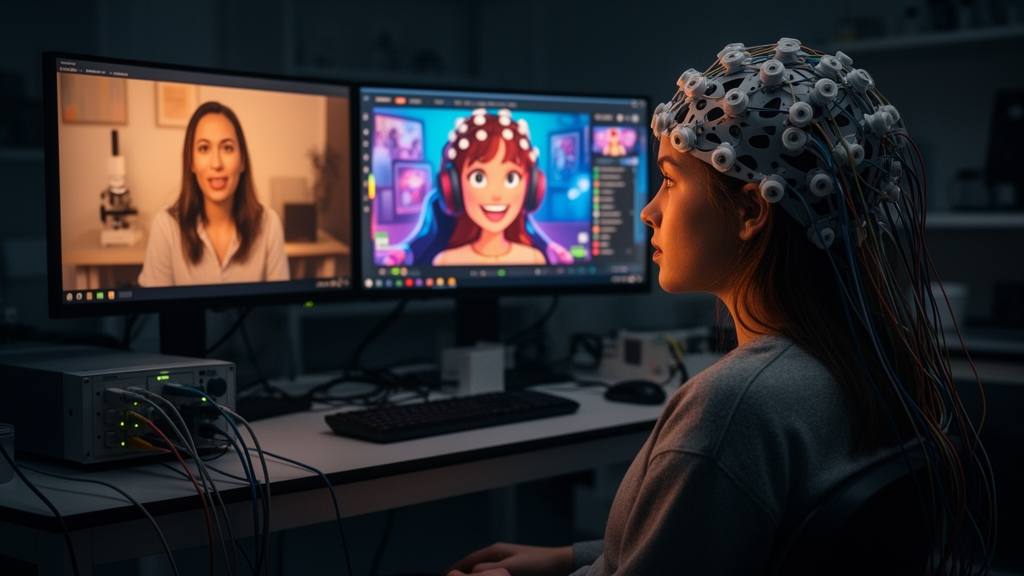
AI-driven virtual streamers are taking over e-commerce livestreams, pitching products with computer-generated faces and tireless enthusiasm. A natural question follows: do consumers actually trust them less than human presenters? A new study published in Current Psychology suggests the answer is more complicated than a simple yes or no. When researchers measured trust behaviorally, people handed over their money to virtual and human streamers at nearly identical rates. But when they peered inside the brain with electroencephalography, they found that the two kinds of presenters are processed in strikingly different ways, with virtual male streamers in particular triggering extra neural work related to conflict and uncertainty.
The study, conducted by Jiaqi Huo, Fuze Sun, Tiantian Liu, and Lele Fang at Liaoning Normal University in collaboration with the University of Liverpool, grounded its investigation in established trust theory and used a classic experimental economics tool: the Trust Game. In this paradigm, a participant is given a sum of money and must decide whether to send it to an anonymous partner. If they trust the partner and send the money, the amount is multiplied, and the partner can either reciprocate by sharing the returns or betray the trust by keeping everything. Because real money or meaningful stakes are involved, the decision is a genuine act of trust rather than a mere opinion survey, which makes the paradigm a rigorous way to probe how people evaluate strangers, including artificial ones.
In this adaptation, the anonymous partners were represented by faces of streamers, some human and some virtual, and of both genders. Participants played repeated rounds of the game with these anonymous counterparts while an electroencephalogram recorded the electrical chatter of their brains. The repeated, anonymous design meant that participants could not build a reputation-based relationship with any particular streamer; every decision was a fresh judgment based only on the face and the label. This setup isolated the immediate, first-impression component of trust, the kind that matters most when a shopper encounters a new livestream host for the first time.
The behavioral headline was one of equivalence. Trust rates, meaning the proportion of trials in which participants chose to invest, did not differ significantly between virtual and human streamers, nor between male and female streamers. On the surface, then, the answer to the question posed in the study’s title appears to be no: virtual streamers are not trusted less, at least not in terms of what people actually do with their money. This finding aligns with a growing body of work suggesting that people often respond socially to computers and artificial agents, a phenomenon famously described as machines and mindlessness, in which users apply human social rules to technology without consciously realizing it.
But the electrical record told a richer story. During the decision phase, when participants were weighing whether to trust, the researchers focused on three well-characterized event-related potential components: P2, N2, and P3. The P2, an early positive deflection appearing roughly 150 to 250 milliseconds after a stimulus, is generally linked to rapid attentional capture and initial perceptual analysis. In this study, male streamers, whether virtual or human, elicited larger P2 amplitudes than female streamers, suggesting that male faces drew stronger early attention during the trust decision.
The N2 and P3 components revealed the virtual-versus-human divide. Virtual streamers produced more negative N2 amplitudes and smaller P3 amplitudes than human streamers, and this difference was most pronounced for male virtual streamers. The N2 is commonly interpreted as a marker of conflict monitoring and uncertainty processing, the brain’s signal that something does not quite fit expectations or requires additional cognitive control. The P3, appearing later, reflects the allocation of evaluative resources and the updating of context. Together, the pattern indicates that when participants faced a virtual male streamer, their brains registered heightened conflict or uncertainty about the decision and simultaneously devoted fewer evaluative resources to it. In other words, the decision felt cognitively messier and was processed with less deep evaluation, even though the ultimate choice to trust was made just as often.
The researchers also examined what happened after the outcome of each round was revealed, whether the streamer had reciprocated the trust or betrayed it. Here, two components took center stage: the feedback-related negativity, or FRN, and the feedback P3. Virtual streamers elicited more negative FRN amplitudes than human streamers, indicating that feedback from artificial presenters was evaluated differently at an early, rapid stage of outcome processing. The FRN is typically sensitive to whether an outcome is better or worse than expected, and its amplification for virtual streamers suggests that participants’ expectations or the emotional weight of outcomes differed when the counterpart was artificial. Meanwhile, gains in general produced larger feedback P3 amplitudes than losses, reflecting stronger late-stage evaluative processing of positive outcomes, consistent with the idea that rewarding feedback engages more elaborate motivational evaluation.
These neural findings resonate with long-standing debates in human-technology interaction. The uncanny valley hypothesis holds that near-human artificial faces can provoke unease precisely because they are almost, but not quite, human, and the elevated N2 observed for virtual streamers is consistent with the kind of expectancy violation and conflict monitoring that uncanny stimuli can provoke. Previous neuroimaging work comparing trust in humans and avatars has similarly shown that behavioral equivalence can mask distinct underlying neural routes to the same decision. The present study extends that logic to the livestreaming commerce context, showing that the brain treats a virtual presenter as a special category even when the wallet opens just as readily. Gender effects add another layer, echoing social role theory and prior findings that female virtual agents often convey greater social presence, while male faces here captured more early attention and, in virtual form, generated the greatest uncertainty signals.
The practical implications reach directly into the booming industry of virtual anchors and AI-driven sales agents. If companies deploy virtual streamers, the evidence suggests consumers will not necessarily withhold trust in their choices, which is good news for scalability, cost control, and round-the-clock broadcasting. Yet the heightened conflict monitoring and reduced evaluative engagement associated with virtual male streamers hint at a subtle friction that could matter over longer viewing sessions or in higher-stakes purchases. Designers may be able to smooth this friction through anthropomorphic refinements, transparent disclosure of the virtual nature of the host, or pairing virtual presenters with product categories where the observed neural patterns are least disruptive. The authors note that their paradigm, applying the Trust Game to streamer facial appearance and identity cues, offers neuroscientific evidence for early trust formation toward virtual agents and a template for testing design choices before full market rollout.
Scientifically, the study’s strength lies in pairing a clean behavioral measure with millisecond-level neural resolution, revealing a dissociation that surveys alone would miss: identical trust, different brains. Its limitations are those typical of laboratory trust games, including simplified facial stimuli, anonymous one-shot interactions stripped of the rich verbal and social cues of real livestreams, and a participant pool drawn from a single cultural context. Real livestreaming involves chat interaction, product demonstrations, and parasocial relationships that unfold over many sessions, none of which were present here. Still, as virtual streamers multiply across platforms and generative AI makes them ever more lifelike, understanding the hidden cognitive cost of trusting a synthetic face becomes increasingly urgent. This research shows that the answer to whether virtual streamers are trustworthy may ultimately be written not in what consumers do, but in how their brains get them there.
Subject of Research: Neural mechanisms of consumer trust toward virtual versus human streamers in e-commerce livestreaming
Article Title: Are virtual streamers more trustworthy? An ERP study of trust in E-commerce livestreaming
Article References: Huo, J., Sun, F., Liu, T., & Fang, L. (2026). Are virtual streamers more trustworthy? An ERP study of trust in E-commerce livestreaming. Current Psychology, 45(17), Article 1437. https://doi.org/10.1007/s12144-026-09984-9
Image Credits: AI Generated
DOI: 10.1007/s12144-026-09984-9
Keywords: virtual streamers, e-commerce livestreaming, trust, event-related potentials, Trust Game, consumer neuroscience, P2, N2, P3, FRN, anthropomorphism, uncanny valley
Cite Scienmag News
Cassandra Pierce. (October 16, 2026). Brains Trust Virtual Streamers as Much as Humans, but Process Them Differently. Scienmag. https://scienmag.com/brains-trust-virtual-streamers-as-much-as-humans-but-process-them-differently/
Cassandra Pierce. "Brains Trust Virtual Streamers as Much as Humans, but Process Them Differently." Scienmag, 16 October 2026, https://scienmag.com/brains-trust-virtual-streamers-as-much-as-humans-but-process-them-differently/. Accessed 16 October 2026.
Cassandra Pierce. "Brains Trust Virtual Streamers as Much as Humans, but Process Them Differently." Scienmag. October 16, 2026. https://scienmag.com/brains-trust-virtual-streamers-as-much-as-humans-but-process-them-differently/


