


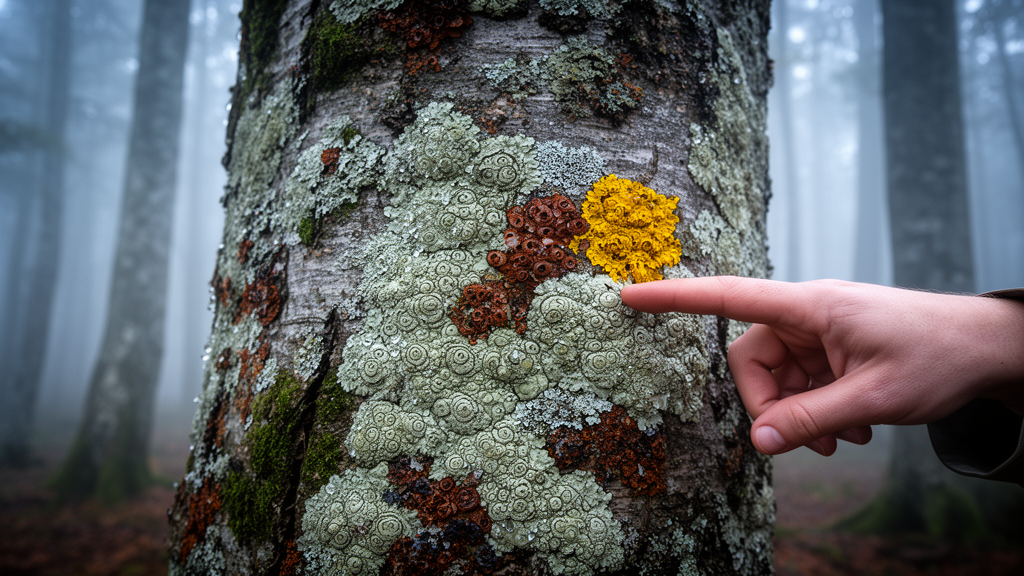
Deep in the primeval beech forests of the Ukrainian Carpathians, some of Europe’s last truly wild woodlands are hiding a biological treasure that has gone largely unnoticed for a century. A new study, published in the journal Vegetation Classification and Survey, has carried out the first comprehensive classification of the lichen communities that cloak the trunks, branches, and even exposed roots of European beech trees in western Ukraine. The results rewrite the textbook picture of epiphytic lichen vegetation in Europe, describing an entirely new class of lichen communities, a new order, three new alliances, and five new associations, while confirming that these ancient forests remain a continental hotspot of lichen diversity.
The research focused on the old-growth beech forests of the Ukrainian Carpathians and the adjacent Roztochchia, Podillia, and Khotyn uplands, including celebrated stands such as Gorgany, Shyrokyi Luh, Irshavka, Velykyi Dil, and Synevyr, many of which lie within the core and buffer zones of the UNESCO World Heritage Site “Primeval Beech Forests of the Carpathians.” These forests are classified as primeval or quasi-primeval and belong to three habitat types under the European Nature Information System: beech forests on non-acid soils, beech forests on acid soils, and temperate mountain forests of silver fir. The significance of the region for lichens is hard to overstate. Earlier biodiversity surveys in the Uholka massif of the Carpathian Biosphere Reserve recorded 387 corticolous and lignicolous lichens and allied fungi across just five one-hectare plots, with a maximum of 228 species per hectare, a record for epiphytic lichen diversity in Central Europe.
Despite this extraordinary richness, knowledge of how these lichens assemble into distinct communities has been remarkably thin. The study of epiphytic lichen communities in European beech forests began almost a hundred years ago, when the Czech botanist Alfred Hilitzer described the first such associations from forest habitats in what is now the Czech Republic. His work was later revised and consolidated by Jan Barkman in his seminal 1958 monograph, and subsequent syntheses in Germany, Hungary, Scandinavia, and the United Kingdom expanded the geographic picture. Yet for Ukraine, the literature recorded only a single association, Pyrenuletum nitidae, from beech forests. The new study set out to fill this gap and, in doing so, to revisit and modernize a century-old scientific tradition.
Between 2019 and 2024, the researchers conducted fieldwork across five Ukrainian oblasts, sampling ecologically uniform patches of lichen vegetation on beech trees with meticulous precision. Each tree could host up to four separate survey plots, called relevés: one at the base of the trunk or on exposed living roots, one on mosses growing on the trunk, one on the smooth bark of the trunk, and occasionally one on branches. Plot sizes were carefully standardized, ranging from tiny 0.02 square meter quadrats along roots and branches to 0.75 square meter strips along the trunks of old trees. For every plot, the team recorded geographic coordinates, altitude, aspect, total lichen cover, and the cover of each individual species. Species that could not be identified in the field were examined microscopically using standard procedures, and nomenclature followed the lichen checklist for the Alps.
The analytical backbone of the study was a dataset of 293 relevés, of which 230 came from western Ukraine and the remainder were digitized from historical literature, including the original diagnoses of Hilitzer’s and other early associations. The data were stored in TURBOVEG software and classified using the modified TWINSPAN algorithm implemented in JUICE, with the average Sørensen index as the dissimilarity measure. A two-step procedure first separated the data into major clusters corresponding to classes and orders of lichen vegetation, then subdivided each cluster into associations and unranked communities. Species were considered diagnostic if their fidelity coefficient reached 0.25 and highly diagnostic above 0.50. Nonmetric multidimensional scaling ordination in R was then used to visualize how the communities relate to one another along environmental gradients.
The first step of the analysis produced seven large clusters that split cleanly along a substrate divide. One group comprised communities on the root systems of trees, while the other gathered communities on trunks and branches. The second step yielded twenty units at the association or unranked community level, twelve of which were recorded in the study area and together encompassed 267 lichen species. The headline result is the description of a new class, Agonimietea repletae, encompassing inconspicuous crustose lichen communities that colonize exposed roots and the bases of old tree trunks with smooth bark. Within this class, the authors established the new order Agonimietalia repletae and two new alliances: Biatorion radicicolae, found on sun-exposed roots near the timberline at elevations of 1150 to 1340 meters, and Dictyocatenulation albae, confined to shaded roots and trunk bases in the montane belt. A provisional third alliance, Biatorion vernalis, was proposed for crustose lichens growing on mosses at the base of old trees.
The five newly described associations carry evocative names that encode their diagnostic species. Biatoretum radicicolae forms grey-greenish coatings on exposed roots near the subalpine belt and includes species normally found on silicate rocks, such as Porpidia macrocarpa. Dictyocatenulatetum albae, dominated by the rare species Dictyocatenulata alba, inhabits shaded root systems in primeval forests. Biatoretum vernalis-Striguletum stigmatellae grows on mosses in the montane belt. Buellio griseovirenti-Bacidinetum sulphurellae colonizes the smooth bark of young, 30 to 60 year old beeches in regenerating stands. Most spectacular are Japewio aliphatici-Parmelietum saxatilis and Parmelio tiliacei-Lobarietum pulmonariae, which develop on old beeches near the timberline and are responsible for the record levels of epiphytic lichen diversity recorded in Central Europe. Alongside these, the well-known class Arthonio radiatae-Lecidelletea elaeochromae of neutral smooth bark, the acidophilous class Hypogymnietea physodis, and the nitrophilous class Physcietea complete the picture.
Beyond taxonomy, the study delivers a practical message for conservation: lichen communities can serve as sensitive indicators of the ecological integrity of forest habitats. The species-rich association Thelotremo lepadini-Biatoretum ponticae, found on the trunks of old beeches in primeval Carpathian forests, particularly in the Shyrokyi Luh massif of the Carpathian Biosphere Reserve, is strongly correlated with recognized primeval forest and hosts a wealth of rare European species, including many classic indicators of forest continuity such as Lobaria pulmonaria, Leptogium saturninum, Parmeliella triptophylla, and Sticta fuliginosa. The species-poor Dictyocatenulatetum albae, most common in the primeval forests of Zacharovanyi Krai National Nature Park, likewise carries a distinctive set of indicator species, including Arthonia helvola, Anisomeridium macrocarpum, and the Red Data Book species Gyalecta herculina. These communities apparently prefer the absence of any forest management and could be formally adopted as indicator communities for primeval beech forest.
The study also documents how human activity, both past and present, leaves its signature on the lichen flora. Moderate sheep grazing on the mountain grasslands called polonynas has created ecotone forest habitats near the timberline where remarkably species-rich communities flourish, with transitional or derivative communities reaching averages of more than 20 lichen species per plot and totals of up to 98 species in a single association. However, the recent decline in grazing has allowed beech and sycamore maple to thicken the understorey, shading out the sun-loving epiphytic communities on old trees; species such as Heterodermia speciosa and Collema nigrescens are disappearing from these darkened stands, and root-dwelling Biatoretum radicicolae communities have vanished entirely from some sites. Conversely, intensive management near settlements, gardens, and even First World War fortifications nitrifies the bark and promotes nitrophilous communities of the class Physcietea, such as Candelarietum concoloris, which lack any indicator species of forest integrity. Their presence in old-growth forests, including UNESCO-listed sites on Ukraine’s plains, signals significant eutrophication of these habitats.
Perhaps most strikingly, the researchers found no correlation between the epiphytic lichen communities on beeches and the three EUNIS habitat types into which the forests are classified, suggesting that current habitat schemes may be too coarse to capture the fine-grained world of lichen vegetation, and that patterns might emerge only when all woody species in these habitats are surveyed. The authors hypothesize that the psychrophilic moss-dwelling communities of the Lobarion pulmonariae alliance, famous indicators of ecological integrity, may be declining rapidly in the Carpathians due to global climate change, with the newly proposed Biatorion vernalis communities potentially representing a warmer-adapted vicariant replacement. As Europe’s primeval beech forests face mounting pressures from a changing climate and shifting land use, this study makes clear that the humble lichens coating their bark and roots are not merely decorative additions but sensitive barometers of wilderness, and that protecting them means protecting the very ecological continuity that makes these forests irreplaceable.
Subject of Research: Syntaxonomic classification of epiphytic lichen communities on European beech in old-growth forests of western Ukraine
Article Title: Epiphytic lichen communities in old-growth beech forests of western Ukraine
Article References: Epiphytic lichen communities in old-growth beech forests of western Ukraine. (n.d.). https://doi.org/10.3897/VCS.149158
Image Credits: AI Generated
DOI: 10.3897/VCS.149158
Keywords: lichens, epiphytes, old-growth forests, beech, Ukrainian Carpathians, syntaxonomy, biodiversity, conservation, phytosociology, UNESCO World Heritage, bioindicators, TWINSPAN
Cite Scienmag News
Margaret Porter. (October 16, 2026). Hidden Lichen Kingdoms Revealed in Ukraine’s Primeval Beech Forests. Scienmag. https://scienmag.com/hidden-lichen-kingdoms-revealed-in-ukraines-primeval-beech-forests/
Margaret Porter. "Hidden Lichen Kingdoms Revealed in Ukraine’s Primeval Beech Forests." Scienmag, 16 October 2026, https://scienmag.com/hidden-lichen-kingdoms-revealed-in-ukraines-primeval-beech-forests/. Accessed 16 October 2026.
Margaret Porter. "Hidden Lichen Kingdoms Revealed in Ukraine’s Primeval Beech Forests." Scienmag. October 16, 2026. https://scienmag.com/hidden-lichen-kingdoms-revealed-in-ukraines-primeval-beech-forests/


