


A shark that has puzzled paleontologists since its formal naming in 2017 has just rewritten its own biography. Megalolamna, an extinct relative of today’s great white and sandtiger sharks, was known only from scattered fossil teeth along the Pacific Rim and the western Atlantic. Now, a new study published in Zitteliana reports the first European occurrences of the genus, based on teeth from Austria, France, Germany, and Italy, and in the process resolves a taxonomic tangle that stretches back nearly a century and a half. The once-mysterious predator, it turns out, was swimming in the warm seas that covered much of Europe during the early Miocene, roughly 20 to 16 million years ago.
The research team, led by fossil shark specialist Florian Pollerspöck and colleagues, examined museum specimens and newly recognized teeth from four countries, nearly doubling the number of countries from which Megalolamna is known, from five to nine. Until now, the genus had been documented from the upper Oligocene Chandler Bridge Formation in South Carolina and eight Miocene localities, including the Calvert Formation of Maryland, the Pungo River Formation of North Carolina, the Jewett Sand of California, the Uitpa Formation of Colombia, the Dos Bocas Formation of Ecuador, the Chilcatay Formation of Peru, and two formations in Japan. The new European records extend the genus into the Mediterranean and Paratethys seas, vast marine realms that once covered much of the continent.
Megalolamna belongs to the order Lamniformes, the mackerel sharks, and more specifically to the family Otodontidae, the lineage that produced the legendary giant Megalodon. The genus is classified as monospecific, meaning it contains just one species, but even that single species has been elusive. Its teeth are never abundant at any locality, even in regions that have been intensively collected for fossil shark teeth for more than a century. This spotty yet geographically wide distribution is what earned Megalolamna the label of an enigmatic shark, and it is a pattern that echoes some of the rarest sharks alive today.
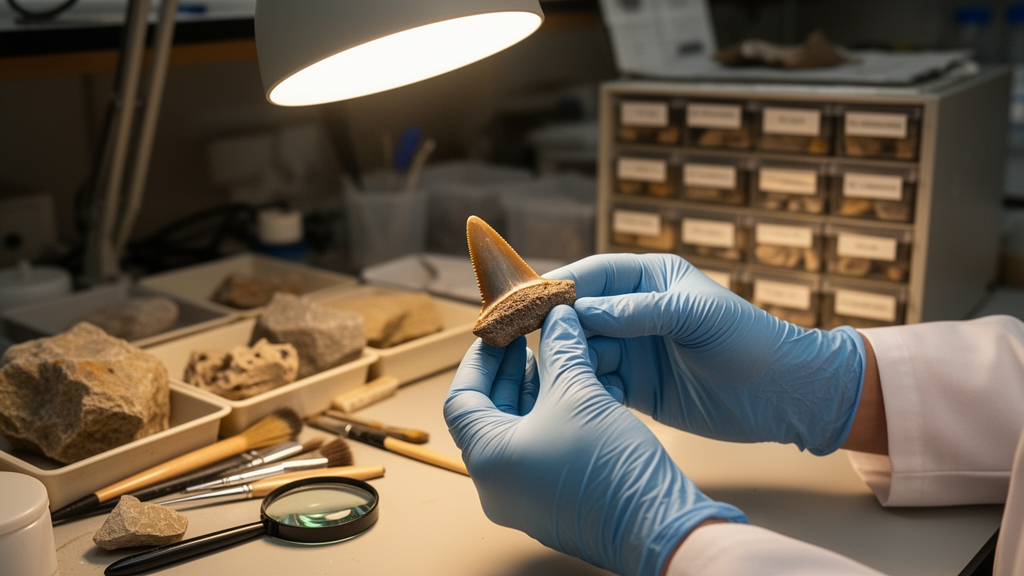
The European detective story began with a re-examination of historical collections. In Germany, the key specimen is a tooth originally described in 1879 by the German paleontologist Probst as Otodus serotinus, recovered from the now-closed Kodelsberg quarry east of Baltringen in Baden-Württemberg. That tooth, catalogued as GPIT-PV-31738 and housed at the University of Tübingen, measures about 8.2 millimeters in both height and width and preserves the diagnostic features of Megalolamna: a sharply pointed, triangular main cusp with a pair of lateral cusplets, razor-like smooth cutting edges, a distinctive chevron-shaped tooth neck, and a strongly bilobed root. A second German tooth, described in 1991 from the Walbertsweiler sand pit, had been listed only as Lamna sp. and now also belongs to the genus.
In Austria, a previously undescribed tooth was found around 1985 by collector Dietmar Stadlhuber in the phosphorite sands near Plesching in Upper Austria, deposits laid down in the Ottnangian stage of the middle Burdigalian. The Plesching site, with its glauconite-rich green-brown sands and evidence of a steep rocky coast, was famous among collectors for its shark teeth, yet the Megalolamna tooth remained unrecognized in a private collection for decades. In France, a tooth from the Mazan site in the Mormoiron Basin of Provence comes from sediments deposited directly above the Paleogene-Neogene boundary, dating it to the lowest Burdigalian. And in Italy, teeth from the Pietra da Cantoni Group in eastern Monferrato, including specimens described as Lamna bassanii by Alessandri in 1897 and others catalogued by Caretto in 1972 under a different name, all proved to belong to Megalolamna.
Recognizing these specimens as Megalolamna was only half the battle. The team then had to determine which species name had priority under the International Code of Zoological Nomenclature. Because Probst’s name serotinus was published in 1879, it predates both Alessandri’s bassanii from 1897 and the name paradoxodon coined by Shimada and colleagues in 2017 when they erected the genus. Under the Principle of Priority, the oldest available name wins, unless specific exceptions apply. The authors searched the literature and found that both serotinus and bassanii had been used as valid names after 1899, in works by Joleaud in 1907, D’Erasmo in 1924, Fowler in 1966, and Cappetta in 2006, which blocks the reversal-of-precedence exception. The verdict: the species must now be called Megalolamna serotinus, a new combination, with bassanii and paradoxodon relegated to junior synonyms.
The taxonomic reshuffle may seem like an academic formality, but it matters enormously for how scientists reconstruct ancient ecosystems and track evolution through deep time. Every fossil occurrence of this shark must now be filed under a single, stable name, allowing researchers to map its true geographic and temporal range without the noise of synonymy. The emended diagnosis published in the new paper also sharpens the anatomical definition of the genus, detailing features such as the convex lingual crown face, the nearly equal height and width of the lateral cusplets, the robust lingual protuberance of the root with its nutritive foramina, and the osteodentine tooth histology that characterizes otodontid sharks.
The geographic implications are equally striking. Megalolamna inhabited tropical to mid-latitudinal zones in both hemispheres, and its known range now spans the eastern and western margins of the Pacific Ocean, the western Atlantic, the Caribbean, and, with the new finds, the Mediterranean and Paratethys seas. The German specimens come from the North Alpine Foreland Basin, the so-called Molasse Basin, where the Upper Marine Molasse preserves glauconitic sands deposited in shallow, nearshore waters less than 50 meters deep, with a former coastline lying less than 25 kilometers away. These were warm, productive shelf seas, precisely the kind of environment where a mid-sized lamniform shark would hunt fish and squid.
Perhaps the most tantalizing aspect of the study is what it says about the shark’s lifestyle. The authors draw a parallel between Megalolamna and some of the most elusive lamniform sharks alive today: the goblin shark, the megamouth shark, and the bigeye sandtiger shark. All of these modern species are sparsely but broadly distributed, rarely encountered, and poorly understood. If Megalolamna shared this pattern, its rarity in the fossil record is not an artifact of poor preservation but a genuine reflection of a naturally scarce, wide-ranging predator. That raises an intriguing prediction: teeth of Megalolamna may yet turn up at other Miocene localities, possibly along the Atlantic coasts of Africa and South America, or in the Indian Ocean and southwestern Pacific regions of Oceania.
For now, the discovery stands as a reminder that major paleontological findings often hide in plain sight. The European teeth of Megalolamna sat in museum drawers and old monographs for more than a century, mislabeled or overlooked, while the shark’s true range remained hidden. Only when researchers revisited the historical literature with fresh eyes and modern comparative frameworks did the pieces fall into place. A shark named from a single German tooth in 1879, eclipsed by a flashy new genus named in 2017, has reclaimed its place as the one and only species of one of the ocean’s most mysterious extinct predators, and the hunt for its next appearance is already on.
Subject of Research: First European fossil record and taxonomic revision of the extinct lamniform shark genus Megalolamna from the lower Miocene
Article Title: The first recognition of the enigmatic fossil shark genus Megalolamna ( Lamniformes , Otodontidae ) from the lower Miocene of Europe and M. serotinus (Probst, 1879) as the newly designated type species for the genus
Article References: The first recognition of the enigmatic fossil shark genus Megalolamna ( Lamniformes , Otodontidae ) from the lower Miocene of Europe and M. serotinus (Probst, 1879) as the newly designated type species for the genus. (n.d.). https://doi.org/10.3897/zitteliana.98.131387
Image Credits: AI Generated
DOI: 10.3897/zitteliana.98.131387
Keywords: Megalolamna, fossil shark, Lamniformes, Otodontidae, Miocene, Paratethys, Mediterranean, taxonomy, paleontology, ICZN priority, teeth, Europe
Cite Scienmag News
Gavin Prescott. (October 16, 2026). Enigmatic Fossil Shark Megalolamna Surfaces in Europe for the First Time. Scienmag. https://scienmag.com/enigmatic-fossil-shark-megalolamna-surfaces-in-europe-for-the-first-time/
Gavin Prescott. "Enigmatic Fossil Shark Megalolamna Surfaces in Europe for the First Time." Scienmag, 16 October 2026, https://scienmag.com/enigmatic-fossil-shark-megalolamna-surfaces-in-europe-for-the-first-time/. Accessed 16 October 2026.
Gavin Prescott. "Enigmatic Fossil Shark Megalolamna Surfaces in Europe for the First Time." Scienmag. October 16, 2026. https://scienmag.com/enigmatic-fossil-shark-megalolamna-surfaces-in-europe-for-the-first-time/


