


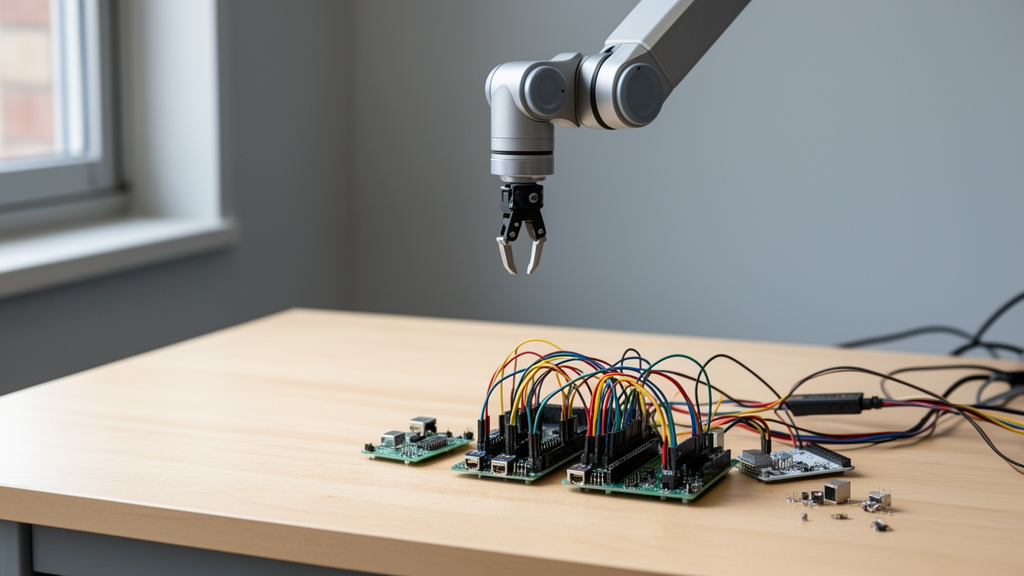
A prosthetic arm that never mistakes your intention for its own guesswork sounds like an obvious goal, but most gesture-controlled devices quietly fail at it. A typical myoelectric controller is what engineers call a closed-world system: it was trained on a handful of gestures, yet it assigns one of those labels to every incoming signal, even when the user is doing something completely untrained. The result is unintended actuation: a hand that closes when it should stay still. A team at MIT Art, Design and Technology University in Pune and Somaiya Vidyavihar University in Mumbai has now built and rigorously audited a low-cost control pipeline that knows when to say nothing, and their findings, published in Frontiers in Rehabilitation Sciences, are as much a lesson in honest measurement as they are a step toward safer prostheses.
The system, developed by Anagha Shinde, Virendra Shete and Ninad Mehendale, reads surface electromyography (sEMG): the faint electrical chorus of muscle fibres firing beneath the skin. Three consumer-grade MyoWare sensors were spaced equally around the forearm flexor group of healthy volunteers, digitised by a single Arduino Uno. Instead of relying on deep neural networks, the researchers used four classic time-domain features per channel: mean absolute value, root-mean-square amplitude, waveform length and zero crossings, feeding a Random Forest of 100 decision trees. It is a deliberately modest toolkit, computable in real time on cheap microcontrollers, and the entire 3D-printed prosthetic prototype, with five servo-driven fingers, came in at under 50 US dollars in materials.
The central innovation is not the classifier but what happens after it. Two stages of robustness filtering sit between the classifier and the motors. The first is a confidence gate: predictions are accepted only if the forest’s maximum class probability exceeds an operating threshold of 0.65, selected on a separate calibration partition. The second is temporal majority voting: accepted predictions accumulate in a buffer five predictions deep, and a command is issued only when the buffer is full, taking the plurality class. Isolated misfires are outvoted; low-confidence guesses are rejected outright; and if neither condition is met, the arm simply holds its last position.
To test it, the team built an unusually careful dataset. Thirteen limb-intact adults attended three sessions on separate days, generating 117 recordings of 120 seconds each, with 60 seconds of continuous gesture work followed by repeated sustained contractions and genuine rest. Segmentation in physical time, using 0.6-second windows with 0.2-second overlap, produced 21,294 analysis windows, of which 4,212 were true rest windows kept deliberately as negative examples. Alongside the live data, the pipeline was benchmarked on modelled synthetic sEMG and on the public Ninapro DB5 dataset, always trained and tested within each domain rather than pretending to measure transfer between them.
The evaluation itself is where the paper earns its credibility. A common shortcut in machine learning studies, splitting overlapping signal windows randomly between training and testing sets, secretly leaks information, because adjacent windows share raw samples. The team quantified exactly how misleading that shortcut is: a pooled window-level split inflated live accuracy by 7.7 percentage points compared with repetition-level separation, and by 18.3 points compared with leave-one-participant-out validation. Under the strictest, participant-disjoint protocol, the Random Forest reached 80.2 percent on synthetic data, 74.5 percent on Ninapro DB5 and 80.2 percent on live signals, topping four rival classifiers in every domain.
Perhaps the most striking statistic is how much this headline number hides. Per-participant accuracy ranged from 63.1 percent to 91.8 percent, a spread of 28.7 percentage points that dwarfs every difference between datasets. About 6.1 percentage points of the overall drop are attributable to electrode re-application between sessions and a further 4.5 points to generalising to a person the model has never seen. For a device meant to be calibrated once and worn daily, this user-to-user variability is the dominant engineering challenge, and the authors are explicit that pooled averages are inadequate for a system intended for individual use.
The team also interrogated the confidence score itself, and what they found should worry anyone who treats classifier confidence at face value. Random Forest probabilities are vote frequencies, compressed away from the extremes of the probability range, and the uncalibrated forest showed an expected calibration error of 0.147, meaning a nominal threshold of 0.65 does not correspond to a 65 percent chance of being right. A simple post-hoc correction, Platt scaling, reduced that error to 0.038. Open-set detection, measured separately against rest, electrode displacement and genuinely untrained movements, declined in that order: AUROC values of 0.842, 0.784 and 0.741 respectively. Crucially, the gate cannot fix what it cannot see. At the operating threshold, 7.4 percent of windows were confidently wrong, and roughly one in five inputs belonging to no trained class slipped through above threshold anyway.
So does the robustness layer work? A four-arm ablation on identical test windows answers precisely. The bare classifier issued a command for every window, producing a false actuation rate of 19.80 percent and 0.16 command switches per second. Confidence gating alone cut false actuation to 8.60 percent; voting alone to 9.40 percent; and the combination to 5.00 percent, with command switching collapsing by 87.5 percent and accepted-command accuracy rising from 80.2 to 95.0 percent. But the effects are not multiplicative, as the authors candidly note: a window rejected by the gate would often have been outvoted anyway, so the two mechanisms overlap rather than compound. The price is steep, too. Median gesture-to-command latency rose from 0.60 to 1.95 seconds, and measured gesture-to-visible actuation took about 2.5 seconds, at or beyond what users of myoelectric devices would consider responsive.
On the benchtop, the 3D-printed arm completed 12 of 15 actuation trials, an 80 percent success rate. The three failures are instructive. One hand-close command was blocked because the confidence gate rejected its onset windows, the gate working exactly as designed and imposing its cost on a genuine gesture. Two wrist-flexion trials failed after muscle fatigue attenuated the signal amplitude, pulling the features away from the training distribution. Both failure modes trace back to a fixed threshold applied to amplitude-sensitive features, pointing the authors toward adaptive thresholds and within-session recalibration as the next steps. Permutation importance confirmed that amplitude features, mean absolute value and RMS, carried 68 percent of the classification information, while zero crossings contributed least, consistent with the aliasing limitations of the 333.3-hertz-per-channel acquisition rate.
The authors are careful to frame this as a benchtop engineering proof of concept, not a clinical result. Three gestures, thirteen able-bodied participants, no amputees, no socket integration, no testing during walking, and fifteen benchtop trials cannot support claims of safety or deployment readiness. Yet the study’s real contribution may be methodological: it measures rejection behaviour, calibration, residual high-confidence errors and latency costs that most confidence-rejection studies leave unexamined, and it demonstrates that even a sub-50-dollar pipeline can suppress three-quarters of false actuations when it is allowed to be honest about its uncertainty. For a field racing toward smarter prostheses, the message is refreshingly counterintuitive: sometimes the most intelligent thing a machine can do is decline to act.
Subject of Research: Confidence-gated temporal voting for surface-EMG control of a low-cost prosthetic arm
Article Title: Confidence-gated temporal voting for EMG-based prosthetic arm control: a low-cost end-to-end pipeline with quantified rejection behaviour
Article References: Shinde, A., Shete, V., & Mehendale, N. (2026). Confidence-gated temporal voting for EMG-based prosthetic arm control: a low-cost end-to-end pipeline with quantified rejection behaviour. Frontiers in Rehabilitation Sciences, 7, Article 1864998. https://doi.org/10.3389/fresc.2026.1864998
Image Credits: AI Generated
DOI: 10.3389/fresc.2026.1864998
Keywords: surface electromyography, prosthetic arm, myoelectric control, random forest, confidence-based rejection, temporal majority voting, open-set recognition, probability calibration, leave-one-participant-out validation, false actuation, latency, rehabilitation engineering
Cite Scienmag News
Teresa Odom. (October 16, 2026). Cheap Sensors, Smarter Voting: A $50 Robotic Arm Learns When Not to Move. Scienmag. https://scienmag.com/cheap-sensors-smarter-voting-a-50-robotic-arm-learns-when-not-to-move/
Teresa Odom. "Cheap Sensors, Smarter Voting: A $50 Robotic Arm Learns When Not to Move." Scienmag, 16 October 2026, https://scienmag.com/cheap-sensors-smarter-voting-a-50-robotic-arm-learns-when-not-to-move/. Accessed 16 October 2026.
Teresa Odom. "Cheap Sensors, Smarter Voting: A $50 Robotic Arm Learns When Not to Move." Scienmag. October 16, 2026. https://scienmag.com/cheap-sensors-smarter-voting-a-50-robotic-arm-learns-when-not-to-move/


