

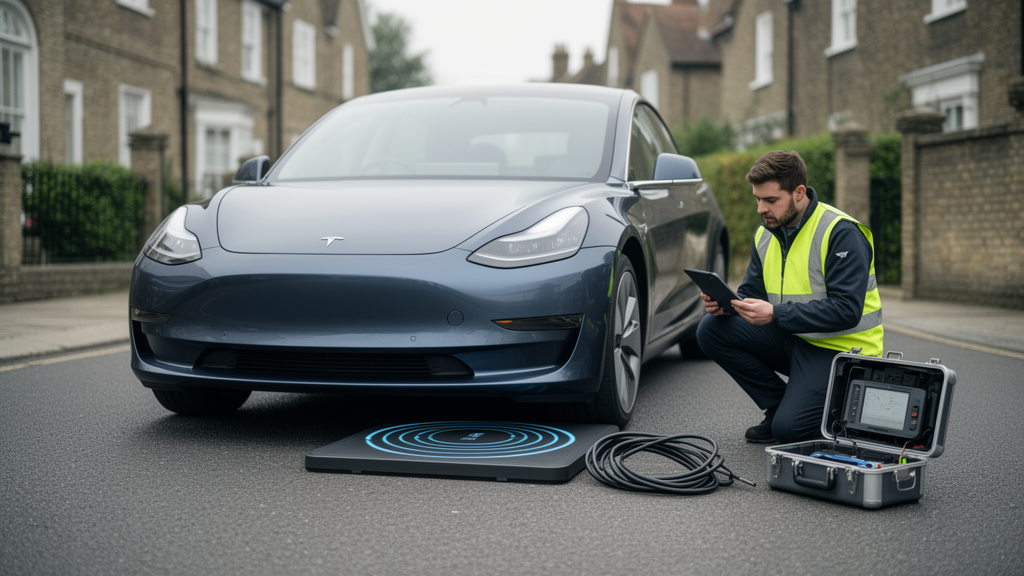
When engineers buried wireless charging plates beneath pavements in Milton Keynes, Marlow and the London Borough of Redbridge, they expected to prove a technology. What they got instead, according to a new study published in Frontiers in Sustainable Cities, was something arguably more valuable: a complete redefinition of the problem the technology was supposed to solve. The On-Street Residential Induction Charging (OSRIC) demonstrator, part of a £37 million UK investment in electric vehicle charging infrastructure, never achieved permanent adoption of its wireless chargers. Yet researchers Miguel Valdez and Matthew Cook of The Open University argue that the project’s real achievement lay in the dialogues, tensions and unexpected futures it surfaced in three very different English places.
The technical premise was elegant. Induction charging plates, hidden under the pavement and drawing power from the electricity supply already feeding lampposts, could transfer energy across an air gap of roughly 12 centimetres to vehicles fitted with a suitable adapter. The original design envisioned low-power 3 kW chargepoints that could be deployed at scale on public streets without adding clutter or forcing upgrades to the electricity distribution network. That mattered because around 30 percent of UK households lack allocated off-street parking, meaning some 10 million electric cars and vans would need to be charged overnight on-street by 2050 under government projections. Wireless charging promised a tidy answer to a messy urban problem.
The first charger went into the ground in August 2021, and wirelessly charged vehicles were available to the public for ten months. Forty-one unique users drove cars equipped with wireless charging capability, making 120 bookings across the three sites between August 2021 and July 2022. Fifteen users booked once, thirteen twice, and the three most enthusiastic made eleven bookings each. Most became repeat users despite early performance issues, sometimes hunting down alternative chargepoints when the wireless plate could not deliver enough charge to complete a planned trip. Public response was positive, and the project met its stated objective of demonstrating clutter-free on-street charging.
Then came the commercial reality. The cost structure of installation and the projected return on investment showed that even at scale, the design would not be financially viable. No location adopted the technology permanently, and the charging plates were removed immediately after the project concluded. On paper, that reads as failure. But Valdez and Cook, analyzing 25 semi-structured interviews and 33 surveys through reflexive thematic analysis, found that the demonstrator had revealed new aspects of the charging challenge in each location, and those revelations pointed toward solutions no one had anticipated when the project was conceived.
The researchers approached the case through an unusual analytical lens: curation. Just as a museum curator filters, organizes and cares for a story assembled from an infinite array of potential objects and voices, the actors surrounding an urban experiment selectively shape which futures appear plausible and desirable. This framing matters because urban experiments are profoundly political. When low-carbon futures involving genuine urban reconfiguration are framed as unreasonable, like-for-like replacement of combustion cars with electric ones becomes the default vision, potentially justifying continued road investment and perpetuating automobility rather than encouraging multimodal transport alternatives.
Four themes emerged from the analysis. The first was dialogue: the chargers became what the authors call sites of extended conversation between objects, places and publics. Local authorities did much of this relational labor, negotiating between national agendas and neighborhood-level knowledge from parish councils, residents’ associations and property developers. Publics were not passive recipients. Users joined deliberately, tolerated teething problems, and voiced their own challenges, from lack of parking to the pressures facing taxi drivers under London’s Ultra-Low Emission Zone. The technology became, in the researchers’ phrase, an evocative thing to think with.
The second theme was multiplicity. The same device meant different things in different places. In Marlow, a Victorian market town of 14,000 with 89 percent car ownership and scarce parking, surveys showed the wirelessly charged car-club vehicles appealed most to two-driver households with a single car, suggesting shared electric vehicles could replace underused second cars. In Milton Keynes, a city founded in 1967 to showcase new ways of urban living, authorities framed wireless charging within a portfolio of technologies at neighborhood charging hubs. In Redbridge, where installation required digging one-cubic-metre access chambers and residents showed limited tolerance for disruption, the borough ultimately updated its strategy toward wired lamppost chargers and rapid chargepoints for taxis and ride-hailing fleets.
The third theme, tension and disruption, proved unexpectedly generative. The original plan called for adapters that residents could fit to their own vehicles, but designing a functional kit for even one make of car revealed that supporting every model would be a major undertaking. Pandemic-related supply chain disruptions meant the consortium could secure parts for only ten adapters instead of the 45 envisioned. Forced to redefine the problem, the team pivoted to shared wirelessly charged vehicles, and a single car in Marlow ended up serving 41 drivers. The disruption nudged participants away from private car ownership toward shared mobility, a shift the original design had never intended to encourage.
The fourth theme was care, in the curatorial sense of the word derived from the Latin for taking care of. Unlike the move-fast-and-break-things ethos of Silicon Valley, the OSRIC actors practiced what the authors describe as careful, controlled disruption. Local authorities planned for failure: funds were set aside to remove the plates, and alternative transport was provisioned in case residents grew dependent on a time-bound demonstrator. In Milton Keynes, parish councilors made their acceptance of the chargers conditional on better public transport, prompting a Demand Responsive Transport scheme that outlived the project itself. Care, the study suggests, is not sentimental softness but the labor of maintaining and repairing the world while experimenting within it.
The broader lesson challenges how we judge urban experiments. Success was not measured in market creation or technical optimization but in restructuring the original problem. The solutions that ultimately emerged in each site relied on relatively low-technology approaches, such as wired chargers and through-pavement channels with hinged lids that let cables cross pavements without creating trip hazards, combined with changes in practices and patterns of automobility. The authors caution that their findings come from a single multi-site case in the South of England with only 41 users, so generalisability remains an open question. Still, their conclusion is striking: transformative urban futures may emerge not when demonstrators broadcast a pre-defined vision, but when they become sites of dialogue where cities learn from their publics, and where a failed technology can still illuminate the path forward.
Subject of Research: A qualitative case study of a wireless electric vehicle charging demonstrator in England analyzed through a curatorial framework to understand how urban experiments reshape problems and futures.
Article Title: How urban experiments redefine problems, imaginaries and futures: a case study on wireless charging in London and South of England
Article References: How urban experiments redefine problems, imaginaries and futures: a case study on wireless charging in London and South of England. (n.d.). https://doi.org/10.3389/frsc.2026.1884518
Image Credits: AI Generated
DOI: 10.3389/frsc.2026.1884518
Keywords: urban experiments, wireless EV charging, electric vehicles, OSRIC demonstrator, curation, sustainable cities, sociotechnical imaginaries, Milton Keynes, Redbridge, transport policy, reflexive thematic analysis, urban futures
Cite Scienmag News
Scienmag. (October 16, 2026). Wireless EV chargers failed in England, but the experiment rewrote the problem itself. https://scienmag.com/wireless-ev-chargers-failed-in-england-but-the-experiment-rewrote-the-problem-itself/
Scienmag. "Wireless EV chargers failed in England, but the experiment rewrote the problem itself." Scienmag, 16 October 2026, https://scienmag.com/wireless-ev-chargers-failed-in-england-but-the-experiment-rewrote-the-problem-itself/. Accessed 16 October 2026.
Scienmag. "Wireless EV chargers failed in England, but the experiment rewrote the problem itself." Scienmag. October 16, 2026. https://scienmag.com/wireless-ev-chargers-failed-in-england-but-the-experiment-rewrote-the-problem-itself/


