


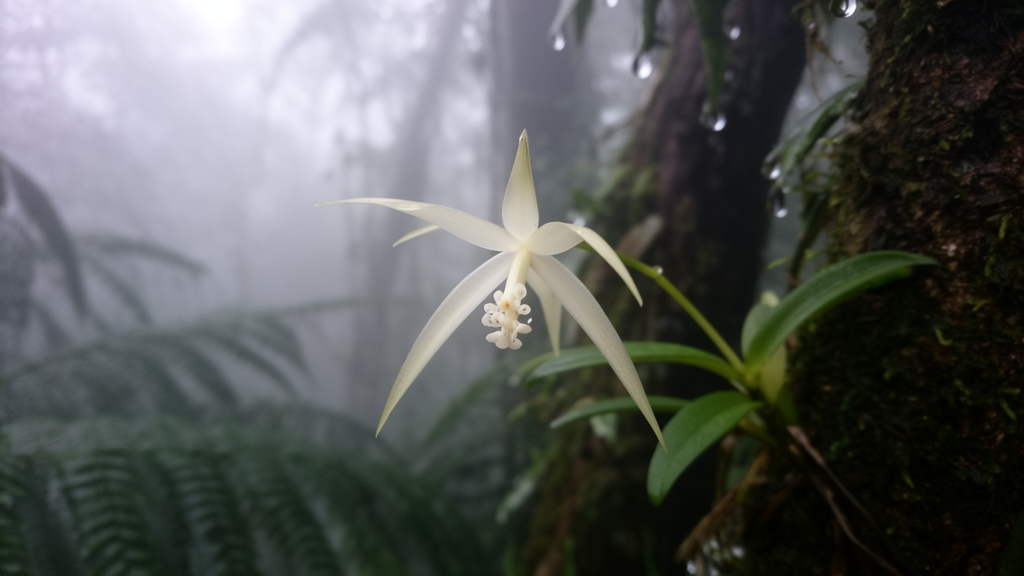
High in the moss-draped cloud forests of Cameron Highlands, botanists have identified a delicate new orchid species that had been hiding in plain sight among the epiphytes coating mountain ridges nearly two thousand metres above sea level. The plant, formally described in the journal PhytoKeys as Ceratostylis wanrosdyi, is an epiphytic orchid barely six centimetres tall, bearing pure white, partially translucent flowers on slender, thread-like stalks that stretch almost as long as the leaves themselves. Its discovery brings the number of Ceratostylis species recorded in Peninsular Malaysia to thirteen and underscores how much undiscovered diversity still clings to the trunks and branches of Southeast Asia’s montane forests.
The genus Ceratostylis is widespread, ranging from the eastern Himalayas through tropical Asia and Malesia to the western Pacific. Its roughly 153 species are predominantly epiphytes of lowland to montane forests, distinguished by tufted or elongated stems, fleshy leaves, terminal single-flowered inflorescences, and flowers that carry eight pollinia rather than the four typical of many orchids. The genus name itself refers to a distinctive anatomical feature: a bilobed, horned column, derived from the Greek words keras, meaning horn, and stylis, meaning style. Species formerly placed in the genus Sarcostoma have since been folded into Ceratostylis, reflecting ongoing refinement of orchid classification.
The new species was encountered during recent botanical exploration in the mossy montane forest of Cameron Highlands, in the state of Pahang. Researchers noticed a small orchid with elongate peduncles nearly matching the leaves in length and completely white flowers equipped with an entire, oblong-lanceolate labellum. Detailed morphological examination, combined with comparison against taxonomic literature and herbarium specimens from multiple institutions, confirmed that the material represented a species previously unknown to science. The type specimen was collected on 30 October 2025 at approximately 2,000 metres elevation, with precise coordinates withheld for conservation purposes, and deposited in the herbarium of the Department of Biology at Universiti Putra Malaysia.
What sets Ceratostylis wanrosdyi apart is a combination of vegetative and floral characters that, taken together, separate it cleanly from its closest relatives. Its leaves are narrowly elliptic, measuring just 2.4 to 3.5 centimetres long and about 3 millimetres wide, with an unevenly bilobed apex. The peduncle, at roughly 2.3 centimetres, is nearly as long as the leaf at anthesis. The labellum, or lip, is entire rather than lobed, broadly lanceolate, and uniformly white. Each of these traits diverges from the pattern seen in related species, and the authors provide a detailed diagnostic comparison and a revised identification key to all Ceratostylis species in Peninsular Malaysia to help future researchers separate them.
The species most closely resembles three white-flowered congeners with narrow petals: the widespread C. radiata, the Peninsular Malaysian endemic C. pulchella, and the Bornean endemic C. longisegmenta. Yet the differences are striking when measured. C. radiata carries narrowly lanceolate leaves up to 16 centimetres long with a peduncle of only about 1 centimetre and a three-lobed labellum. C. pulchella has linear leaves of 12 to 20 centimetres and a peduncle around 4 centimetres. C. longisegmenta bears narrowly oblong leaves of roughly 10.5 centimetres. In all three, the labellum is trilobed, whereas the new species has a single, unbroken, broadly lanceolate lip. Petal texture differs as well: C. wanrosdyi has membranous sepals and petals but a fleshy labellum, while its relatives show different combinations of fleshiness across the perianth.
One particularly intriguing biological detail emerged during observation: the peduncle of C. wanrosdyi elongates progressively as the flower develops. At the budding stage it is shorter than the leaf, but by the time the flower opens it nearly equals or slightly exceeds the leaf in length. This dynamic growth pattern adds a temporal dimension to a character that taxonomists typically record as a static measurement, and it may explain why such plants could be misidentified at different developmental stages. The species flowers in August and October, and some collected plants were cultivated ex situ to obtain additional floral material for study, while others were preserved as dried and liquid-preserved vouchers, with flowers stored in Copenhagen solution to maintain delicate structures for microscopic examination.
Habitat details reveal a species tightly bound to a specific and vulnerable ecosystem. C. wanrosdyi grows as an epiphyte on moss-covered trunks and lower branches at elevations of 1,800 to 2,000 metres, on exposed ridges and in partially shaded spots within montane cloud forest. Documented host trees include Clethra hendersonii and several species of Lithocarpus, with individuals on C. hendersonii observed about two metres above the ground. The new orchid occurs sympatrically with C. eria, another epiphytic species characteristic of this habitat, which it superficially resembles in its elongate peduncles and white flowers but from which it differs in leaf dimensions, labellum size, and colouration, since C. eria’s lip is green with two dark brown blotches.
The formal description follows rigorous modern methods. Researchers examined minute floral structures using a digital microscope camera, verified nomenclature against the Plants of the World Online database, and compared digitised specimens accessed through multiple herbaria and the Global Biodiversity Information Facility. A preliminary conservation assessment was conducted following the IUCN Red List Categories and Criteria, with the extent of occurrence and area of occupancy estimated using the GeoCAT tool at the recommended 2 by 2 kilometre grid scale. The species is currently known from only two localities, both in Cameron Highlands, giving an estimated area of occupancy of just 8 square kilometres.
That restricted distribution, combined with accessible habitat, has led to a provisional assessment of Endangered under IUCN criterion B2. Although the type locality lies within a protected forest reserve, it sits in a popular recreational and ecotourism area frequented by visitors, and the second subpopulation likewise occurs in accessible montane forest. The main plausible threat is localised habitat disturbance from tourism infrastructure, trail maintenance, and recreational use, any of which could alter the humid microclimatic conditions that epiphytic orchids require. The accessibility of both sites also raises the risk of illegal collection, a well-documented pressure on wild orchid populations, particularly rare epiphytes growing near recreational facilities. Because the two subpopulations are treated as two separate locations under IUCN definitions, the species does not meet the stricter threshold for Critically Endangered, but the assessment notes an inferred continuing decline in habitat quality.
The species name honours Dato’ Sri Diraja Haji Wan Rosdy bin Wan Ismail, the Menteri Besar of Pahang, in recognition of his support for biodiversity exploration, conservation, and environmental stewardship in the state, including his role in approving the establishment of the UNESCO Man and the Biosphere Mossy Forest in Cameron Highlands in 2024, which encompasses the orchid’s habitat. Beyond the honour, the designation highlights a broader truth: the cloud forests of Peninsular Malaysia remain a frontier of botanical discovery, where a plant no larger than a matchbox can evade science until someone looks closely at a mossy branch. Protecting these humid ridge-top habitats, the authors’ work suggests, is not only a conservation obligation but a prerequisite for finding what else may still be growing there unnoticed.
Subject of Research: Taxonomic description and conservation assessment of a new epiphytic orchid species, Ceratostylis wanrosdyi, from montane cloud forest in Peninsular Malaysia
Article Title: Ceratostylis wanrosdyi ( Orchidaceae ), a new species from Peninsular Malaysia
Article References: Mad Jabar, Q. A., Besi, E. E., Mat Esa, M. I., Tan, S. H., Sandin, D., Yong, C. S. Y., Rani, R., Jamaluddin, Z., Akeng, G., Amaludin, N. A., & Go, R. (2026). Ceratostylis wanrosdyi (Orchidaceae), a new species from Peninsular Malaysia. PhytoKeys, 279, 245-254. https://doi.org/10.3897/phytokeys.279.206002
Image Credits: AI Generated
DOI: 10.3897/phytokeys.279.206002
Keywords: Ceratostylis wanrosdyi, orchid, new species, Cameron Highlands, Malaysia, epiphyte, cloud forest, taxonomy, IUCN Endangered, PhytoKeys, montane biodiversity, conservation
Cite Scienmag News
Margaret Porter. (October 16, 2026). Ghostly White Orchid Discovered in Malaysia’s Cloud Forests Named Ceratostylis wanrosdyi. Scienmag. https://scienmag.com/ghostly-white-orchid-discovered-in-malaysias-cloud-forests-named-ceratostylis-wanrosdyi/
Margaret Porter. "Ghostly White Orchid Discovered in Malaysia’s Cloud Forests Named Ceratostylis wanrosdyi." Scienmag, 16 October 2026, https://scienmag.com/ghostly-white-orchid-discovered-in-malaysias-cloud-forests-named-ceratostylis-wanrosdyi/. Accessed 16 October 2026.
Margaret Porter. "Ghostly White Orchid Discovered in Malaysia’s Cloud Forests Named Ceratostylis wanrosdyi." Scienmag. October 16, 2026. https://scienmag.com/ghostly-white-orchid-discovered-in-malaysias-cloud-forests-named-ceratostylis-wanrosdyi/


