


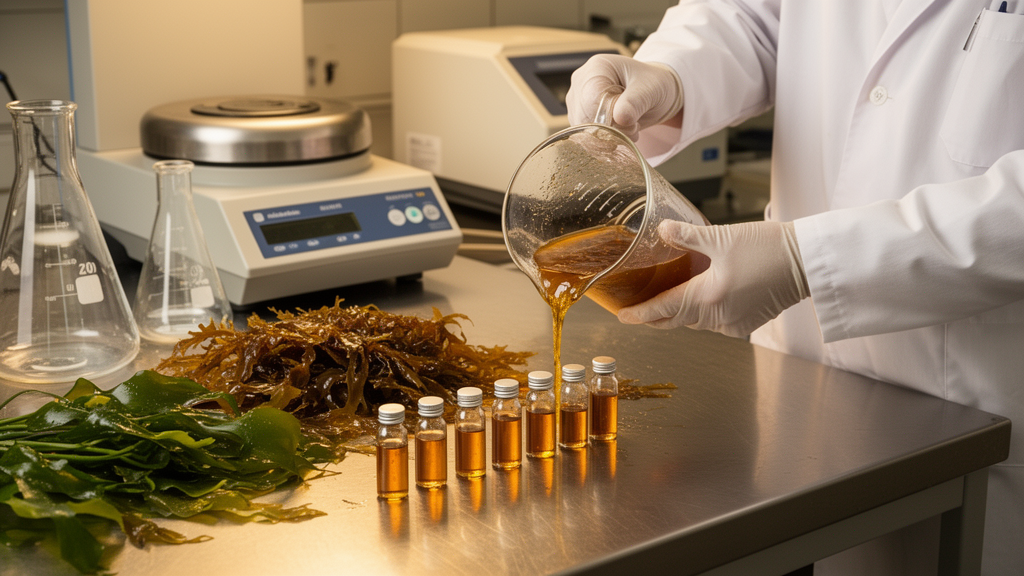
A tropical brown seaweed harvested from the rocky shores of Pangandaran, West Java, has become the centerpiece of a meticulous statistical study that challenges a long-standing assumption in natural-product chemistry: that extracting more material from a plant automatically means extracting more of what matters. Researchers who optimized two classic extraction techniques for Sargassum polycystum found that the conditions producing the greatest mass of extract were not the conditions producing the strongest antioxidant activity, a trade-off with real consequences for anyone hoping to turn marine algae into nutraceuticals, cosmetics, or pharmaceuticals.
The team, publishing in the journal Pharmacia, collected fresh Sargassum polycystum from the east coast of Pangandaran at coordinates 7°42’22.5″S, 108°39’50.3″E, and had the material authenticated as Sargassaceae by the Herbarium Jatinangor at Universitas Padjadjaran. Forty kilograms of fresh algae were cleaned, dried at 40 °C for 24 hours, ground, and sieved, yielding just 2.6 kilograms of dried powder, a dry-material recovery of 6.50 percent. Crucially, a single common batch of this powder fed both extraction experiments, ensuring that any differences between the two methods reflected processing rather than raw-material variability.
Sargassum polycystum is a chemically rich target. Like other brown algae, it contains phlorotannins and other phenolic compounds capable of donating electrons or hydrogen atoms to neutralize free radicals, along with flavonoids, pigments, polysaccharides, and sterol-related metabolites. Brown algal cell walls, however, are formidable barriers: alginates, sulfated polysaccharides, cellulose, and proteins restrict solvent penetration and can slow the release of intracellular constituents. This structural complexity means that a high extraction yield, which simply measures total soluble mass, may largely reflect dissolved polysaccharides, salts, and pigments rather than the phenolic and flavonoid constituents that drive antioxidant quality.
To disentangle these effects, the researchers ran two independent three-factor, three-level Box–Behnken designs, each with 15 extraction runs including three independently prepared center points to estimate pure experimental error. Reflux extraction was tested across temperatures of 50 to 70 °C, durations of 1 to 3 hours, and solid-to-solvent ratios of 1:5 to 1:15, with particle size fixed at 60 mesh and 96 percent ethanol as the solvent. Maceration, the gentle room-temperature alternative, was tested across 24 to 72 hours, particle sizes of 40 to 80 mesh, and the same ratio range at 25 ± 2 °C. Four responses were tracked for every run: extraction yield, total phenolic content (TPC), total flavonoid content (TFC), and radical-scavenging potency expressed as the DPPH IC50, the concentration needed to quench half of the DPPH radicals in the assay.
The observed ranges told the first part of the story. Reflux produced yields of 5.46 to 15.38 percent, with the maximum at 60 °C, 2 hours, and a 1:10 ratio, while maceration spanned 2.01 to 15.30 percent, peaking after 72 hours at 60 mesh and 1:15. But the quality responses inverted the picture. Maceration achieved the highest phenolic content of the entire study, 62.98 mg gallic acid equivalents per gram of extract, and by far the strongest DPPH activity, with an IC50 of just 36.19 µg/mL, both at 24 hours, 80 mesh, and 1:10. Reflux peaked at 53.05 mg GAE/g and an IC50 of 98.66 µg/mL, notably at its mildest condition of 50 °C and 1 hour. In both designs, the recipe for maximum yield was a different recipe from the recipe for maximum antioxidant quality.
The statistical models behind these observations were robust. All eight response models, four per method, were significant, with p-values ranging from 0.001 to 0.006, and lack-of-fit tests were non-significant throughout, indicating the second-order models adequately represented the design space. R² values ranged from 81.78 to 99.16 percent. The dominant factors were revealing: extraction temperature carried the largest F-values among the reflux factors, while extraction time dominated every maceration response. The researchers also flagged an important caveat, noting that predicted R² values for the bioactive responses were substantially lower than adjusted R² values, particularly for reflux, signaling limited out-of-sample precision for TPC, TFC, and IC50 even when the models fit the observed data well.
Desirability-based multi-response optimization then translated the models into recommended operating points. For reflux, the optimum landed at 50.404 °C, 1.0404 hours, and a ratio of approximately 1:9.55, with a composite desirability of 0.663. Validation runs using three independently prepared extractions delivered a 10.32 percent yield, 39.68 mg GAE/g TPC, 33.24 mg QE/g TFC, and an IC50 of 109.25 µg/mL, all within the corresponding 95 percent confidence and prediction intervals. For maceration, the optimum was 24 hours, 80 mesh, and roughly 1:5.30, with a higher composite desirability of 0.704. Validation produced a 5.54 percent yield, 59.39 mg GAE/g TPC, 38.03 mg QE/g TFC, and an IC50 of 55.66 µg/mL, again within intervals, though the maceration IC50 prediction interval was wide, reflecting genuine uncertainty in that estimate.
The most consequential insight emerged when the team normalized results to the starting biomass rather than to the extract itself. Because the optimized maceration extract was more concentrated but obtained at lower yield, reflux actually recovered more total antioxidant-related material per unit of seaweed: an estimated 409.50 mg of gallic acid equivalents and 343.04 mg of quercetin equivalents per 100 grams of dry algae, versus 329.02 and 210.69 mg respectively for maceration. In other words, the choice between methods is not a simple ranking but a decision about the goal. If the priority is a concentrated, potent extract per gram, maceration wins. If the priority is stripping the maximum phenolic and flavonoid payload from a given harvest of biomass, reflux wins, provided temperature and duration are kept mild to protect thermolabile constituents.
The mechanistic explanation fits the physics of each process. Reflux accelerates mass transfer through controlled heating and continuous solvent condensation, but heat is a double-edged sword, since elevated temperatures and prolonged exposure can degrade phenolic and flavonoid structures. That is why reflux quality peaked at its gentlest setting. Maceration relies on passive diffusion, and grinding the seaweed to 80-mesh powder shortened diffusion pathways and increased contact area, allowing phenolics to be recovered within 24 hours. Extending maceration to 72 hours pulled more total soluble material into solution, inflating yield, but the additional mass was evidently not proportional phenolic content, and prolonged contact risks oxidation or degradation of compounds already released.
The authors are careful about the limits of their claims. Qualitative phytochemical screening of representative extracts confirmed reagent-reactive phenolics, flavonoids, tannins, saponins, and steroidal or triterpenoid constituents, with alkaloid reactions depending on the reagent used, but these colorimetric and precipitation tests are group-level indicators, not compound identifications. The Folin–Ciocalteu and aluminum chloride assays quantify equivalent classes rather than specific phlorotannins, and DPPH measures chemical radical scavenging under defined solvent conditions, not activity in living cells. The team recommends chromatographic profiling by HPLC-DAD or LC-MS to link process conditions to individual constituents, additional assays such as ABTS, FRAP, or ORAC to broaden the antioxidant picture, and quantification of residual solvent in future standardization work.
Even with those caveats, the study offers a practical blueprint for a growing industry. Indonesia’s extensive tropical coastline holds substantial Sargassum resources, and brown algae are increasingly pursued for antioxidant, anti-inflammatory, antidiabetic, and neuroprotective applications. The finding that reflux and maceration should be treated as complementary rather than interchangeable options, each with its own validated optimum, gives process developers a defensible starting point. The researchers suggest that future work should explore assisted extraction technologies and green-process metrics, including solvent consumption and energy demand, to push these conventional methods toward more sustainable production. For now, the message from Pangandaran is clear: in seaweed chemistry, what you extract and how much you extract are two different questions, and answering only one of them can leave the real prize in the pot.
Subject of Research: Multi-response optimization of reflux and maceration extraction of bioactive compounds from the brown alga Sargassum polycystum
Article Title: Parallel multi-response optimization of reflux and maceration extraction of Sargassum polycystum from the east coast of Pangandaran using Box–Behnken design
Article References: Susanti, S., Fisabilah, A., Kamil, I., Adlina, S., Rizkuloh, L. R., Mardianingrum, R., & Singgih, M. (2026). Parallel multi-response optimization of reflux and maceration extraction of Sargassum polycystum from the east coast of Pangandaran using Box–Behnken design. Pharmacia, 73, Article e209685. https://doi.org/10.3897/pharmacia.73.e209685
Image Credits: AI Generated
DOI: 10.3897/pharmacia.73.e209685
Keywords: Sargassum polycystum, brown algae, extraction optimization, response surface methodology, Box–Behnken design, antioxidant activity, total phenolic content, total flavonoid content, DPPH assay, reflux extraction, maceration, Pangandaran
Cite Scienmag News
Ophelia Keating. (October 16, 2026). Seaweed Extraction Study Reveals a Surprising Trade-Off Between Yield and Antioxidant Power. Scienmag. https://scienmag.com/seaweed-extraction-study-reveals-a-surprising-trade-off-between-yield-and-antioxidant-power/
Ophelia Keating. "Seaweed Extraction Study Reveals a Surprising Trade-Off Between Yield and Antioxidant Power." Scienmag, 16 October 2026, https://scienmag.com/seaweed-extraction-study-reveals-a-surprising-trade-off-between-yield-and-antioxidant-power/. Accessed 16 October 2026.
Ophelia Keating. "Seaweed Extraction Study Reveals a Surprising Trade-Off Between Yield and Antioxidant Power." Scienmag. October 16, 2026. https://scienmag.com/seaweed-extraction-study-reveals-a-surprising-trade-off-between-yield-and-antioxidant-power/


