


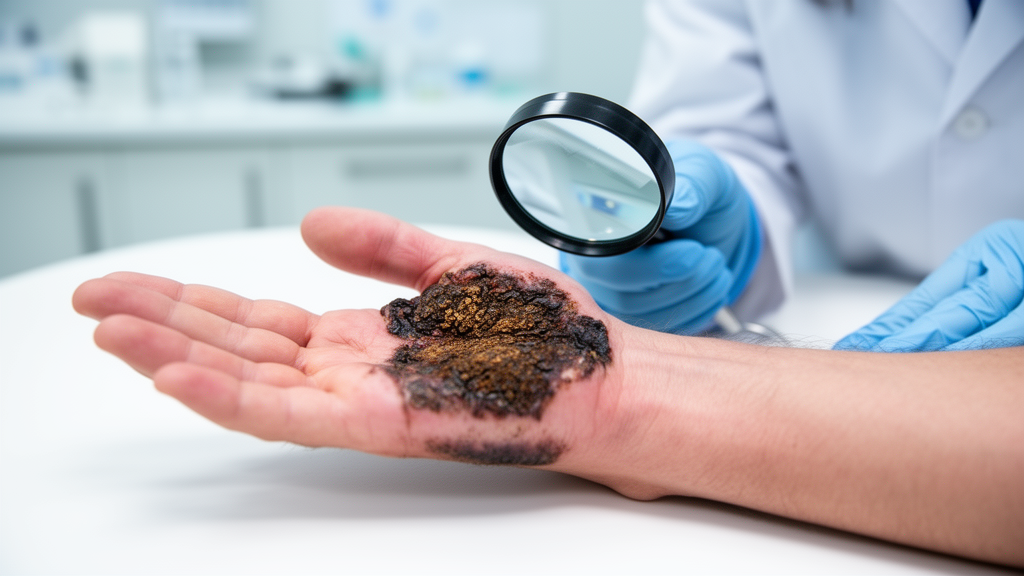
A fungus so new to science that it was only described in 2019 has now been identified inside a human patient for the first time. In a case report published in BMC Infectious Diseases, physicians and researchers at the University of Miami, the Bruce W. Carter Veterans Affairs Healthcare System, and the University of Washington describe how Gloniopsis leucaenae, a mold previously known only from plant material in Thailand, was recovered from a persistent swelling on the back of a Florida landscaper’s hand. The finding is a striking reminder that the boundary between plant pathology and human medicine is far more porous than most clinicians assume, and that fungi once confined to agricultural settings can cross into people with little warning.
The patient was a 68-year-old man who had spent his career working outdoors with plants and soil. He lived in Florida, had no history of international travel, and was being treated with vedolizumab, a targeted biologic medication for Crohn’s disease that selectively blocks a gut-homing molecule on white blood cells. Unlike broad immunosuppressants, vedolizumab is considered relatively gut-specific, and the patient was, for practical purposes, fairly immunocompetent. He presented with a swelling on the dorsal aspect of his hand, a location entirely consistent with his occupational exposure to thorns, splinters, and plant debris.
Surgeons performed an excisional biopsy, and the pathology told an unusual story. Under the microscope, the lesion was a subcutaneous phaeohyphomycosis, an infection caused by pigmented, or dematiaceous, fungi that form dark-walled hyphae in tissue. Critically, the inflammatory reaction appeared to be nucleated by a fragment of plant matter, suggesting that a splinter or similar vegetative foreign body had carried the fungus beneath the skin and seeded the infection. This mechanism, known as inoculation through traumatic implantation, is the classic route by which environmental molds gain access to the subcutaneous tissues of gardeners, farmers, and foresters.
Identifying the organism required more than conventional microbiology. Broad-range polymerase chain reaction, a technique that amplifies conserved fungal genetic regions and compares the resulting sequence against reference databases, pinpointed the culprit as Gloniopsis leucaenae. The genus Gloniopsis belongs to the class Dothideomycetes, a large and diverse group of fungi that includes many plant pathogens. Before this case, G. leucaenae had been isolated in 2019 and reported exclusively from plant matter in Thailand. Its appearance in a human hand in Florida, in a patient who had never left the United States, was entirely unexpected.
The clinical course added another layer of complexity. The initial lesion was excised surgically, and no antifungal therapy was given, a reasonable approach when an infection is thought to be fully removed. Yet a second lesion subsequently arose at the site and had to be excised as well. On histology, fungal hyphae were again demonstrated, but this time both culture and PCR came back negative, a pattern that can occur when the fungal burden is low, when prior surgery has disrupted the organism, or when laboratory conditions fail to support growth. Faced with evidence of recurrence, the team initiated empiric treatment with itraconazole, an azole antifungal commonly used against pigmented molds because of its reliable activity against this group.
The case carries particular significance when set against the only other documented Gloniopsis infection in humans. A prior report involved a related species that caused disseminated disease in an immunocompromised host, spreading beyond the initial site and posing a serious systemic threat. The new report stands in contradistinction to that picture: G. leucaenae caused a localized infection in a relatively immunocompetent individual, apparently contained by surgical excision with antifungal coverage added for security. This contrast suggests that different Gloniopsis species, and different host immune states, can produce dramatically different disease spectra, ranging from a contained subcutaneous nodule to widespread disseminated infection.
For the authors, one of the most important lessons is geographic. A pathogen described on one continent caused an infection on another, in a patient with no identifiable travel history. How G. leucaenae reached Florida remains unknown, but the plausible explanations point to forces reshaping the microbial world. Global trade networks move plants, soil, timber, and agricultural products across oceans at unprecedented speed, and microscopic fungi hitchhike readily in these shipments. Climate change simultaneously alters temperature and rainfall patterns, expanding the ecological niches available to environmental molds and allowing them to establish populations far from where they were first catalogued. A fungus described from Thai plant material may now be living quietly in North American soil or vegetation, awaiting the right opportunity to inoculate a human host.
The report also underscores the diagnostic challenges posed by rare fungal infections. Phaeohyphomycosis itself is uncommon, and when it occurs, the causative agents span dozens of dematiaceous genera, including Alternaria, Exophiala, Bipolaris, and Curvularia. Traditional identification by morphology and culture is slow and often imprecise, and many environmental fungi fail to grow at all in the laboratory. Molecular methods such as broad-range PCR and sequencing have become indispensable, as they were here, where the organism would likely have remained nameless without genetic analysis. The authors argue that clinicians need to broaden the differential diagnosis for fungal infections, considering organisms that were previously regarded strictly as plant pathogens, particularly in patients with occupational or recreational exposure to vegetation.
There is also a pharmacological dimension worth noting. Vedolizumab, the biologic the patient was taking, is designed to minimize systemic immunosuppression by targeting the alpha-4-beta-7 integrin and limiting lymphocyte trafficking to the gut. Its safety profile is generally favorable with respect to opportunistic infections, which makes the appearance of an invasive fungal lesion in this patient noteworthy, even if the plant-matter inoculation likely explains the infection more directly than the medication does. The case raises open questions about whether gut-selective biologics alter skin-level fungal immunity in subtle ways, or whether the exposure burden of landscaping work simply overwhelmed local defenses. The report does not resolve this, but it flags the interaction between modern immunomodulatory therapies and environmental pathogens as an area deserving closer study.
Ultimately, the first human case of Gloniopsis leucaenae infection is less a story about one patient than about the changing map of fungal disease. Fungi are emerging as significant human pathogens at a growing pace, driven by international commerce, shifting climates, expanding immunosuppressed populations, and better molecular detection. Most Dothideomycetes will never harm a person, but the ones that occasionally do tend to arrive unannounced, hiding in a splinter of wood or a handful of soil. The Miami team’s careful integration of surgery, histopathology, and sequencing turned an anonymous hand swelling into a documented first, and their message to clinicians is clear: when a pigmented fungal infection appears, especially in someone who works with plants, the list of possible culprits is longer, and more global, than ever before.
Subject of Research: First human case of cutaneous phaeohyphomycosis caused by the plant-associated fungus Gloniopsis leucaenae
Article Title: Cutaneous phaeohyphomycosis with the recently described fungus Gloniopsis leucaenae: first case report
Article References: Cutaneous phaeohyphomycosis with the recently described fungus Gloniopsis leucaenae: first case report. (n.d.). https://doi.org/10.1186/s12879-026-14551-5
Image Credits: AI Generated
DOI: 10.1186/s12879-026-14551-5
Keywords: Gloniopsis leucaenae, phaeohyphomycosis, fungal infection, Dothideomycetes, vedolizumab, broad-range PCR, itraconazole, plant pathogen, emerging infectious disease, case report, Florida, climate change
Cite Scienmag News
Roger Howard. (October 16, 2026). Plant Fungus Gloniopsis leucaenae Infects Human Hand in First Reported Case. Scienmag. https://scienmag.com/plant-fungus-gloniopsis-leucaenae-infects-human-hand-in-first-reported-case/
Roger Howard. "Plant Fungus Gloniopsis leucaenae Infects Human Hand in First Reported Case." Scienmag, 16 October 2026, https://scienmag.com/plant-fungus-gloniopsis-leucaenae-infects-human-hand-in-first-reported-case/. Accessed 16 October 2026.
Roger Howard. "Plant Fungus Gloniopsis leucaenae Infects Human Hand in First Reported Case." Scienmag. October 16, 2026. https://scienmag.com/plant-fungus-gloniopsis-leucaenae-infects-human-hand-in-first-reported-case/


