


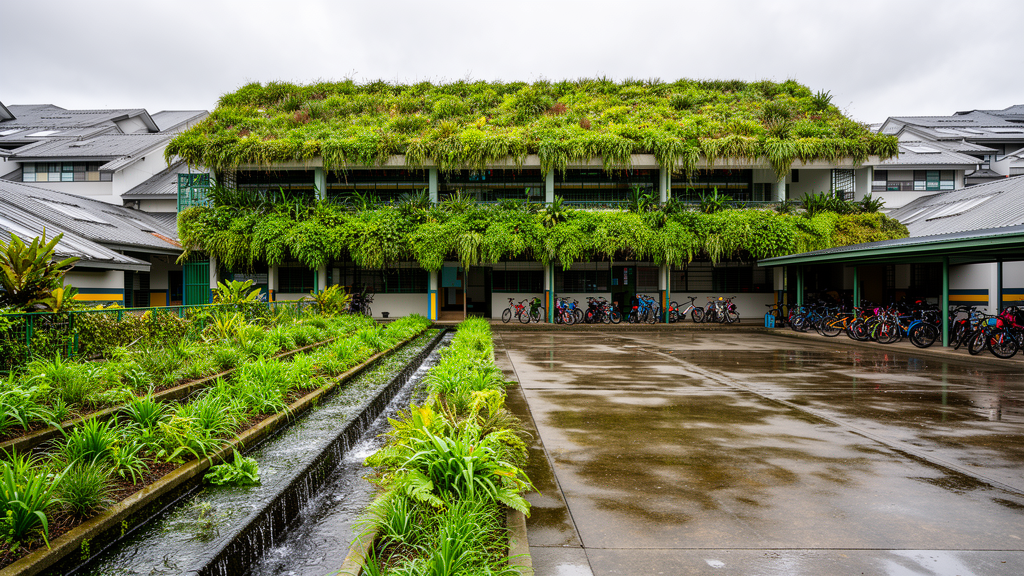
In the coastal city of Durán, Ecuador, a school called Ciudad de Nazareth has a problem that repeats itself every rainy season. Water pools in courtyards, seeps into classrooms, blocks access routes and turns daily lessons into an exercise in endurance. The city sits on flood-prone alluvial terraces in the lower reaches of the Guayas River basin, and roughly a quarter of its urban area suffers chronic flooding. Yet like many fast-growing tropical cities, Durán has almost no hydrometric data — no long records of flow or water depth — to guide drainage decisions. A new study published in Frontiers in Water shows how a research team tackled that data gap by pairing community knowledge with a widely used hydrological model, and the results offer a strikingly practical blueprint for flood-proofing schools across the urban tropics.
The research, led by Joao Calle-Espinoza of the Escuela Superior Politécnica del Litoral (ESPOL) and colleagues, focused on what the team calls vulnerable educational infrastructure, or VEI. Schools are particularly exposed to rainwater flooding because standing water disrupts teaching, limits safe movement, damages sanitation facilities and exposes children and teachers to unhealthy conditions. Flooding of schools also carries an equity dimension: studies in the United States have linked flood-prone schools to socio-economic disadvantage, and multi-hazard assessments show that flooding can damage buildings, cut accessibility and interrupt education. In Durán, where 143 educational institutions serve more than 67,000 students, the stakes are considerable.
The team’s approach combined two ingredients that are rarely brought together so systematically. The first was a participatory workshop held in October 2025 with 28 members of the school community — parents and teachers selected from an accessible population of 36 representatives using a finite-population sampling calculation. Through participatory mapping and group discussion, participants identified where water repeatedly accumulates, how deep it gets, how long it lingers and which classrooms and walkways suffer most. They named missing internal drainage, debris-clogged drains, inadequate infrastructure and local weather as the main culprits, and they ranked a sustainable drainage intervention as their preferred solution. The second ingredient was the U.S. Environmental Protection Agency’s Storm Water Management Model, or SWMM, a well-established event-based framework for simulating urban runoff, drainage-network flow, surface ponding and green-infrastructure controls.
To build the model, the researchers used drone imagery processed into a digital elevation model, then delineated the school’s drainage system in QGIS. The modeled area covered just 0.2721 hectares, divided into 23 subcatchments representing roofs and other runoff-generating surfaces, connected through 15 nodes and 11 conduits. One node served as the main outlet and hydraulic control point, while three auxiliary outfalls represented roof drainage that discharges directly onto surrounding streets. The model’s continuity errors were tiny — mean runoff errors below 0.26 percent — indicating numerically stable simulations. Importantly, the authors are explicit that SWMM was not treated as a calibrated predictive tool but as a comparative framework: the same rainfall forcing was applied to a baseline and to intervention scenarios, so differences in output could be attributed to the interventions themselves.
That rainfall forcing came from 15 synthetic design storms built from a regionalised intensity-duration-frequency relationship for coastal Ecuadorian provinces, distributed in time using the Chicago method at five-minute intervals. The storms combined return periods of 5, 10 and 20 years with durations from 30 minutes to 4 hours, producing total depths ranging from about 40 millimeters for the shortest, most frequent event to nearly 115 millimeters for the longest, rarest one. Local records from the INAMHI meteorological station underscored the urgency: February 2025 alone delivered 618.4 millimeters of rain, with monthly totals exceeding 450 millimeters during the wettest months.
Against this baseline, the team tested three low-impact development scenarios rooted in the Nature-based Solutions approach: bioretention cells covering 569 square meters, green roofs covering 710 square meters, and a combined alternative spanning 1,279 square meters. The results revealed a subtlety that the authors describe as the study’s central finding. Bioretention alone produced the greatest reduction in peak discharge — about 12 percent — and trimmed surface runoff by roughly 9 percent, but it actually increased flood volume within the network by nearly 5 percent and slightly prolonged the time the drainage system spent at capacity. In other words, taming the flow at the main outlet did nothing to fix the waterlogging that actually disrupts the school. Green roofs performed better on local flooding, cutting flood volume by about 31 percent and maximum water depth by roughly 33 percent.
The combined scenario emerged as the clear winner. It reduced average surface runoff by 37.90 percent, flood volume by 50.90 percent, maximum water depth by 46.44 percent and outflow volume by 17.37 percent relative to the baseline, and it shortened the duration of limited hydraulic capacity from 0.42 hours to 0.29 hours. By distributing runoff control across both roof and ground surfaces, the combination relieved pressure at multiple points in the drainage network rather than at just one. The team integrated these responses into two multi-criteria indices — a LID Performance Index weighing all four hydrological indicators, and a Flood Severity Index focused specifically on local flooding — and the combined alternative ranked first in both.
What makes the study unusually rigorous is how hard the authors tried to break their own ranking. They tested four deterministic weighting schemes reflecting different management priorities, then generated 10,000 random weighting vectors from a symmetric Dirichlet distribution; the combined scenario stayed in first place in 99.45 percent of cases, losing ground only when peak flow was weighted almost exclusively — the one indicator where bioretention excelled. A one-at-a-time sensitivity analysis perturbed five parameter groups, including Horton infiltration, surface roughness, depression storage, bioretention storage depth and green-roof substrate depth, across 1,200 perturbed simulations. A global analysis using Latin hypercube sampling added 30,000 more runs across 500 parameter vectors. Depression storage proved the most influential parameter, with a partial rank correlation coefficient of −0.988, yet the combined alternative still ranked first in 98.10 percent of event-level evaluations and in every aggregated ranking, with a minimum margin of 6.16 percentage points over its nearest competitor. Paired bootstrap resampling of the 15 storms with 2,000 replicates confirmed that the preference held across event-to-event variability.
The economics add a sobering footnote. Using Ecuadorian wage and material prices, the team estimated construction costs of about 1,765 dollars for bioretention, 7,854 dollars for green roofs and 9,619 dollars for the combined package — roughly 7.52 dollars per treated square meter. Because costs were deliberately excluded from the performance indices, the combined scenario’s top ranking reflects hydrological and hydraulic superiority, not economic efficiency. The authors suggest a phased implementation could reconcile the trade-off, starting in the most exposed areas and expanding as budgets allow, with green roofs serving as an intermediate option when local flooding is the priority. They also caution that green roofs demand structural verification and that bioretention requires attention to inflows, overflow and sediment — conditions that matter in a school with limited maintenance resources.
Perhaps the most transferable lesson is methodological. The participatory workshop did not calibrate the model — the authors are careful to note that community perceptions of flood depth are not hydrometric measurements — but it defined the problem, focused the assessment on the indicators that matter to people, and grounded the interpretation of results in socially significant locations. The team emphasizes that the ranking demonstrates internal robustness, not field validation, and that the next steps should include monitoring rainfall, flow and depth at community-identified checkpoints, calibrating the most influential parameters, and running an instrumented pilot. Even so, the framework offers something rare for data-scarce cities in the Global South: a reproducible, statistically defensible way to decide which green infrastructure to build, and where, before the next rainy season turns a schoolyard into a pond.
Subject of Research: Nature-based drainage solutions for reducing flood risk at a vulnerable school in tropical urban Ecuador
Article Title: Nature-based flood assessment for vulnerable educational infrastructure under tropical urban conditions
Article References: Calle-Espinoza, J., Serrano-Chano, J. J., Bermello-Guadamud, Y., Bravo-Montero, L., Tumbaco-Vega, B., Dominguez-Granda, L., & Arias-Hidalgo, M. (2026). Nature-based flood assessment for vulnerable educational infrastructure under tropical urban conditions. Frontiers in Water, 8, Article 1916414. https://doi.org/10.3389/frwa.2026.1916414
Image Credits: AI Generated
DOI: 10.3389/frwa.2026.1916414
Keywords: urban flooding, nature-based solutions, low-impact development, SWMM, green roofs, bioretention, Ecuador, schools, participatory assessment, stormwater management, tropical cities, sensitivity analysis
Cite Scienmag News
Violet Maxwell. (October 16, 2026). Green Roofs and Gardens Could Halve Flooding at a Drowning Ecuadorian School. Scienmag. https://scienmag.com/green-roofs-and-gardens-could-halve-flooding-at-a-drowning-ecuadorian-school/
Violet Maxwell. "Green Roofs and Gardens Could Halve Flooding at a Drowning Ecuadorian School." Scienmag, 16 October 2026, https://scienmag.com/green-roofs-and-gardens-could-halve-flooding-at-a-drowning-ecuadorian-school/. Accessed 16 October 2026.
Violet Maxwell. "Green Roofs and Gardens Could Halve Flooding at a Drowning Ecuadorian School." Scienmag. October 16, 2026. https://scienmag.com/green-roofs-and-gardens-could-halve-flooding-at-a-drowning-ecuadorian-school/


