


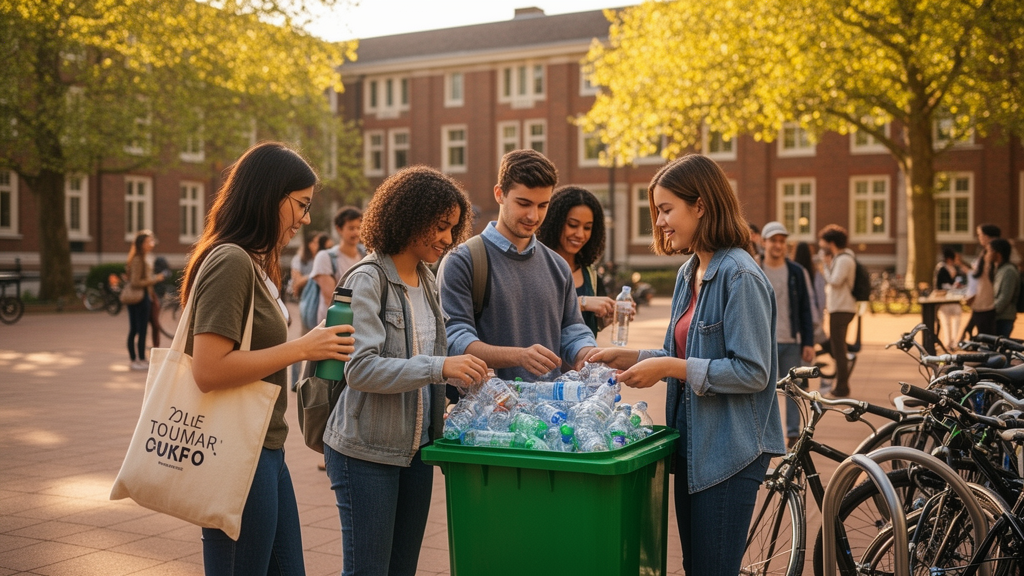
Why do some university students diligently sort their recycling and switch off lights while others show up at campus sustainability meetings, sign petitions, and push institutions to change? A new study published in BMC Psychology tackles this question with unusual precision, using one of psychology’s most widely tested models of human decision-making to disentangle two very different kinds of environmental action. Drawing on survey responses from 806 Chinese university students and a statistical technique known as partial least squares structural equation modeling, the research team mapped out the psychological machinery that drives both private, everyday green habits and more socially visible, participatory forms of campus environmentalism.
The study builds on the theory of planned behavior, or TPB, a framework introduced decades ago that has become the workhorse of behavioral psychology research. In its classic form, the theory holds that the single best predictor of whether someone will perform a behavior is their intention to do so, and that intention itself is shaped by three forces: attitude, meaning how favorably the person evaluates the behavior; subjective norms, meaning perceived social pressure from people around them; and perceived behavioral control, meaning how easy or difficult they believe the behavior to be. Researchers have repeatedly extended the model by adding constructs such as environmental knowledge, connectedness to nature, personal norms, and efficacy beliefs. What has remained murky, according to the authors, is how these additions should be theoretically ordered relative to one another, and whether the same extended model applies to different forms of environmental action.
That gap matters because pro-environmental behavior is not a single thing. Saving water in a dormitory shower is a private-sphere act, performed alone and quietly. Attending an environmental club meeting, lobbying a university administration, or participating in a collective campus campaign is public-sphere behavior, socially embedded and dependent on other people. Whether the same psychological pathway leads to both has been an open empirical question, and the new study was designed to answer it directly rather than assume it.
The researchers recruited 806 Chinese university students and administered a survey measuring the full battery of TPB constructs alongside the extended variables. Before testing the structural model, they conducted a pooled exploratory factor analysis combining the private-sphere and public-sphere behavior items. This statistical procedure asks whether items measuring two supposedly distinct behavioral domains actually separate into distinct factors when analyzed together. The result was instructive: the analysis supported two strongly related but empirically recoverable subdomains. In other words, private and public environmental behaviors are correlated enough to sit close together in a person’s behavioral repertoire, yet distinct enough that statistical methods can pull them apart. Students who recycle also tend to participate, but the two tendencies are not the same trait.
The structural model then revealed a clear architecture of distal and proximal influences. At the distal level sit relatively stable cognitive and affective orientations. Environmental knowledge, the study found, was most closely associated with perceived behavioral control. This makes intuitive sense: students who understand the environmental consequences of their actions tend to feel more capable of acting, because knowing what to do is a prerequisite for believing you can do it. Connectedness to nature, by contrast, showed strong associations with attitudinal, social, and moral orientations. Students who feel emotionally bonded to the natural world evaluate green behavior more favorably, perceive more social support for it, and experience stronger personal moral obligations to act. Nature connectedness, in this account, functions less as a direct driver of action and more as a fertile soil from which multiple motivational pathways grow.
At the proximal level, the classical TPB variables did their expected work. Attitude, subjective norms, and perceived behavioral control were all positively associated with behavioral intention, confirming that the original triad remains predictive even when richer constructs are added to the model. Personal norms, the internalized sense of moral obligation that echoes early norm-activation theory, added further predictive power. Intention, in turn, emerged as the central hub for both behavioral domains, the conduit through which all the upstream psychological forces funnel into actual behavior. Whatever distal or proximal origins a motivation has, it must pass through intention to become action.
Yet the two behavioral domains did not follow identical routes. Collective efficacy, a person’s belief that a group acting together can achieve environmental goals, provided an additional pathway specifically for public-sphere participation. Private behaviors can be enacted by an individual alone; participating in collective environmental action requires confidence not just in oneself but in the group’s capacity to make a difference. This finding gives collective efficacy a distinctive theoretical position: it is not a general enhancer of all green behavior but a domain-specific enabler of socially participatory action. For universities hoping to mobilize students into campus sustainability movements, cultivating the belief that organized groups can succeed may be as important as cultivating individual motivation.
The methodological choice to use partial least squares structural equation modeling deserves mention. Unlike covariance-based approaches, PLS-SEM is well suited to complex models with multiple constructs and pathways, making it a practical tool for testing extended frameworks like this one. Combined with the pooled factor analysis, the study offered both a confirmatory test of the ordered model and an empirical check on whether its two behavioral outcome domains were genuinely distinct. The convergent results strengthen the case that the observed architecture reflects something real about how environmental motivation is organized in students’ minds rather than an artifact of questionnaire design.
The practical implications are concrete. Because environmental knowledge feeds primarily into perceived behavioral control, sustainability education that stops at raising awareness may be incomplete; students also need the practical skills and perceived ease that convert knowledge into a sense of capability. Because connectedness to nature nourishes attitudes, norms, and moral obligations simultaneously, experiences that foster emotional bonds with nature, from outdoor programs to campus green spaces, could pay dividends across the entire motivational chain. And because collective efficacy uniquely empowers public-sphere engagement, universities need to offer credible structures for collective participation: student environmental organizations with real influence, visible examples of successful group action, and institutional channels through which student voices demonstrably shape campus policy.
The broader significance of the study lies in its integrated account of environmental behavior. Rather than treating pro-environmental action as a monolith driven by a single motive, the findings support a layered model in which distal cognitive and affective orientations relate to more proximal individual mechanisms, intention serves as the shared gateway, and collective agency becomes particularly important precisely when action requires other people. For a generation of students who will live with the consequences of today’s environmental decisions, the study suggests that building green campuses is a two-part engineering problem: equip individuals with the knowledge, moral conviction, and confidence to act alone, and convince them that acting together can actually change the world around them.
Subject of Research: Psychological predictors of private and public campus pro-environmental behavior among Chinese university students using an extended theory of planned behavior
Article Title: An extended TPB approach to examining Chinese university students’ public and private campus pro-environmental behavior
Article References: Chen, X., Huang, X., Liu, Y., Jiang, L., Kumar, J., & Huang, J. (2026). An extended TPB approach to examining Chinese university students’ public and private campus pro-environmental behavior. BMC Psychology. https://doi.org/10.1186/s40359-026-05638-4
Image Credits: AI Generated
DOI: 10.1186/s40359-026-05638-4
Keywords: theory of planned behavior, pro-environmental behavior, campus sustainability, environmental psychology, connectedness to nature, collective efficacy, personal norms, behavioral intention, PLS-SEM, Chinese university students, private-sphere behavior, public-sphere behavior
Cite Scienmag News
Glenn Wilkins. (October 16, 2026). What Makes Students Act Green? Study Maps the Mind of Campus Environmental Behavior. Scienmag. https://scienmag.com/what-makes-students-act-green-study-maps-the-mind-of-campus-environmental-behavior/
Glenn Wilkins. "What Makes Students Act Green? Study Maps the Mind of Campus Environmental Behavior." Scienmag, 16 October 2026, https://scienmag.com/what-makes-students-act-green-study-maps-the-mind-of-campus-environmental-behavior/. Accessed 16 October 2026.
Glenn Wilkins. "What Makes Students Act Green? Study Maps the Mind of Campus Environmental Behavior." Scienmag. October 16, 2026. https://scienmag.com/what-makes-students-act-green-study-maps-the-mind-of-campus-environmental-behavior/


