


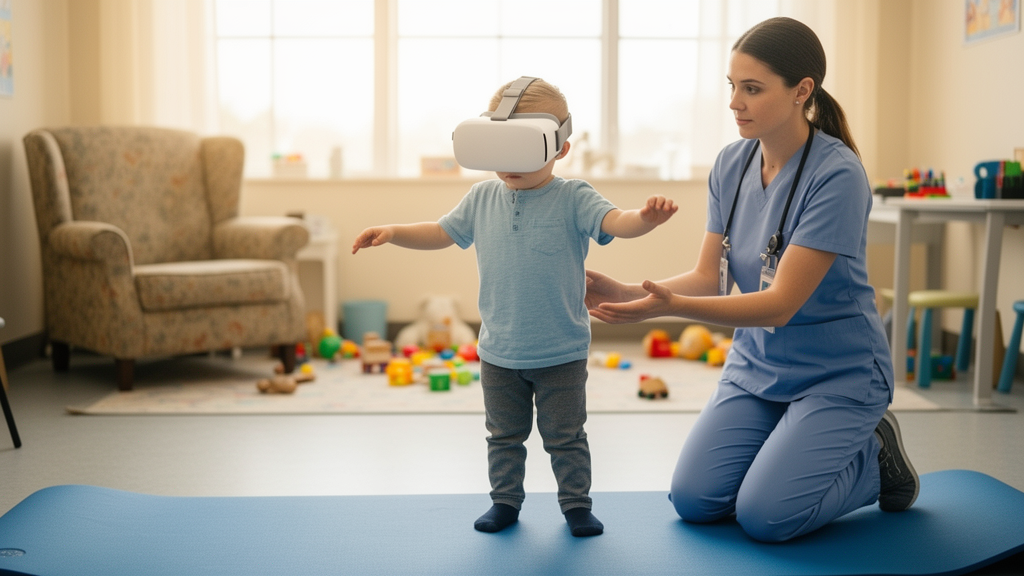
Immersive technologies, from virtual reality headsets to augmented reality overlays, are capturing the imagination of pediatric rehabilitation researchers worldwide. A sweeping new bibliometric analysis has now mapped a decade of this scientific activity, revealing a field that is expanding rapidly and diversifying in fascinating ways, yet one that remains heavily anchored in clinics and dominated by a single technology. The study, published in Frontiers in Virtual Reality, examined 388 publications from 2015 to 2024, drawing on four major scholarly databases to paint the most complete picture yet of how virtual, augmented, mixed, and extended reality research is organized in the rehabilitation of children and adolescents.
The research team, led by Alexis Ken Cartajenas of Oslo Metropolitan University in collaboration with colleagues from the Oslo Health Agency, retrieved records from Scopus, Web of Science, PubMed, and the Lens scholarly search platform. After rigorous deduplication and screening, the initial pool of more than 1,800 records was narrowed to 388 peer-reviewed articles and conference papers focused on immersive technologies applied to pediatric rehabilitation. The ten-year window was chosen deliberately: 2015 marks the point when commercially available immersive hardware began to spread widely, while 2024 was the most recent fully indexed year at the time of the search, avoiding the artificial decline that incomplete citation data would have introduced.
The findings show a field in vigorous growth. Publication output increased overall across the decade, with the United States leading productivity at 79 articles, followed by Italy with 44 and China with 36. Institutionally, the University of Toronto topped the list with 55 publications, closely trailed by Stanford University School of Medicine with 52 and the University of Washington with 36. The journal landscape followed Bradford’s law of scattering, a classic bibliometric pattern in which a compact core of 20 journals contributed roughly a third of all publications, while the remaining two-thirds were dispersed across 200 other outlets. Games for Health Journal and the Journal of NeuroEngineering and Rehabilitation emerged as the most prolific core venues, with the latter also showing the highest consistent citation performance in the corpus.
Perhaps the most striking pattern is the overwhelming dominance of virtual reality. The keyword virtual reality appeared 200 times across the dataset, dwarfing augmented reality at 28 occurrences, while mixed reality and extended reality barely registered, with just 3 and 6 appearances respectively. This modality skew mirrors broader trends across medical extended reality research, where head-mounted virtual environments attract far more attention than their augmented and mixed counterparts. The field’s clinical focus is equally concentrated: cerebral palsy appeared as a keyword 84 times, making it the second most frequent term overall, and it was frequently associated with motor rehabilitation, upper limb training, balance, and gait. Autism, hemiplegia, and serious games also ranked among the top terms.
To uncover the field’s hidden conceptual architecture, the researchers employed multiple correspondence analysis, a statistical technique that plots keywords in a multidimensional space based on how often they co-occur. The first two dimensions explained 39.3 percent of the total inertia, a moderate but interpretable representation. The analysis distinguished six thematic orientations: motor- and therapy-oriented work, gamified approaches, remote therapy, cognitive and developmental rehabilitation, immersive technologies, and a core XR rehabilitation cluster anchored by cerebral palsy and autism research. Terms like telerehabilitation, hemiplegia, and immersive virtual reality acted as drivers pulling the axes toward distinct thematic territories, while ubiquitous terms like rehabilitation and children sat near the origin, foundational but non-discriminating.
Thematic evolution analysis, which sliced the decade into five two-year intervals, revealed how the field’s priorities have shifted. Early work from 2015 to 2016 centered on virtual and augmented reality applications for cerebral palsy, upper limb function, and gaming. Autism emerged as a new theme by 2017, followed by motor skills, balance, and executive function around 2019 and 2020. After 2020, coinciding with the COVID-19 pandemic’s disruption of healthcare delivery, output surged and new themes appeared, including artificial intelligence, exergaming, haptic feedback, and participatory design. By 2023 and 2024, extended reality had surfaced with links to memory and physical activity, while augmented reality persisted with connections to social and communication skills.
Yet these emerging themes remain strikingly immature. Gamification, extended reality, and artificial intelligence each appeared only five times as author keywords, with median years of prominence in 2023 or 2024. The researchers caution that these should be read as early signals of future research activity rather than established pillars of the literature. The promise is tantalizing: artificial intelligence could enable adaptive, real-time feedback during rehabilitation sessions, dynamically adjusting therapeutic tasks to a child’s performance, while gamified environments have shown potential for supporting personalized learning and engagement, particularly for children with cerebral palsy or autism. But the bibliometric data show these convergences are still on the horizon.
The social structure of the field proved equally revealing. Author collaboration analysis identified 47 distinct research communities, ranging from domestically concentrated groups to internationally diverse consortia. Three Italian clusters exhibited complete country-level homophily, meaning every author worked within a single nation, while one cluster anchored in Belgium spanned ten countries. A handful of researchers, including Monteiro CBDM, Biffi E, and Levac DE, occupied bridging positions with high betweenness centrality, acting as intellectual brokers between otherwise distant groups. This configuration carries both strengths and risks: central thought leaders can catalyze innovation, but over-reliance on a small set of connectors may limit the field’s capacity for growth and external validity.
One of the study’s most consequential findings concerns where rehabilitation actually happens. Explicit home-, remote-, and telerehabilitation-related terminology appeared in only 41 publications, or 10.6 percent of the corpus, indicating that decentralized delivery remains a minority framing within the broader literature. This is a notable gap given that clinic-based rehabilitation is often limited by cost, accessibility, and engagement, especially for families in remote or underserved areas. Children’s rehabilitation outcomes are shaped by family resources, school participation, and access to care, and the authors argue that immersive technologies could help overcome these barriers if designed for real-world home and community contexts rather than well-resourced clinics alone.
The researchers are careful to emphasize a crucial caveat: bibliometric prominence is not evidence of clinical effectiveness. Publication counts describe patterns of scientific activity, not whether interventions work. Systematic reviews cited in the study report promising findings, including positive pooled effects of virtual reality rehabilitation on balance in cerebral palsy, but small samples, short interventions, and heterogeneous protocols continue to limit generalizability. The authors call for rigorous clinical evaluation, consistent reporting, standardized outcomes, and setting-specific implementation research addressing feasibility, usability, safety, and equity. As immersive technologies converge with artificial intelligence and gamification, the field stands at an inflection point where the challenge is no longer proving that children will engage with virtual worlds, but ensuring those engagements translate into measurable, equitable clinical benefit in the places where children actually live.
Subject of Research: Bibliometric mapping of immersive technology research in pediatric rehabilitation from 2015 to 2024
Article Title: Mapping immersive technologies in pediatric rehabilitation: a multi-database bibliometric analysis
Article References: Cartajenas, A. K., Saidi, T., Gazerani, P., Rosseland, I. K., Bergheim, Å., Selmer-Olsen, K., Mørk, N., Pavel, N., & Pikkarainen, M. A. (2026). Mapping immersive technologies in pediatric rehabilitation: a multi-database bibliometric analysis. Frontiers in Virtual Reality, 7, Article 1821977. https://doi.org/10.3389/frvir.2026.1821977
Image Credits: AI Generated
DOI: 10.3389/frvir.2026.1821977
Keywords: virtual reality, augmented reality, pediatric rehabilitation, bibliometrics, cerebral palsy, telerehabilitation, gamification, extended reality, artificial intelligence, serious games, home-based rehabilitation, science mapping
Cite Scienmag News
Harold Sullivan. (October 16, 2026). Virtual reality dominates pediatric rehabilitation research, but home-based care lags behind. Scienmag. https://scienmag.com/virtual-reality-dominates-pediatric-rehabilitation-research-but-home-based-care-lags-behind/
Harold Sullivan. "Virtual reality dominates pediatric rehabilitation research, but home-based care lags behind." Scienmag, 16 October 2026, https://scienmag.com/virtual-reality-dominates-pediatric-rehabilitation-research-but-home-based-care-lags-behind/. Accessed 16 October 2026.
Harold Sullivan. "Virtual reality dominates pediatric rehabilitation research, but home-based care lags behind." Scienmag. October 16, 2026. https://scienmag.com/virtual-reality-dominates-pediatric-rehabilitation-research-but-home-based-care-lags-behind/


