


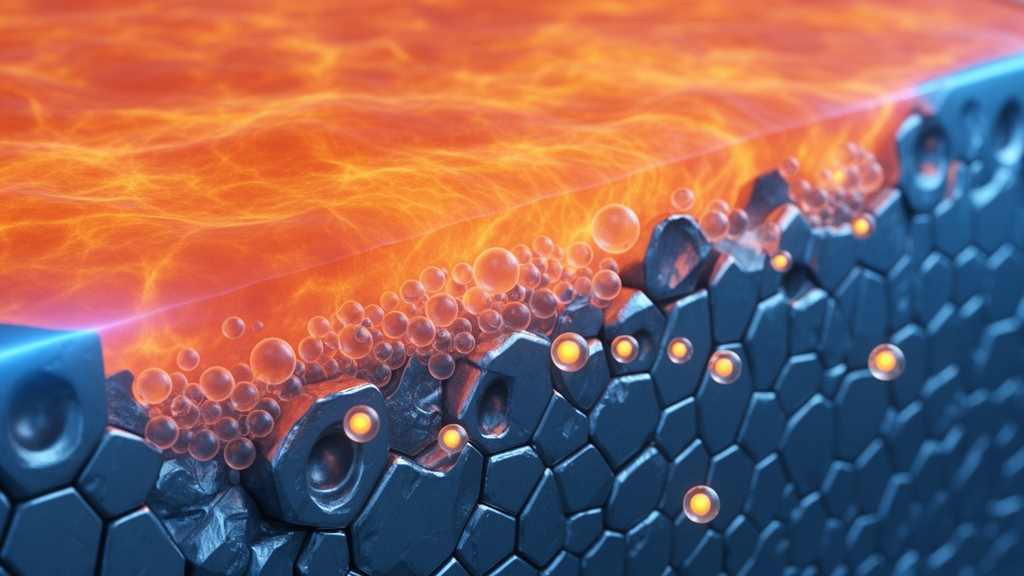
The path to practical fusion energy runs directly through some of the most punishing conditions ever asked of a solid material. Inside a reactor core, structural components are battered by intense streams of high-energy neutrons, and over time that bombardment reshapes the metal at the atomic scale. Now a research team at the Institute of Solid State Physics, part of the Hefei Institutes of Physical Science (HFIPS) of the Chinese Academy of Sciences, has produced a detailed account of how one class of radiation defects, nano-voids, takes shape in reactor metals, and has used that understanding to propose a concrete strategy for flushing damaging helium out of fusion materials before it can tear them apart. The work, led by associate professor Li Xiangyan, was published in the journals Tungsten and Nuclear Fusion.
The scale of the problem is easy to underestimate. When neutrons slam into the lattice of a metal such as iron or tungsten, they knock atoms out of position, leaving behind vacancies and clusters of vacancies. As irradiation continues, these vacancy clusters grow into nano-voids, tiny empty cavities just nanometers across. Individually they are minuscule, but collectively they cause the material to swell, harden, and creep, degrading mechanical properties in ways that can shorten component lifetimes and compromise reactor safety. Fusion devices are particularly demanding because, unlike fission reactors, they subject structural materials to an especially harsh neutron spectrum that simultaneously creates both displacement damage and new chemical species inside the metal.
Among those species, helium is the most insidious. It is not present in the material to begin with; instead it is born inside the lattice through nuclear reactions between incoming neutrons and the atoms of the alloy itself. Helium atoms are essentially insoluble in most metals, so they drift toward defects, vacancies, dislocations, and especially grain boundaries, the interfaces between the microscopic crystallites that make up a polycrystalline metal. There they coalesce into bubbles. Grain boundaries act as traps, soaking up the mobile helium, but trapping is a double-edged solution: over time the accumulated helium can build pressure and concentration to the point where the boundary itself weakens, a process that embrittles the material and undermines the very interfaces that hold it together.
To understand the first half of this damage cascade, the HFIPS team needed to know what nano-voids actually look like when they are stable, a surprisingly difficult question because the possible atomic arrangements of a cavity grow combinatorially with its size. Their answer came from a new computational framework built on the differential evolution algorithm, an evolutionary optimization method that searches vast configuration spaces for the arrangement that minimizes energy. Applied to body-centered cubic metals, the framework mapped out the ground-state structures, energetic properties, and a linear discrete model describing how nano-void properties change with size. The simulations revealed a clear pattern: small nano-voids tend to adopt compact, polyhedral shapes, while larger voids develop faceted geometries bounded by low-energy crystallographic surfaces, notably the (110) and (100) planes. In other words, as voids grow, the metal effectively carves out cavities whose walls align with the crystallographic directions that cost the least energy.
That structural insight had a kinetic payoff. The researchers found that vacancies situated around a nano-void do not all behave identically; their energy levels depend on the local atomic environment, meaning that a vacancy adjacent to a smooth facet sits in a different energetic landscape than one tucked into a corner or edge of the cavity. By linking the energy levels of nano-voids directly to their atomic structures, the team built a bridge between what a void looks like and how it moves. This connection helps explain why some voids are remarkably stable while others migrate through the lattice, a distinction that ultimately governs whether defects disperse harmlessly or accumulate into the clusters that cause swelling, hardening, and creep. A linear discrete model relating void energetics to size gives researchers a quantitative tool for predicting this behavior without simulating every atom of every possible configuration.
With the defect physics established, the team turned to the second, and arguably more dangerous, half of the problem: what to do about the helium. Grain boundaries had long been viewed mainly as sinks, passive traps where helium collects and bubbles nucleate. Li’s group asked a different question: could some grain boundaries, rather than merely storing helium, actually help move it out of the material entirely? To answer it, the researchers combined high-throughput calculations with object kinetic Monte Carlo simulations, a modeling approach that tracks defect populations over experimentally relevant length and time scales far beyond what atom-by-atom dynamics alone can reach.
The simulations delivered a result with real engineering promise. Grain boundaries are not interchangeable; their atomic structure varies widely depending on how the adjacent crystals are misoriented. The team found that some boundaries, those with suitable atomic structures, act as rapid diffusion channels for helium. Along these boundaries, helium atoms move orders of magnitude faster than they can through the perfect lattice. Crucially, when such a fast-diffusion boundary is connected to a free surface of the material, it becomes a pipeline: helium that would otherwise stagnate in the interior can instead be carried along the boundary and released at the surface. The researchers observed this same behavior in both iron and tungsten, the two signature bcc metals of fusion structural materials research, suggesting the mechanism is general rather than an accident of one particular element.
From these findings the researchers distilled a design philosophy they describe as a capture-transport-expulsion strategy. Instead of relying on grain boundaries purely as passive sinks, a properly engineered microstructure would use them as a coordinated system: boundaries capture the mobile helium, transport it along fast diffusion pathways, and, when those pathways intersect free surfaces, expel it from the material altogether. This reframing moves helium management from passive capture toward active removal, offering a theoretical basis for grain-boundary engineering as a route to materials that resist helium-induced damage rather than merely tolerating it. In practice, such engineering would mean tailoring the types, densities, and connectivity of boundaries in an alloy so that the microstructure functions as a built-in helium plumbing network.
The significance for fusion energy development is considerable. One of the central obstacles to a viable fusion power plant has always been the lifetime of first-wall and blanket materials, which must endure decades of neutron exposure in a commercial-scale device. Every mechanism that mitigates swelling, embrittlement, and helium bubble formation extends component lifetimes, reduces maintenance, and improves the economics of fusion power. The HFIPS work contributes on two fronts simultaneously: a predictive, size-resolved model of how the vacancy defects that drive swelling form and evolve, and a microstructural design principle aimed specifically at the helium that embrittles boundaries. Because the atomistic picture was developed for body-centered cubic metals, it speaks directly to tungsten, the leading candidate for plasma-facing components, and to the iron-based ferritic and reduced-activation steels favored for structural applications.
The team frames the achievement in terms of fundamental understanding feeding directly into design. By understanding how these defects form and evolve, Li Xiangyan said, the researchers hope to provide useful guidance for developing fusion materials with better radiation resistance. The combination of evolutionary algorithms for ground-state searching, discrete models of defect energetics, and kinetic Monte Carlo simulation of defect populations illustrates how modern computational materials science can close the gap between atomic-scale mechanisms and engineering-scale strategies. What emerges is a picture of radiation damage that is not an unavoidable fate but a set of processes that can, in principle, be routed and redirected, with the right atomic-scale architecture turning a material’s own grain boundaries from collection points for helium into escape routes for it.
Subject of Research: Irradiation damage mechanisms and helium mitigation in fusion reactor structural materials
Article Title: Researchers reveal irradiation damage mechanisms and mitigation strategies for fusion reactor structural materials
Article References: Researchers reveal irradiation damage mechanisms and mitigation strategies for fusion reactor structural materials. (n.d.). Original publication
Image Credits: AI Generated
DOI: Not provided
Keywords: fusion reactors, nano-voids, irradiation damage, helium bubbles, grain boundaries, tungsten, iron, differential evolution algorithm, kinetic Monte Carlo, radiation resistance, structural materials, HFIPS
Cite Scienmag News
Katie Riggs. (October 16, 2026). Inside the Damage Zone: Scientists Decode Nano-Void Behavior to Shield Fusion Reactors from Helium. Scienmag. https://scienmag.com/inside-the-damage-zone-scientists-decode-nano-void-behavior-to-shield-fusion-reactors-from-helium/
Katie Riggs. "Inside the Damage Zone: Scientists Decode Nano-Void Behavior to Shield Fusion Reactors from Helium." Scienmag, 16 October 2026, https://scienmag.com/inside-the-damage-zone-scientists-decode-nano-void-behavior-to-shield-fusion-reactors-from-helium/. Accessed 16 October 2026.
Katie Riggs. "Inside the Damage Zone: Scientists Decode Nano-Void Behavior to Shield Fusion Reactors from Helium." Scienmag. October 16, 2026. https://scienmag.com/inside-the-damage-zone-scientists-decode-nano-void-behavior-to-shield-fusion-reactors-from-helium/


