


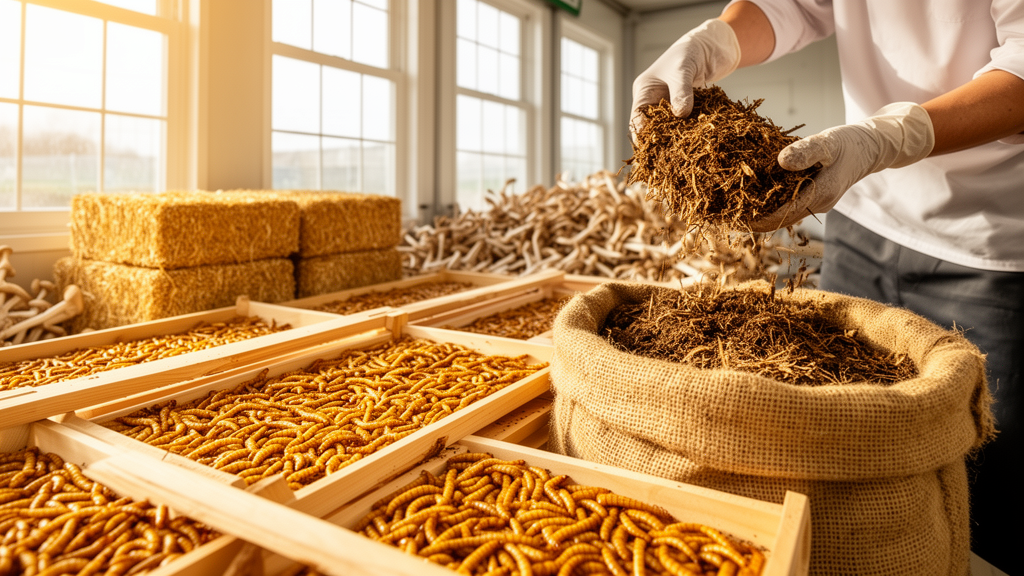
The mushroom industry throws away a mountain of perfectly good food every year. When growers of the nameko mushroom Pholiota microspora harvest their crop, the basal one to three centimeters of each stipe — the tough, fibrous base of the stem that touches the growing bed — is too coarse for commercial sale and is simply discarded. Now, a team at Yan’an University in China has shown that this waste can be turned into feed for one of the world’s most widely reared insects, the yellow mealworm Tenebrio molitor, provided the amount is carefully controlled. The finding, published in Frontiers in Insect Science, offers a technical blueprint for cutting the cost of insect farming while valorizing an agricultural by-product that currently has no market.
Yellow mealworms matter far beyond the pet-food and feed trades. Under Regulation (EU) 2015/2283, several Tenebrio molitor-derived products have been authorized as novel foods for human consumption in the European Union, and the larvae carry a crude protein content of 40.2 to 63.3 percent on a dry-matter basis, with a well-balanced amino acid profile that includes lysine, phenylalanine, threonine, and valine. They are also a source of unsaturated fatty acids, vitamins, and minerals. Their polyphagous feeding behavior, environmental adaptability, high reproductive capacity, and ease of rearing make them prime candidates for the bioconversion of organic waste into nutrient-rich biomass. But the conventional cereal-based diets they are usually reared on — wheat bran above all — remain a major cost constraint on large-scale production, which is exactly why researchers keep hunting for cheap agricultural and food-processing by-products that can partially or fully replace them.
Mushroom production residues are attractive candidates because they are generated in enormous quantities and are often available year-round. Spent mushroom substrates, the material left after mushrooms are harvested from cultivation beds, have been reported to retain roughly 75 to 85 percent of their original nutrients. Previous studies have shown that mushroom-derived substrates can be incorporated into mealworm diets, although their effects on larval performance vary according to mushroom species and dietary inclusion level. Kim and colleagues, for example, evaluated orange peel, cabbage, king oyster mushroom, and shiitake mushroom substrates as wheat bran replacements and found that shiitake mushroom substrate supported larval rearing at replacement levels of 40 and 50 percent. But the capacity of Tenebrio molitor to utilize diverse substrates does not mean that all substrates are nutritionally adequate or safe. Janković-Tomanić and colleagues reported that larvae fed zearalenone-contaminated grain showed no significant difference in survival but exhibited reduced body weight and locomotor activity, a reminder that each alternative substrate must be evaluated on its own physiological merits.
The Yan’an team focused on a by-product that has never been tested in this context before: the basal stipe of Pholiota microspora. Unlike the tender upper portion of the fruiting body, which is sold commercially, the basal stipe is unsuitable for sale and is typically discarded during production. P. microspora fruiting bodies contain carbohydrates, proteins, dietary fiber, polysaccharides, minerals, vitamins, and amino acids, and some of these nutrients may also be retained in the discarded basal portions. To test whether this waste could serve as feed, the researchers formulated five experimental diets in which wheat bran was replaced with dried P. microspora basal stipe powder at substitution levels of 0, 25, 50, 75, and 100 percent. All diets also contained 24 percent corn flour, 5 percent soybean meal, 0.5 percent compound vitamin premix, and 0.5 percent salt, and all feed ingredients were confirmed to be free of pesticide residues.
The experimental design was rigorous. Tenebrio molitor larvae were purchased from a commercial supplier in China and maintained under laboratory conditions until pupation and adult emergence. The emerged adults were allowed to mate and oviposit, and the resulting eggs were collected and incubated to establish the first laboratory generation. F1 larvae were reared to adulthood, and the resulting adults were allowed to mate and oviposit to produce the second laboratory generation. Uniformly sized fifth-instar F2 larvae were then selected for the experiment. Each dietary treatment had three biological replicates, and each replicate contained 150 healthy, uniformly sized fifth-instar larvae. All developmental stages were maintained in a programmable climate chamber at 25 degrees Celsius and 60 percent relative humidity. Because each larval instar of T. molitor lasts approximately 10 days under comparable rearing conditions, larval growth and developmental indices were measured at the 6th, 8th, 10th, 12th, 14th, and 15th instars. At each sampling point, body length was measured with a ruler, body width was measured at the seventh abdominal segment, and 30 larvae per replicate were individually weighed on an electronic balance.
The results tell a clear story of dose-dependent effects. Across all dietary treatments, larval body length, width, and weight increased with advancing instar, and body length was strongly and positively correlated with body width within each treatment group, with correlation coefficients of 0.93 to 0.94. The control group generally exhibited the greatest larval body size and weight, whereas the 100 percent substitution group showed the lowest values. Differences among treatments were minimal during the 6th to 8th instars, but from the 9th to 15th instars, larval growth in the 25 percent substitution group was comparable to that in the control group and significantly greater than that in the 50, 75, and 100 percent substitution groups. By the 15th instar, body weight ranged from 3.88 grams in the control to 3.64 grams at 25 percent substitution, 3.31 grams at 50 percent, 3.13 grams at 75 percent, and 2.46 grams at 100 percent substitution. These results indicate that replacing 25 percent of wheat bran with P. microspora basal stipe powder did not adversely affect larval growth.
Larval duration, however, told a different story. It increased significantly with increasing replacement level, from 144.67 days in the control to 178.67 days at 100 percent replacement, representing a 34-day prolongation of the larval period. This extended production cycle is a serious practical concern for commercial operations, where every additional day of rearing translates into higher labor, energy, and facility costs. Larval mortality was not significantly affected by the replacement level, although it was numerically higher in the replacement groups, ranging from 9.11 to 10.45 percent, than in the control group at 7.67 percent. No significant differences were observed among groups in pupation rate, pupal duration, sex ratio, or eclosion rate either, suggesting that the mushroom by-product had no adverse effects on these measured biological parameters even at high inclusion levels.
Pupal and adult weights, by contrast, declined significantly with increasing substitution level. Pupal weight fell from 0.118 grams in the control to 0.105 grams at 100 percent replacement, and adult weight similarly declined from 0.106 grams to 0.095 grams. Female and male pupal and adult weights showed similar declining patterns across replacement levels, with no significant sex-specific differences detected. The pupal weight in the 25 percent substitution group was significantly lower than that in the control group but significantly higher than that in the 50, 75, and 100 percent substitution groups, reinforcing the conclusion that low-to-moderate replacement is biologically feasible whereas high replacement levels impair growth and reduce final biomass yield.
Why did higher substitution levels impair growth? The authors propose several mechanisms, though they caution that these remain speculative because feed intake, diet physical properties, and nutrient digestibility were not measured. Because P. microspora basal stipe powder had a smaller particle size than wheat bran, increasing its proportion in the diet may have altered dietary physical properties such as bulk density and nutrient digestibility. Higher replacement levels may also have changed the texture, color, and odor of the diet, potentially reducing feed acceptability and larval feed intake. In addition, the fiber content of the basal stipe powder may have contributed to reduced growth at high replacement levels, as elevated dietary fiber levels can reduce digestibility and impair larval development. Mushroom-derived residues may also contain phenolic compounds that inhibit fiber-degrading microorganisms and reduce fiber digestibility, further limiting nutrient availability. When starch is limited, mealworm larvae can adjust their feed intake and derive energy from other nutrients, including dietary protein and digestible fiber fractions, but their nutritional plasticity has limits.
From a practical perspective, replacing 25 percent of wheat bran with P. microspora basal stipe powder could reduce reliance on conventional feed ingredients and provide a productive use for mushroom cultivation residues. However, the authors note that savings in wheat bran costs may be offset by residue processing and handling costs, and the actual economic benefit of this substitution cannot yet be determined because feed intake, feed conversion efficiency, processing costs, and economic returns were not assessed in this study. Nevertheless, the results suggest that a 25 percent replacement level is a promising starting point, as it maintained larval growth performance while significantly reducing the amount of wheat bran needed. Further studies should evaluate processing methods, nutrient composition, and cost-benefit performance under commercial production conditions, and analyses of digestive enzyme activity and gut microbial communities are needed to clarify the mechanisms behind the growth impairment observed at higher inclusion levels. For now, the message is clear: mushroom farm waste can feed the insects that feed us, but only up to a point.
Subject of Research: Effects of Pholiota microspora basal stipe powder on growth and development of Tenebrio molitor
Article Title: Effects of Pholiota microspora basal stipe powder on growth and development of Tenebrio molitor
Article References: Mu, T., Jiang, Z., Hu, H., Wang, Y., Jia, Y., Sun, Z., & He, X. (2026). Effects of Pholiota microspora basal stipe powder on growth and development of Tenebrio molitor. Frontiers in Insect Science, 6, Article 1916272. https://doi.org/10.3389/finsc.2026.1916272
Image Credits: AI Generated
DOI: 10.3389/finsc.2026.1916272
Keywords: Effects, Pholiota, microspora, basal, stipe, powder, growth, development, Tenebrio, molitor, scientific research
Cite Scienmag News
Alan Morgan. (October 16, 2026). Mushroom Farm Waste Could Slash the Cost of Rearing Mealworms. Scienmag. https://scienmag.com/mushroom-farm-waste-could-slash-the-cost-of-rearing-mealworms/
Alan Morgan. "Mushroom Farm Waste Could Slash the Cost of Rearing Mealworms." Scienmag, 16 October 2026, https://scienmag.com/mushroom-farm-waste-could-slash-the-cost-of-rearing-mealworms/. Accessed 16 October 2026.
Alan Morgan. "Mushroom Farm Waste Could Slash the Cost of Rearing Mealworms." Scienmag. October 16, 2026. https://scienmag.com/mushroom-farm-waste-could-slash-the-cost-of-rearing-mealworms/


