


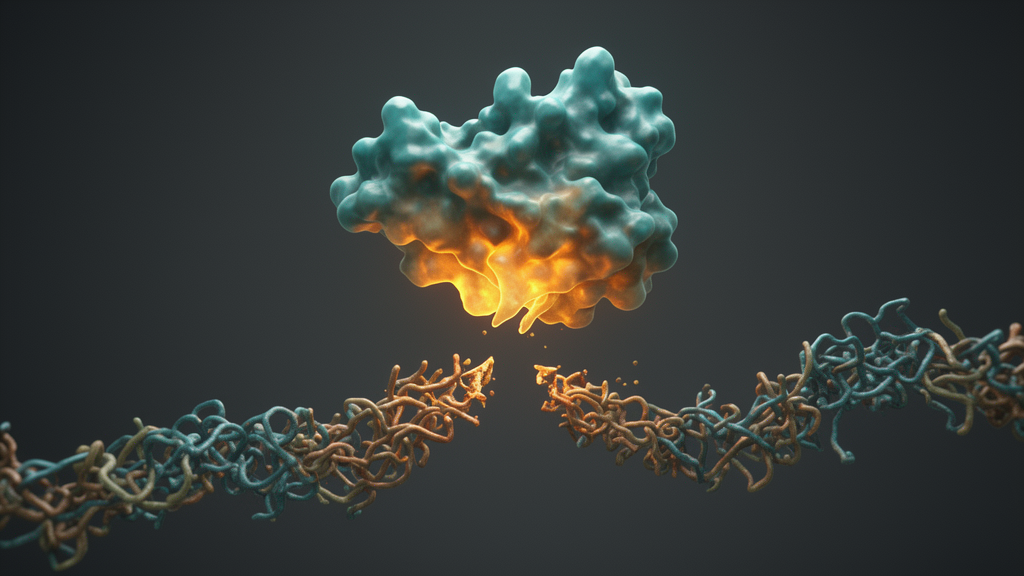
Proteins that cut other proteins are among the most powerful tools in biology, yet designing them from scratch has long been considered one of the toughest challenges in computational enzymology. The peptide bond that holds amino acids together is extraordinarily stable, and natural proteases achieve their remarkable catalytic feats through finely tuned active sites that evolved over billions of years. Now a team led by David Baker at the University of Washington’s Institute for Protein Design, working with collaborators including Donald Hilvert at ETH Zurich and Anthony Hyman at the Max Planck Institute of Molecular Cell Biology and Genetics, reports in Nature that artificial intelligence-driven protein design can produce entirely new zinc-dependent proteases that rival natural enzymes in both activity and programmability.
The core of the achievement lies in the use of RFdiffusion, a generative deep-learning method that builds novel protein backbones around specified functional motifs. Rather than copying an existing enzyme scaffold, the researchers instructed the diffusion model to create protein structures containing a water-activating zinc-based active site positioned directly adjacent to a peptide substrate binding pocket. The zinc ion, coordinated by catalytic residues in a geometry inspired by natural metalloproteases such as astacin and thermolysin, polarizes a bound water molecule so it can attack the scissile amide bond of a target peptide. This motif-scaffolding approach, refined through multiple rounds of partial diffusion, sequence design and filtering with AlphaFold 3 predictions, allowed the team to generate enzymes in which the catalytic machinery and the substrate recognition surface were designed as an integrated whole.
The experimental results were striking. Of 135 designs tested in the laboratory, 36 percent catalysed cleavage of their cognate peptide substrates at precisely the bond they were designed to target. That success rate is remarkable for any de novo enzyme design campaign, but especially for one targeting amide bond hydrolysis, a reaction class that has historically resisted computational design efforts. The best initial design accelerated peptide bond hydrolysis by more than 100-million-fold compared with the uncatalysed reaction in neutral solution, a benchmark established decades ago by chemists measuring the intrinsic stability of the amide linkage in water.
Even more impressive was what happened next. By screening a library of single-site mutations across 21 positions in and around the active site of one design, and then recombining the most beneficial substitutions, the team identified four changes that boosted catalytic acceleration to more than ten-billion-fold over background. Structural and kinetic analysis indicated that these mutations worked primarily by improving active-site preorganization, holding the catalytic residues and the zinc-bound water in a geometry closer to the transition state of the reaction. In enzymology, preorganization is a key determinant of catalytic power, and the finding that a handful of rationally screened substitutions could push a designed enzyme into the kinetic territory of naturally evolved proteases suggests that the computational pipeline had already captured most of the essential physics of the reaction.
Crystal structures of several designs, deposited in the Protein Data Bank, confirmed that the experimentally determined backbones and active sites matched the computational models with high fidelity. The zinc coordination geometry, the positioning of the substrate binding pocket and the overall fold all closely resembled the design blueprints. Molecular dynamics simulations and machine-learning force-field calculations of the nucleophilic attack step further supported the mechanistic picture, showing that the designed active sites lower the activation energy of the rate-limiting chemical step in a manner analogous to natural astacin-family enzymes.
What elevates this work from an impressive technical demonstration to a potential therapeutic platform is the demonstration that the method can target real human disease proteins. The team designed metalloproteases that selectively cleave TDP-43, the RNA-binding protein whose pathological aggregation is a hallmark of amyotrophic lateral sclerosis and frontotemporal lobar degeneration; amyloid-beta, the peptide central to the amyloid hypothesis of Alzheimer’s disease; and serum amyloid A, the precursor of inflammatory AA amyloidosis. These disease-targeting designs achieved rate enhancements of up to a billion-fold, and specificity experiments showed that each protease preferentially cleaved its intended substrate over the other peptides tested in the panel.
The TDP-43 work illustrates the biological nuance the team brought to the targeting strategy. Full-length degradation of TDP-43 would risk destroying functions essential to the cell, because the protein contains structured N-terminal and RNA-recognition domains needed for its nuclear role. Instead, the designers aimed their protease, called TDPr3, at the intrinsically disordered C-terminal domain that governs liquid-liquid phase separation and aggregation. Cleavage within this region can modulate the phase behaviour and oligomerization of TDP-43 without ablating its essential functions. Experiments with both oligomeric and monomeric forms of full-length human TDP-43, characterized by dynamic light scattering and microscopy, showed that the designed protease progressively cleaved the protein over time, while a catalytically dead knockout variant produced no cleavage products at all.
Beyond degrading disease proteins, the platform opens the door to a powerful new form of biological control: conditional activation of therapeutic molecules. The researchers designed caged cytokines and receptor antagonists that remain inactive until a designed protease clips off a masking sequence, releasing the active biomodulator. Because both the protease and its cleavage site are designed rather than borrowed from nature, the pair can operate bioorthogonally, meaning the activation event does not interfere with, or depend on, any endogenous human protease. Such protease-activatable prodrugs have long been a goal in the field of targeted therapeutics, and the ability to specify both the enzyme and its substrate from first principles makes it possible to build orthogonal activation cascades in which one designed protease unlocks one signal and another unlocks a different one.
The implications extend across therapeutics, biotechnology and bioremediation. Programmable proteases could in principle be deployed to remodel pathological protein deposits, to process biopharmaceuticals during manufacturing, to activate drugs only in diseased tissue, or to break down recalcitrant protein pollutants in the environment. The design code, structural data and experimental protocols have been made publicly available through Zenodo, and provisional patent applications covering aspects of the methods and designs have been filed, signalling serious translational intent. The work was funded by a broad coalition including the Bill and Melinda Gates Foundation, the Defense Threat Reduction Agency, the Howard Hughes Medical Institute, the Audacious Project at the Institute for Protein Design and multiple institutes of the National Institutes of Health.
For the protein design community, the study marks a milestone in a decade-long arc that has taken the field from stable novel folds to functional binders and now to genuinely catalytic enzymes of biomedical relevance. The combination of diffusion-based backbone generation, sequence design, AlphaFold-based filtering and modest experimental optimization proved sufficient to solve a problem, amide bond hydrolysis, that many considered a benchmark of true catalytic sophistication. If the success rate and activity levels reported here can be generalized across arbitrary target sequences, the ability to write a protease for any protein of interest, on demand, would fundamentally change how scientists approach protein-mediated disease, offering a programmable molecular scalpel wherever biology needs one.
Subject of Research: Computational de novo design of zinc-dependent metalloprotease enzymes for targeted protein cleavage
Article Title: Computational design of metalloproteases
Article References: Computational design of metalloproteases. (n.d.). https://doi.org/10.1038/s41586-026-11167-2
Image Credits: AI Generated
DOI: 10.1038/s41586-026-11167-2
Keywords: protein design, metalloproteases, RFdiffusion, enzymology, TDP-43, amyloid-beta, serum amyloid A, zinc catalysis, de novo enzymes, protease-activatable prodrugs, David Baker, Institute for Protein Design
Cite Scienmag News
Denise Maddox. (October 16, 2026). AI-Designed Enzymes Slice Disease Proteins With Unprecedented Precision. Scienmag. https://scienmag.com/ai-designed-enzymes-slice-disease-proteins-with-unprecedented-precision/
Denise Maddox. "AI-Designed Enzymes Slice Disease Proteins With Unprecedented Precision." Scienmag, 16 October 2026, https://scienmag.com/ai-designed-enzymes-slice-disease-proteins-with-unprecedented-precision/. Accessed 16 October 2026.
Denise Maddox. "AI-Designed Enzymes Slice Disease Proteins With Unprecedented Precision." Scienmag. October 16, 2026. https://scienmag.com/ai-designed-enzymes-slice-disease-proteins-with-unprecedented-precision/


