


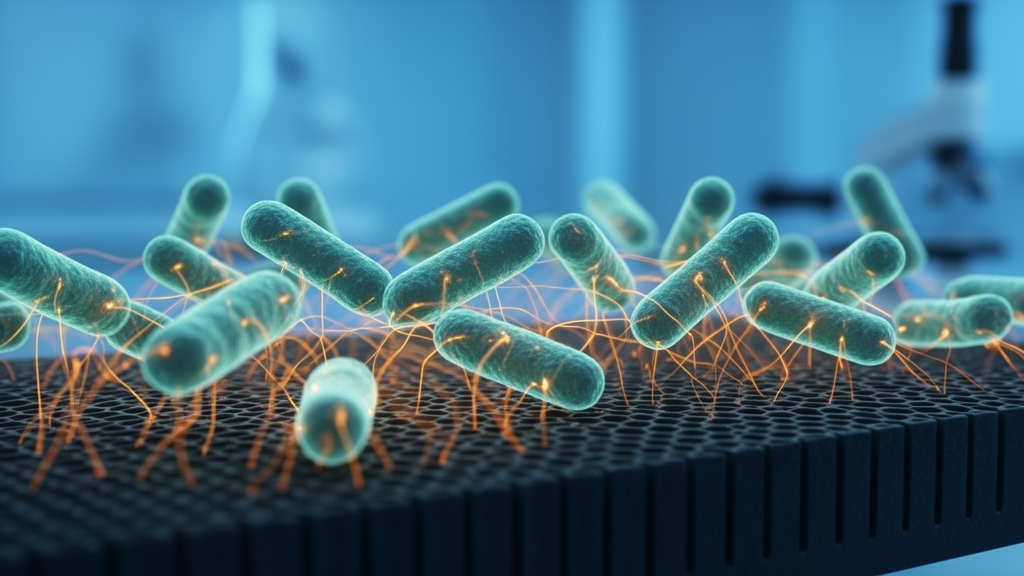
Fifteen years ago, a genetically engineered rhodopsin-based voltage reporter called PROPS captured the first optical recordings of fast membrane-potential transients in Escherichia coli, revealing spike-like electrical events in cells that biologists had long treated as electrically inert. What began as a provocative observation has since matured into a quantitative, multi-scale research program spanning single cells, biofilms, and entire microbial communities, according to a new review published in Frontiers in Photobiology by Edoardo Cianflone, Helena R. Keller, Nivedha Subramaniam, and Giuseppe Maria Paternò of Politecnico di Milano and the Istituto Italiano di Tecnologia.
The 2011 milestone, when Kralj and colleagues imaged electrical spiking in E. coli at roughly one hertz, was field-shaping in two ways. First, the signal itself: electrical spikes in bacteria invited comparisons to neuronal action potentials, even though the underlying mechanisms and spatial scales differ profoundly. Second, the hypothesis space: the spikes coincided with rapid efflux of a small-molecule fluorophore, hinting that electrical state might couple directly to membrane transport machinery and potentially influence drug susceptibility or stress responses. That observation also seeded the field’s central controversy, which persists today: are membrane-potential transients a cause of downstream bacterial behavior, or merely an aftereffect of fluctuating metabolic conditions?
Conceptually, the review distinguishes three related but mechanistically distinct domains that are frequently conflated in the literature. Transmembrane voltage dynamics encompass fluctuations and excitability-like transients in individual cells. Ionic signaling in communities involves extracellular potassium waves that depolarize neighboring cells across millimeter scales. Electrochemical interactions at interfaces include electrode-based stimulation and impedance phenotyping. Bacterial membrane potential typically lies within a roughly seventy-millivolt range between minus seventy-five and minus one hundred forty millivolts, with strong dependence on growth medium, growth phase, and species. In neuroscience, excitability requires a stereotyped, amplified response to a threshold stimulus followed by a refractory period, and whether bacteria strictly fulfill this definition remains debated, which is why the authors deliberately use the term excitability-like.
Measurement remains the field’s principal bottleneck and driver of controversy. Many classical voltage probes and calibration assumptions were developed for eukaryotic membranes and must be re-validated for bacterial envelopes and growth conditions. Commonly used Nernstian indicators such as thioflavin T, DiBAC, and TMRM tend to report steady-state potential rather than fast transients, and their signals can be confounded by membrane permeability changes, efflux pump activity, and other variations in membrane physiology independent of voltage. Even at low concentrations, these dyes can influence bacterial growth. Genetically encoded PROPS-like indicators avoid some of these pitfalls but require genomic modification, limiting clinical applicability. Recent synthetic reviews now explicitly call for bacterial-specific standardization, including careful reporting of medium composition, growth phase, probe concentration, illumination dose, and validation by multiple experimental approaches.
Non-optical approaches play a crucial complementary role, corroborating optical results while avoiding potential biases such as phototoxicity. Krasnopeeva and colleagues developed an electric-circuit analogue linking the proton motive force, membrane electrical properties, and catabolism, using the bacterial flagellar motor as a rapid single-cell readout under dynamic stresses. Their approach could separate stressors that directly change membrane potential, as an ionophore would, from those that cause physical membrane damage. Notably, they found that shorter-wavelength light can induce electrophysiological impairment, reinforcing the need for rigorous wavelength and dose controls in photobiology-driven experiments. Other physical voltmeters have achieved millisecond resolution in membrane-potential variations, and a 2025 study pushed toward absolute membrane-potential measurements in Bacillus subtilis using fluorescence lifetime, showing that a single strain can vary between minus sixty-five and minus one hundred twenty-seven millivolts when moving from rich to minimal medium.
The second inflection point came from biofilm studies in B. subtilis, where electrical and metabolic dynamics were shown to be coupled at community scale. In 2015, Liu and colleagues described long-range metabolic codependence between peripheral and interior biofilm cells as a mechanism resolving a growth-protection conflict, producing collective oscillations. The same year, Prindle and colleagues demonstrated that ion channels can conduct long-range electrical signals through spatially propagating potassium waves: a metabolic trigger induces potassium release, the increased extracellular potassium depolarizes neighboring cells, and the depolarization wave coordinates metabolic states across the biofilm. These findings extended beyond a single community, with two oscillating biofilms shown to synchronize through electrical signaling, an ecological phenomenon described as nutrient time-sharing.
Theory has matured in parallel. A percolation-based framework linked signal propagation to community heterogeneity and spatial organization, providing a quantitative language for when long-range transmission becomes possible and how near-critical organization can facilitate it. A complementary spatial reaction-diffusion model explicitly combined metabolic and electrical components, bridging the metabolism-first and channel-first schools of thought that often appear as competing intuitions. Preliminary coincident results have emerged in Gram-negative bacteria as well: membrane-potential oscillations have been demonstrated in E. coli biofilms, and collective polarization dynamics beyond a critical biofilm size have been observed in Neisseria gonorrhoeae. Electrical signals also reach outward: potassium-channel-mediated signaling generated by a biofilm can attract distant motile cells in a species-independent manner, and voltage transients in E. coli have been shown to induce calcium influx, supporting the idea that bacteria can treat calcium as a second messenger.
The field has now entered a perturb-and-measure phase, shifting from observation to intervention. A membrane-targeted azobenzene called Ziapin2 was shown to photomodulate membrane potential in B. subtilis, positioning photopharmacology-like strategies as practical tools for bacterial electrophysiology without genetic manipulation. Structured multiscale silicon has been developed as a nongenetic optical transducer capable of modulating single bacterial cells and biofilms at high spatiotemporal resolution. Electrical platforms are advancing too: identical electrical stimuli can produce opposite polarization dynamics depending on the proliferative capacity of the cells, emphasizing that bacterial electrical responses are state-dependent. At the translational end, a drug-free bioelectronic strategy exploited the selective excitability of Staphylococcus epidermidis and demonstrated reduced colonization on a porcine skin model using an electroceutical patch, while electrical impedance spectroscopy revealed that E. coli biofilms exhibit stable negative capacitances under small DC bias, implicating a specific voltage-gated potassium channel.
Among the more provocative post-2015 directions is the possibility that bacterial communities encode persistent electrical states. Transient optical perturbations have been shown to generate a long-lasting potassium-channel-mediated change in membrane potential within a biofilm, such that exposed cells subsequently responded out of phase relative to unexposed cells during oscillations, interpreted as a type of membrane-potential-based memory within a microbial community. This behavior is consistent with bistable dynamics within the metabolic-electrical network, and for photobiology it opens a methodological opportunity: optical perturbation can write states, optical readout can track them, and spatially structured illumination can test whether writing is local, propagative, or dependent on community connectivity.
Looking forward, the review identifies several frontiers. Nongenetic optical modulators point toward bacterial all-optical electrophysiology experiments where stimulation patterns are as controllable as in modern optogenetics. Supplementing cultures with tricarboxylic acid cycle intermediates such as glutamate, fumarate, or pyruvate can boost the proton motive force, amplify membrane potential, and increase the uptake of aminoglycoside antibiotics, suggesting a relevant clinical framework that might work synergistically with chemical phototransducers like Ziapin2. Standardized interrogation protocols pairing defined stimuli with time-resolved readouts could generate reproducible response fingerprints of bacterial physiological state, enabling diagnostics for antibiotic tolerance, persister formation, and dormancy. The relation between membrane potential and antibiotic tolerance still lacks consensus on how hyperpolarization versus depolarization affects antibiotic efficacy, requiring extensive investigation across bacterium-stimulus-antibiotic combinations. Whether bacterial spikes ultimately earn the name action potentials or demand bacteria-native descriptors anchored in metabolism and transport physiology, the next fifteen years promise to transform light-driven tools into causal instruments for reading, writing, and programmatically controlling the electrical lives of microbes.
Subject of Research: bacterial bioelectricity and membrane potential dynamics
Article Title: Bacterial bioelectricity, the first 15 years: developments, tools, and remaining questions
Article References: Cianflone, E., Keller, H. R., Subramaniam, N., & Paternò, G. M. (2026). Bacterial bioelectricity, the first 15 years: developments, tools, and remaining questions. Frontiers in Photobiology, 4, Article 1834373. https://doi.org/10.3389/fphbi.2026.1834373
Image Credits: AI Generated
DOI: 10.3389/fphbi.2026.1834373
Keywords: bacterial bioelectricity, membrane potential, electrophysiology, biofilms, potassium waves, voltage imaging, optogenetics, photobiology, antimicrobial control, ion channels, Bacillus subtilis, Escherichia coli
Cite Scienmag News
Morgan Morrow. (October 16, 2026). Bacterial Bioelectricity at Fifteen: From Provocative Spikes to Programmable Microbial Collectives. Scienmag. https://scienmag.com/bacterial-bioelectricity-at-fifteen-from-provocative-spikes-to-programmable-microbial-collectives/
Morgan Morrow. "Bacterial Bioelectricity at Fifteen: From Provocative Spikes to Programmable Microbial Collectives." Scienmag, 16 October 2026, https://scienmag.com/bacterial-bioelectricity-at-fifteen-from-provocative-spikes-to-programmable-microbial-collectives/. Accessed 16 October 2026.
Morgan Morrow. "Bacterial Bioelectricity at Fifteen: From Provocative Spikes to Programmable Microbial Collectives." Scienmag. October 16, 2026. https://scienmag.com/bacterial-bioelectricity-at-fifteen-from-provocative-spikes-to-programmable-microbial-collectives/


