


Every year, hundreds of thousands of people undergo lumbar interbody fusion, a spinal operation in which a degenerated disc is removed and replaced with a metal or polymer cage that holds the vertebrae together while bone grows across the joint. The most common variant, transforaminal lumbar interbody fusion, or TLIF, reaches the disc space through a posterolateral window that minimizes nerve retraction and avoids midline scarring. Yet the insertion step itself is surprisingly crude: the surgeon attaches the interbody fusion device, or IFD, to the end of an insertion instrument and hammers it into place with a mallet. On rare occasions, that impaction force exceeds what the device was designed to withstand, and the cage or the instrument fails inside the operating room.
Now a team of engineers at Mississippi State University, working with colleagues at Medtronic Spine and Biologics, has validated a modular benchtop device that reproduces the impact energy absorbed by an IFD during cadaveric TLIF procedures. Writing in Frontiers in Medical Engineering, the researchers report that their refined drop-weight apparatus replicated three of four key characteristics of the cadaveric impact waveform, including the area under the impulse curve, which directly represents the energy transferred from the insertion instrument into the device. The work, published on 16 February 2026, offers a repeatable laboratory surrogate for cadaveric testing and could accelerate the refinement of spinal cage design and surgical technique.
The motivation is straightforward. Cadavers have long served as the gold standard for practicing and validating spinal procedures, but they are scarce, expensive, and time-consuming to prepare. More importantly, cadaveric studies introduce enormous variability: anatomies and pathologies differ between donors, and mallet strikes differ between surgeons. Low back pain, meanwhile, is the second most prevalent cause of disability among adults in the United States, so the demand for better fusion devices and more predictable procedures is acute. A benchtop model that faithfully mimics the cadaveric impact event would let engineers establish use-condition parameters quickly and cheaply, before any cadaveric validation is attempted.
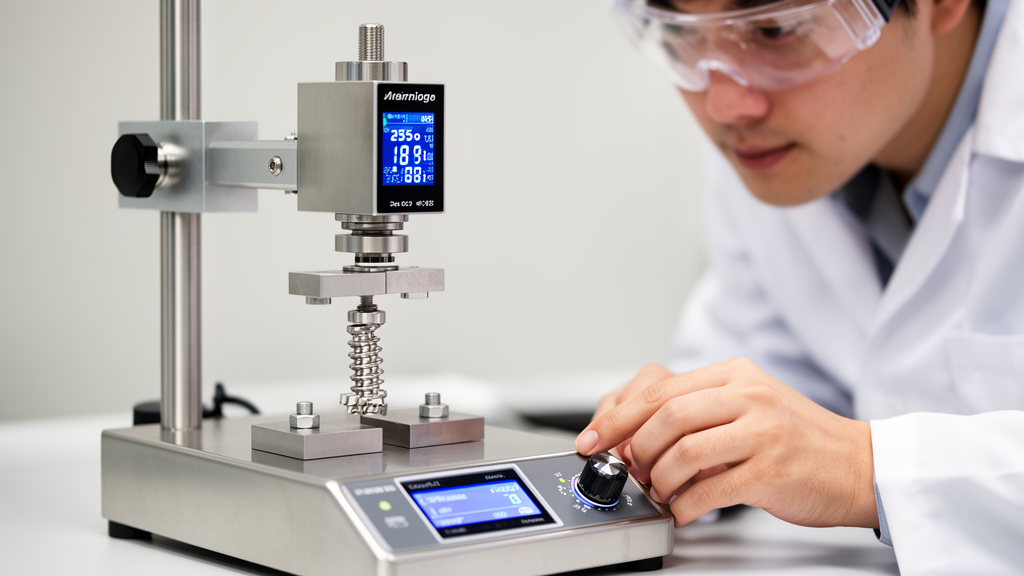
The device itself is a drop tower coupled to a spring-loaded compression fixture. A one-pound cylindrical drop weight is released from a controlled height and strikes the insertion instrument, driving a titanium-alloy IFD between two compression platens. The platens are spaced 12 millimeters apart, matching the height of the 12 by 24 millimeter Ti-6Al-4V test device, and are lined with 3-millimeter-thick polyurethane foam sheets that replicate the cancellous bone of the vertebral bodies. Springs with a stiffness of 63.22 pounds per inch, or about 11.07 newtons per millimeter, apply a lateral compressive load of roughly 200 newtons, a value chosen to mimic the physiological preload of the prone lumbar spine reported in prior in vivo studies.
One of the study’s most elegant findings concerns the drop weight material. In previous work, the team used low-carbon steel weights, which produced impact durations shorter than those recorded in cadavers. The coefficient of restitution, a measure of how much energy is dissipated in a collision, ranges from zero for a perfectly plastic impact to one for a perfectly elastic one. Because aluminum possesses a higher coefficient of restitution than steel, the researchers hypothesized that an aluminum weight would prolong the impact duration. They machined one-pound weights from steel 1018, commercially pure zinc, and 6061 aluminum, calculated the predicted restitution coefficients for each material using elastoplastic impact models, and performed three benchtop insertions per material. Aluminum indeed produced an impact duration closest to the historical cadaveric data, and all three materials yielded strike counts statistically equivalent to the cadaveric group, so aluminum was adopted for all subsequent testing.
With the aluminum weight in place, the team varied only the drop height, from 60 to 120 centimeters in 10-centimeter increments, producing seven test groups of eight full insertions each, for a total of 56 insertions. Instrumentation was thorough: a piezoelectric impact force sensor mounted on the insertion instrument recorded the force-time waveform, button compression sensors behind the springs monitored the lateral load, and a laser displacement sensor beneath the device tracked implant motion. A Python script extracted four waveform characteristics from each impact: impact duration, defined as the time the signal remained above a 1.5-volt threshold; the area under the impulse curve, approximated by a left Riemann sum and representing energy absorption; peak impact force; and the initial impact slope, which reflects the loading rate. Partial strikes and outliers were removed using Chauvenet’s criterion.
The results reveal a nuanced picture. Impact duration was replicated by every drop height group, with benchtop values clustering tightly around 106 to 111 microseconds against a cadaveric average of 109.7 microseconds. Peak impact force was matched by the 90, 110, and 120 centimeter groups, which produced forces between roughly 11.6 and 12.1 kilonewtons compared with the cadaveric average of 12.89 kilonewtons. Most significantly, the area under the impulse curve, the direct measure of energy absorption from the insertion instrument into the IFD, was replicated by the two highest drop heights, 110 and 120 centimeters, with percent differences from the cadaveric value of less than one percent and about seven percent respectively. Notably, the cadaveric data exhibited greater variability than the benchtop data across all waveform characteristics, underscoring the controlled nature of the laboratory model.
Not every characteristic was conquered. No benchtop group replicated the initial impact slope of the cadaveric waveform; all benchtop slopes were lower, with percent differences ranging from about 35 to 68 percent below the cadaveric value. The researchers suggest that aluminum’s higher coefficient of restitution may have contributed to this reduction in loading rate. Strike counts told a different story still: only the 60 centimeter group matched the cadaveric average of 15.56 strikes to full insertion, and strike count fell steadily as drop height rose, from 12.86 strikes at 60 centimeters to 5.75 strikes at 120 centimeters. The team notes that matching all four waveform characteristics at a single drop height may be unachievable, and that increasing the lateral compressive load would likely be required to prevent strike count from decreasing as drop height increases.
The discussion also flags a surprise: peak impact force plateaued beginning at 90 centimeters of drop height, presumably because frictional forces within the drop tower impeded the weight’s velocity. Future iterations will incorporate velocity sensors to determine whether the weight is still accelerating with height or whether friction is genuinely capping the impact forces. Other limitations are candidly acknowledged. The study was not designed to predict intra-operative performance, implant sizing relative to the platen spacing is not captured in benchtop testing, and there is no consensus on the in vivo spinal compressive forces experienced during surgery. The coefficient of friction, which varies with discectomy technique and endplate preparation, was held constant, though the authors argue that incorporating variable friction into experimental or computational models could improve the work’s translational impact.
Even so, the achievement is substantial. This is the first benchtop device to accurately replicate impact duration, area under the impulse curve, and peak impact force from cadaveric TLIF data; earlier devices matched only impact duration, or in the team’s own prior work, only peak force and initial slope. Because the apparatus is easily modified, the researchers envision extending it beyond the transforaminal approach to other fusion procedures such as lateral lumbar interbody fusion, and testing alternative device materials such as PEEK. By quantifying the energy a spinal cage must absorb during insertion, the validated benchtop model promises to inform device design, failure analysis, and use conditions, ultimately reducing the incidence of intra-operative device failure and enhancing the repeatability of one of spine surgery’s most common operations.
Subject of Research: Biomedical engineering of spinal fusion devices and surgical impaction testing
Article Title: Impact energy during cadaveric transforaminal lumbar interbody fusion (TLIF) is replicated by a modular benchtop device
Article References: Luke, C., Foster, M., Graham, A., Jones, T., Faulkner, H., Janus, A.-M., Hensley, C., Redmond, J., Henson, M. A., Priddy, L. B., & Priddy, M. W. (2026). Impact energy during cadaveric transforaminal lumbar interbody fusion (TLIF) is replicated by a modular benchtop device. Frontiers in Medical Engineering, 4, Article 1548013. https://doi.org/10.3389/fmede.2026.1548013
Image Credits: AI Generated
DOI: 10.3389/fmede.2026.1548013
Keywords: TLIF, lumbar interbody fusion, interbody fusion device, benchtop testing, impact energy, cadaveric model, coefficient of restitution, spinal cage, biomechanics, drop tower, Medtronic, Mississippi State University
Cite Scienmag News
Ophelia Keating. (October 16, 2026). Benchtop Device Replicates the Impact Energy of Spinal Fusion Surgery. Scienmag. https://scienmag.com/benchtop-device-replicates-the-impact-energy-of-spinal-fusion-surgery/
Ophelia Keating. "Benchtop Device Replicates the Impact Energy of Spinal Fusion Surgery." Scienmag, 16 October 2026, https://scienmag.com/benchtop-device-replicates-the-impact-energy-of-spinal-fusion-surgery/. Accessed 16 October 2026.
Ophelia Keating. "Benchtop Device Replicates the Impact Energy of Spinal Fusion Surgery." Scienmag. October 16, 2026. https://scienmag.com/benchtop-device-replicates-the-impact-energy-of-spinal-fusion-surgery/


