


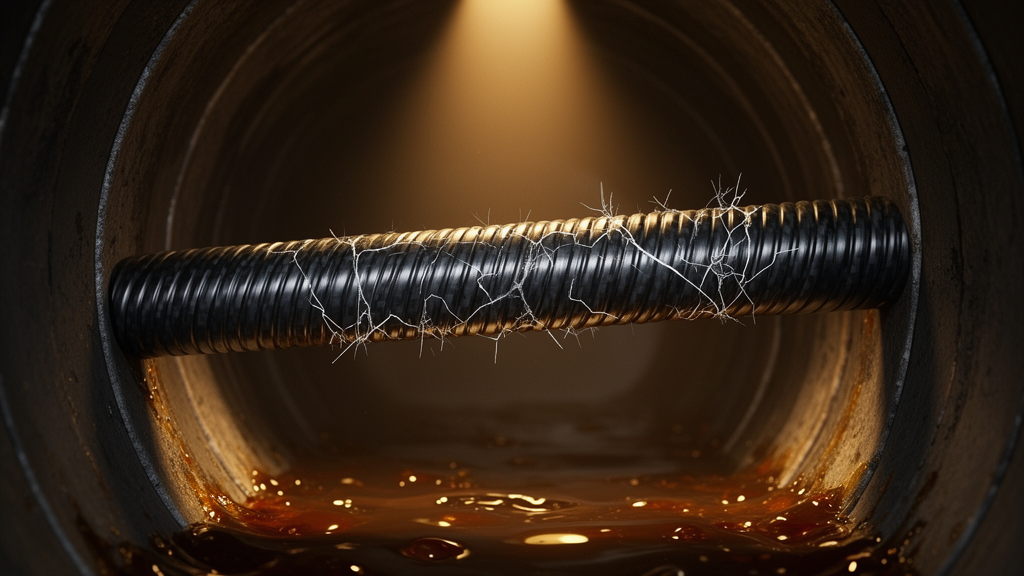
Deep inside operating oil wells, slender composite rods flex and stretch millions of times as they pump crude to the surface. New research from a team studying pultruded carbon/glass-fiber hybrid sucker rods shows that after 435 days of real downhole service, these rods do not simply weaken uniformly. Instead, they accumulate a distinctive pattern of damage that depends strongly on how the material is loaded, and that damage appears to set the stage for the longitudinal splitting failures that occur when the rods are finally pulled from the well and wound onto drums.
The study, published in PLOS One by Dongxu He, Tao Jiang, and Huajing Xu, took an unusually direct approach to the problem. Rather than relying solely on laboratory aging, the researchers compared five specimens cut from a pristine 22-millimeter-diameter parent rod with five specimens sectioned from a service-aged parent rod that had been retrieved after 435 days of actual operation in a producing well. This paired comparison allowed the team to measure how a year and two months of exposure to well fluids, cyclic tension, and bending had altered the mechanical properties of the very same class of material used in the field.
The mechanical testing covered the four loading modes that matter most for sucker rod performance: tension, compression, flexure, and apparent horizontal shear. The results revealed a striking hierarchy of degradation. Mean tensile strength fell by 10.02 percent, flexural strength dropped by 19.92 percent, and apparent short-beam shear strength declined by 21.98 percent. After the researchers applied Holm correction to account for multiple statistical comparisons, the reductions in flexural and apparent short-beam shear strength remained statistically significant, while the tensile-strength reduction did not, with an adjusted p-value of 0.057. Compressive strength, by contrast, barely changed at all, decreasing by only 2.25 percent with no statistically significant difference.
That near-total preservation of compressive strength conceals a more troubling story, however. The coefficient of variation for compressive strength ballooned from 2.42 percent in the pristine rods to 18.88 percent in the service-aged ones, and the Weibull shape-parameter estimate, a statistical measure of how tightly strength values cluster, collapsed from 41.31 to 5.27. In practical terms, the pristine rods failed with remarkable predictability, while the aged rods had become erratic, with some specimens retaining nearly full compressive capacity and others failing at far lower loads. This loss of strength predictability matters enormously for engineers, because design calculations that assume uniform material behavior can no longer be trusted when the scatter becomes this wide.
The loading-mode dependence of the degradation offers important clues about the underlying mechanisms. Flexure and short-beam shear both generate stresses that concentrate at and near the fiber-matrix interfaces and in the resin-rich regions between fibers, and these were precisely the properties that suffered the largest and most statistically robust declines. Tension, which loads the fibers themselves along their axis, showed a more modest reduction that only narrowly missed the threshold for statistical significance. Compression, which is resisted largely by the fiber architecture and the support of the surrounding matrix, was essentially unchanged on average. The pattern suggests that the damage accumulated downhole lives primarily in the matrix and at the hybrid interfaces rather than in the carbon and glass fibers themselves.
Dynamic mechanical analysis of the carbon-fiber core added a thermally revealing dimension to the picture. The storage modulus, a measure of the material’s stiffness under small cyclic deformations, decreased by 34.3 percent after service. Yet the glass-transition temperature, the temperature at which the polymer matrix transitions from a rigid to a rubbery state, actually increased from 159.5 to 164.76 degrees Celsius. These two changes point in seemingly opposite directions, and the authors suggest they may reflect competing contributions from residual post-curing, in which continued thermal exposure during service completes the crosslinking of the resin and raises the transition temperature, and moisture-related effects, which plasticize the matrix and soften its response. The researchers note that the underlying chemical mechanisms were not directly characterized, so this interpretation remains a plausible hypothesis rather than a demonstrated conclusion.
Moisture-desorption measurements reinforced the role of water in the degradation process. The service-aged specimens showed greater equilibrium mass loss during drying than the pristine ones, consistent with greater retention of removable moisture within the aged material. In a downhole environment where rods are continuously bathed in produced fluids, water molecules diffuse into the polymer matrix and along the fiber-matrix boundaries, where they can disrupt the bonding between resin and fiber and contribute to the softening observed in the dynamic mechanical measurements. The combination of absorbed moisture and repeated operational loading appears to work the matrix and the hybrid interfaces over relentlessly during service.
Scanning electron microscopy made the microscopic damage visible. The aged specimens revealed extensive matrix fragmentation, resin loss, fiber-matrix debonding, and longitudinal interfacial cracking running parallel to the fibers. These observations align closely with the mechanical results: the interfaces and matrix, which govern shear and flexural performance, showed the most severe deterioration, while the fibers themselves, which dominate tensile and compressive capacity, remained comparatively intact. The microscopy also revealed how the damage is distributed, with cracks following the longitudinal boundaries between fiber and matrix rather than cutting across the rod.
Putting all of the evidence together, the authors propose a two-phase damage-evolution process. In the first phase, prolonged fluid exposure and repeated operational loading progressively weaken the matrix and the hybrid interfaces, quietly accumulating the microscopic fragmentation, debonding, and longitudinal cracking observed under the microscope. In the second phase, the additional bending imposed during retrieval and drum winding acts on this pre-weakened state, promoting the propagation and coalescence of the pre-existing cracks until local longitudinal splitting occurs. This framework explains why the failures often happen not during the long service life itself but at the moment of retrieval, when the rod is bent around a drum after 435 days of damage accumulation.
The findings carry practical weight for the growing fleet of composite sucker rods deployed in oil fields worldwide. Pultruded carbon/glass-fiber hybrid rods are increasingly favored over traditional steel rods because they are lighter, corrosion-resistant, and can reduce the energy demands of pumping systems. But the study shows that their three-region hybrid architecture, which includes a carbon/glass hybrid transition region, is vulnerable to loading-mode-dependent degradation and to widening strength dispersion as service time accumulates. Engineers designing retrieval procedures and drum-winding operations may need to account for the weakened matrix and interfaces that field-aged rods carry with them out of the well, and the pronounced loss of compressive-strength predictability suggests that statistical approaches to reliability, such as the Weibull analysis applied here, will be essential for tracking the true condition of rods that have spent extended time downhole.
Subject of Research: Mechanical degradation and failure mechanisms of pultruded carbon/glass-fiber hybrid composite sucker rods after long-term downhole service
Article Title: Performance degradation and failure mechanisms of pultruded carbon/glass-fiber hybrid sucker rods after long-term downhole service
Article References: He, D., Jiang, T., & Xu, H. (2026). Performance degradation and failure mechanisms of pultruded carbon/glass-fiber hybrid sucker rods after long-term downhole service. PLOS One, 21(10), e0360408. https://doi.org/10.1371/journal.pone.0360408
Image Credits: AI Generated
DOI: 10.1371/journal.pone.0360408
Keywords: composite sucker rods, carbon/glass-fiber hybrid, pultrusion, downhole service, longitudinal splitting, Weibull analysis, fiber-matrix debonding, scanning electron microscopy, dynamic mechanical analysis, oil well pumping, Performance, degradation
Cite Scienmag News
Beatrice Stafford. (October 16, 2026). Deep in the oil well, composite sucker rods quietly lose strength before they split. Scienmag. https://scienmag.com/deep-in-the-oil-well-composite-sucker-rods-quietly-lose-strength-before-they-split/
Beatrice Stafford. "Deep in the oil well, composite sucker rods quietly lose strength before they split." Scienmag, 16 October 2026, https://scienmag.com/deep-in-the-oil-well-composite-sucker-rods-quietly-lose-strength-before-they-split/. Accessed 16 October 2026.
Beatrice Stafford. "Deep in the oil well, composite sucker rods quietly lose strength before they split." Scienmag. October 16, 2026. https://scienmag.com/deep-in-the-oil-well-composite-sucker-rods-quietly-lose-strength-before-they-split/


