


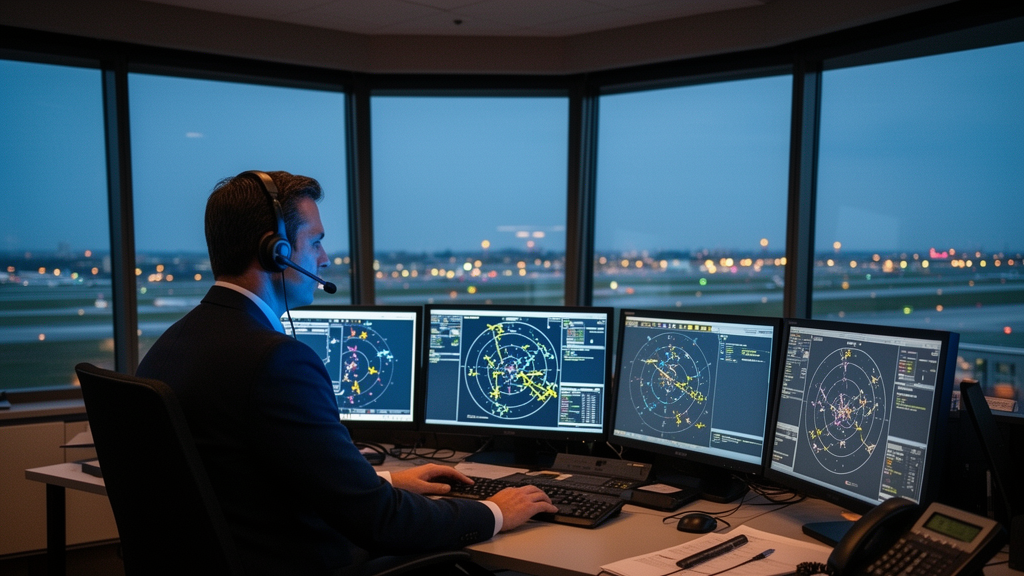
Deep inside every air traffic control tower and radar room, a quiet and largely invisible threat unfolds every single day. It is not a mechanical failure, not a software glitch, and not a rogue drone. It is the slow, silent erosion of human attention itself — the gradual decay of vigilance that turns a highly trained professional into someone who, for a few critical seconds, simply stops seeing what is right in front of them. Now, a comprehensive new systematic review published in Frontiers in Neuroergonomics has pulled together decades of research on this phenomenon, revealing both remarkable promise and a sobering gap between what science can detect in the laboratory and what it can actually deliver on the operational floor.
The review, led by Manal Aich, Jamal El Aoufi, and Ahmed Moussa from Abdelmalek Essaâdi University and the Mohammed VI International Academy of Civil Aviation in Morocco, systematically analysed 34 peer-reviewed studies drawn from PubMed, Scopus, and Web of Science. Following PRISMA 2020 guidelines, the team screened over 850 records and distilled them into a rigorous synthesis of how vigilance decrements in air traffic control are measured, modelled, and — crucially — predicted. Their conclusion is stark: while machine learning models can achieve impressive classification accuracies under controlled conditions, no study to date has validated a vigilance detection system under real shift conditions with a sample large enough to support operational deployment.
Vigilance, in the context of air traffic control, refers to the sustained ability to detect rare but safety-critical events against a continuous backdrop of routine traffic. A controller might spend hours watching radar screens where nothing unusual happens, and then suddenly be required to spot a conflict — two aircraft on converging trajectories — within seconds. The cognitive demands are enormous: simultaneous tracking of multiple aircraft, management of radio communications, integration of meteorological data, and coordination with adjacent sectors. Yet the physical demands are minimal. Controllers sit, watch, and talk. This combination — low physical activity paired with relentless attentional requirements — is precisely the profile that decades of vigilance research have shown to produce reliable and predictable decrements in detection performance.
What makes vigilance failure particularly insidious from a safety perspective is that it leaves no trace. Unlike a mechanical fault or a communication error, a lapse in sustained attention produces no log entry, no anomaly in the data record, and no recoverable artifact after the fact. Incident reports document what happened; they cannot reconstruct where a controller’s attention was in the seconds before a near-miss. This absence of evidence makes vigilance decrements one of the most underreported and underinvestigated contributors to aviation safety events, despite their consistent appearance across incident and accident records worldwide.
The review distinguishes carefully between three related but distinct constructs: vigilance, workload, and fatigue. Vigilance concerns sustained signal detection over time. Workload is the momentary cognitive demand imposed by the task. Fatigue is a cumulative reduction in physiological or cognitive capacity that degrades both. Treating these as interchangeable — as much of the older literature has done — produces models that cannot identify the actual source of a performance decrement. The authors argue that vigilance is the most tractable target for real-time physiological monitoring because declining vigilance produces measurable neural and ocular signatures: increases in theta-band (4–8 Hz) and alpha-band (8–13 Hz) EEG power, changes in blink rate, and shifts in gaze patterns that can, in principle, be detected before a performance error occurs.
The measurement landscape revealed by the review is dominated by two modalities. Electroencephalography (EEG) appears in nearly 59 percent of the included studies, capitalising on well-documented spectral signatures of cognitive state. Eye-tracking features in about half of all studies, capturing fixation duration, saccade dynamics, blink rate, pupil diameter, and gaze entropy — a measure of how randomly a controller scans the display. Heart rate variability (HRV) appears in roughly 29 percent of studies. Increasingly, researchers are combining these modalities into multimodal fusion systems, which accounted for about 44 percent of the reviewed work. The logic is compelling: no single sensor captures the full picture of cognitive state, but combining EEG, ocular, and cardiac signals can produce a more robust and reliable estimate of vigilance than any individual stream.
The machine learning results are, on the surface, impressive. Classification accuracies across the 20 modelling studies ranged from 64 percent to a remarkable 100 percent, with several studies employing sophisticated architectures — convolutional neural networks paired with long short-term memory (CNN-LSTM), spatio-temporal graph networks with centre loss functions, and dual-stream fusion of facial video with radiotelephony audio — reporting accuracies exceeding 90 percent. One study using a spatio-temporal graph network on EEG data for remote tower controllers achieved 96.73 percent accuracy in fatigue detection. Another, combining eye-tracking and heart rate variability through a gradient-boosted model, predicted situational awareness with an R² of 0.78. These are not trivial results; they demonstrate that the physiological signatures of declining vigilance are real, learnable, and exploitable.
But the review’s most important contribution may be its unflinching assessment of what those numbers actually mean. The authors introduce a two-tier classification framework. Tier 1 encompasses proof-of-concept studies: small samples, within-subject validation, simulator-based settings. The overwhelming majority of the reviewed literature falls into this tier. Tier 2, representing stronger external validity, requires cross-subject validation, field data from operational shifts, or operationally relevant metrics such as sensitivity and false alarm rate. Only two studies in the entire review met Tier 2 criteria — and even those relied on dataset or simulation data rather than live operations. No study in the review combined field validation with cross-subject generalisation. The gap between a 97 percent accuracy figure achieved in a laboratory simulator with 15 participants and a system that can reliably protect a controller on a real midnight shift is, the authors make clear, enormous.
The practical constraints on deployment are formidable. High-density EEG arrays and precision eye trackers produce the best laboratory results but are not the sensors that can be worn comfortably during a live six-hour shift. Dry-electrode EEG systems, which eliminate conductive gel, suffer from higher contact impedance and greater susceptibility to motion artefact — particularly problematic for the theta-band signals most central to vigilance detection. Camera-based computer vision systems offer a contact-free alternative, and recent work using improved YOLO-based architectures and vision-language models has shown promise, but these approaches raise their own questions about individual variability, lighting conditions, and data governance. Beyond the sensors themselves, operational deployment requires regulatory clearance for non-interference with certified ATC equipment, hygiene protocols for shared workstations, controller consent frameworks, and data protection measures for continuous biometric monitoring of certified personnel.
Perhaps the most forward-looking contribution of the review is its argument that detection alone is insufficient. The authors call for closed-loop vigilance monitoring systems — ones in which a real-time classifier does not merely log a state label but triggers an automated or supervisory response: a supervisor alert, an adjustment in automation support, a redirection of incoming traffic, or a structured handover protocol. Such systems have been demonstrated in adjacent domains, notably EEG-based driver fatigue detection that issues adaptive alerts, but remain largely absent from air traffic control. The authors also stress the need for explainable AI — systems whose outputs supervisors can actually interpret — and for individual calibration, since vigilance profiles differ substantially across controllers in circadian pattern, workload tolerance, and physiological response. Bridging the gap between proof of concept and operational reality, they conclude, requires individual calibration, closed-loop intervention design, interpretable outputs, field validation at scale, and early regulatory engagement — all pursued in parallel, not as a sequential checklist. The silent threat in the control tower is real, measurable, and increasingly predictable. What remains is the harder work of turning prediction into protection.
Subject of Research: Vigilance decrement detection and prediction in air traffic control using physiological monitoring and machine learning
Article Title: Vigilance decrements in air traffic control as an aviation safety risk: a systematic review of modeling and prediction approaches
Article References: Aich, M., El Aoufi, J., & Moussa, A. (2026). Vigilance decrements in air traffic control as an aviation safety risk: a systematic review of modeling and prediction approaches. Frontiers in Neuroergonomics, 7, Article 1874304. https://doi.org/10.3389/fnrgo.2026.1874304
Image Credits: AI Generated
DOI: 10.3389/fnrgo.2026.1874304
Keywords: air traffic control, vigilance, neuroergonomics, EEG, machine learning, aviation safety, fatigue detection, systematic review, human factors, attention, decrements, traffic
Cite Scienmag News
Ophelia Keating. (October 16, 2026). The Silent Threat in the Control Tower: How AI Is Racing to Catch Fading Attention Before Planes Collide. Scienmag. https://scienmag.com/the-silent-threat-in-the-control-tower-how-ai-is-racing-to-catch-fading-attention-before-planes-collide/
Ophelia Keating. "The Silent Threat in the Control Tower: How AI Is Racing to Catch Fading Attention Before Planes Collide." Scienmag, 16 October 2026, https://scienmag.com/the-silent-threat-in-the-control-tower-how-ai-is-racing-to-catch-fading-attention-before-planes-collide/. Accessed 16 October 2026.
Ophelia Keating. "The Silent Threat in the Control Tower: How AI Is Racing to Catch Fading Attention Before Planes Collide." Scienmag. October 16, 2026. https://scienmag.com/the-silent-threat-in-the-control-tower-how-ai-is-racing-to-catch-fading-attention-before-planes-collide/


