


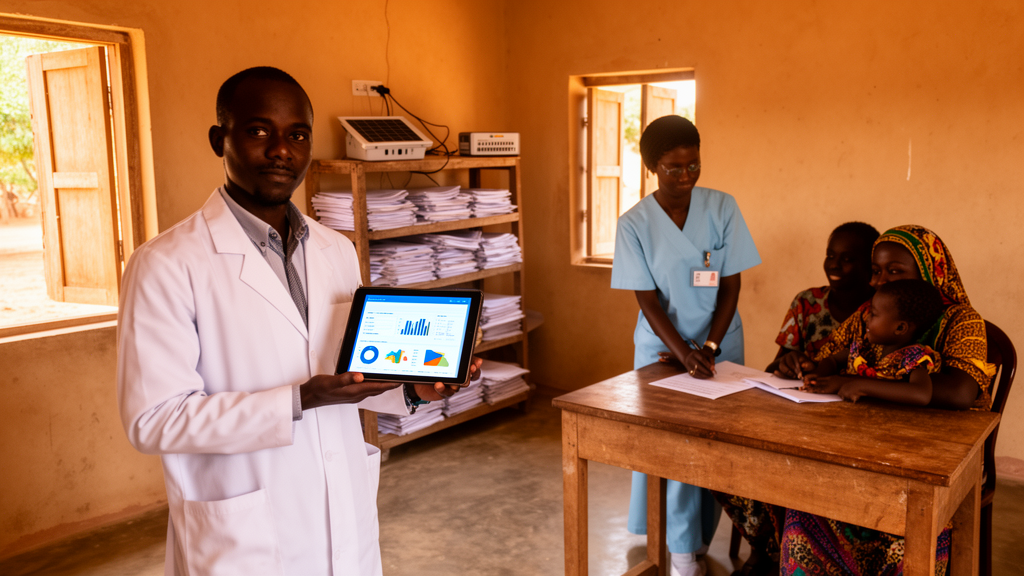
Somalia has one of the weakest records on universal health coverage in the world, and a new analysis argues that the problem is not a lack of digital technology but the way the country’s health system is put together. In a Perspective published in Frontiers in Health Services, researchers from Somali National University in Mogadishu contend that fragmentation across governance, financing, health information systems, and service delivery is the central barrier preventing digital health from strengthening care. Their prescription is unusual: rather than deploying more apps and pilots, Somalia should treat digital health as strategic public infrastructure that knits the entire health system together.
The scale of the challenge is stark. A 2025 Somalia-specific analysis, using a modified composite index that combined essential service coverage and financial risk protection, reported a national universal health coverage score of just 33.5 on a scale from zero to 100. Prolonged conflict, displacement, weak institutions, and heavy donor dependence have left the country with fragmented federal and state governance, severe shortages of health workers, inadequate medicines and infrastructure, and persistent inequities in access. A large and heterogeneous private sector operates within limited regulatory and accountability structures, while much of the population relies on out-of-pocket spending for care.
Digital health has long been promoted as an enabler for exactly these settings. Telemedicine, mobile health, and electronic records can extend service reach, support workforce training and supervision, improve continuity of care, and strengthen the use of data in resource-constrained environments. Evidence from across sub-Saharan Africa shows substantial promise, but with an important caveat: impact depends on infrastructure, workforce capability, and integration with broader health information architecture rather than on stand-alone deployment. In Somalia, digital initiatives have instead evolved largely through pilots and donor-supported projects, including telemedicine efforts, in a context still marked by bandwidth limitations, absent national e-health standards, and fragmented reporting systems.
The authors argue that the policy concern is therefore not the availability of individual technologies but how digital health is governed and integrated. Somalia-specific evidence documents fragmented governance, donor dependence, weak regulatory capacity, parallel implementation arrangements, and limited integration of digital initiatives into national health system reform. Comparative evidence from other low- and middle-income countries and fragile and conflict-affected settings suggests similar patterns, including unclear institutional roles, project-based implementation, weak interoperability, and parallel programmes, can undermine system integration and sustainability. The authors are careful to frame these comparative findings as evidence of plausible mechanisms rather than direct proof of causation in Somalia.
The proposed pathways are structural. Fragmented governance may hinder the development and enforcement of common standards; limited standardization may in turn contribute to non-interoperable platforms; and parallel reporting systems may increase reporting burdens while reducing the consistency and timely use of health information. In Somalia, federal governance fragmentation, donor dependence, infrastructure limitations, and a large but weakly regulated private sector may further shape these dynamics. Evidence from Kenya and the wider African interoperability literature suggests that government stewardship, common standards, and multi-stakeholder coordination can support greater system integration, although the authors stress these experiences should be read as comparative policy lessons rather than guarantees of identical effects.
At the heart of the Perspective is a conceptual reframing. Digital health as public infrastructure refers to the shared institutional and technical foundations required for digital services to function across the health system rather than as isolated projects: coordinated governance, common standards, interoperable information exchange, sustainable financing arrangements, and mechanisms that allow public, private, and humanitarian providers to participate within a common national framework. Digital health functions as a health-system integrator when these shared foundations enable information, service delivery, financing, workforce functions, and accountability to connect across levels of care. When these elements operate together, they could improve continuity of care, reduce duplication, strengthen the availability and use of health information, and support more coordinated allocation of resources.
To operationalize this vision, the authors identify five strategic priorities. First, Somalia should strengthen national digital health governance through a formal federal-state governance platform responsible for agreeing national standards, clarifying institutional responsibilities, coordinating partner-supported investments, and overseeing interoperability, privacy, cybersecurity, and data governance requirements. Second, the country should build an interoperable national digital health architecture under a nationally agreed interoperability framework that defines common data standards, exchange protocols, system interfaces, security requirements, and governance rules for connecting existing and future platforms rather than replacing them with additional stand-alone systems. Implementation could proceed incrementally by prioritizing high-value connections among health information systems, electronic records, surveillance platforms, and referral services.
The remaining priorities address the frontline and the money. Third, digitally enabled primary health care should be accelerated by progressively integrating digital tools into existing primary care workflows rather than creating parallel digital programmes, linking community-level platforms, facility records, referral systems, maternal and child health services, and routine surveillance within an interoperable service architecture. Evidence from African settings suggests integrated digital systems can support point-of-care decision-making, referral coordination, community health worker activities, and more timely surveillance data, but these effects depend on interoperability, workforce capability, and connectivity. Fourth, Somalia should move from short-term, project-based digital funding toward pooled or coordinated investment tied to common interoperability, accountability, and data-governance requirements, with public-private partnerships supporting infrastructure and service delivery within nationally agreed standards. Fifth, digital equity and workforce readiness should be embedded in programme design, with particular attention to rural populations, displaced communities, women, persons with disabilities, and other groups at risk of digital exclusion.
The authors emphasize that these priorities are interdependent rather than separate reform tracks. Governance provides the institutional authority for establishing and enforcing common standards, while interoperability depends on those standards being adopted across public, private, and humanitarian systems. Financing is similarly linked to governance: without alignment to national priorities and common interoperability requirements, new investments may reproduce parallel platforms and fragmented reporting arrangements rather than strengthen system integration. Digitally enabled primary health care likewise depends on workforce readiness, connectivity, and equitable access, because interoperable systems have limited practical value if frontline workers lack the capacity to use them effectively or if digitally excluded populations cannot reach the services they support.
The Perspective concludes that Somalia’s progress toward universal health coverage could be supported by moving from fragmented digital initiatives toward a more integrated and nationally coordinated digital health ecosystem embedded within wider health system reform. The framework positions digital health as shared public infrastructure supported by coordinated governance, interoperable architecture, digitally enabled primary health care, sustainable financing and public-private collaboration, and digital equity with workforce readiness. The authors caution that these priorities constitute an interconnected policy pathway rather than an empirically established causal sequence, and that further policy implementation and empirical evaluation will be needed to determine how the proposed mechanisms operate in practice. If adapted to Somalia’s federal, institutional, and service-delivery context, their coordinated implementation could support stronger health system integration, resilience, accountability, and progress toward universal health coverage.
Subject of Research: From fragmentation to integration: digital health as a catalyst for universal health coverage in Somalia
Article Title: From fragmentation to integration: digital health as a catalyst for universal health coverage in Somalia
Article References: Abdullahi khalif, I., Mohamed Abdi, A., Abdullahi Hubow, Y., Mohamed Adan, A., Ahmed Ali, M., Mohamed Omar, A., Sheikh Rashid, N. A., & Abdulle, A. A. (2026). From fragmentation to integration: digital health as a catalyst for universal health coverage in Somalia. Frontiers in Health Services, 6, Article 1929703. https://doi.org/10.3389/frhs.2026.1929703
Image Credits: AI Generated
DOI: 10.3389/frhs.2026.1929703
Keywords: digital health, Somalia, universal health coverage, health systems strengthening, digital governance, interoperability, health financing, digital equity, fragmentation, integration, digital, health
Cite Scienmag News
Ophelia Keating. (October 16, 2026). Digital health could transform Somalia’s fragmented health system. Scienmag. https://scienmag.com/digital-health-could-transform-somalias-fragmented-health-system/
Ophelia Keating. "Digital health could transform Somalia’s fragmented health system." Scienmag, 16 October 2026, https://scienmag.com/digital-health-could-transform-somalias-fragmented-health-system/. Accessed 16 October 2026.
Ophelia Keating. "Digital health could transform Somalia’s fragmented health system." Scienmag. October 16, 2026. https://scienmag.com/digital-health-could-transform-somalias-fragmented-health-system/


