


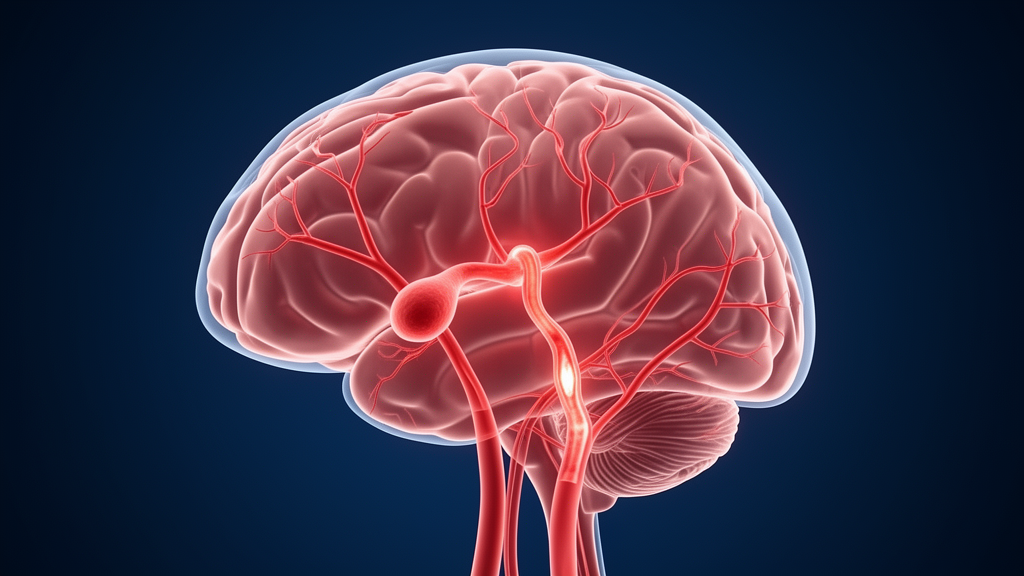
When a brain aneurysm ruptures, it sets off one of the most feared sequences in neurology: bleeding into the subarachnoid space, the fluid-filled compartments surrounding the brain, followed days later by vasospasm, a dangerous narrowing of cerebral arteries that can starve brain tissue of oxygen. A new exchange in the journal Neurocritical Care is now probing a deceptively simple question at the heart of that sequence. When patients with aneurysmal rupture also have an intracerebral hemorrhage, a bleed directly into brain tissue, does that hemorrhage truly raise the risk of vasospasm and delayed cerebral ischemia? Or is the apparent association merely a statistical shadow cast by where the aneurysm happens to sit?
The debate began with a study by Nada Babtain, Guilherme Neves, Danielle Sandsmark, and Rajat Dhar, published in Neurocritical Care in August 2026, which examined vasospasm and delayed cerebral ischemia in patients with aneurysmal rupture and intracerebral hemorrhage, comparing those with and without accompanying subarachnoid hemorrhage. Their analysis suggested that the presence of intracerebral blood was associated with vasospasm and ischemic complications, hinting that parenchymal hemorrhage might be an independent driver of delayed brain injury rather than a passive bystander.
That conclusion drew a challenge from a letter to the editor published on 16 October 2026. The letter writers argued that the association could be confounding rather than causation, specifically by aneurysm location. Their reasoning is technically grounded: aneurysms arising from the middle cerebral artery, particularly at its bifurcation, are far more likely to produce intracerebral hematomas because the rupture ejects blood directly into adjacent brain parenchyma. If middle cerebral artery aneurysms also happen to carry a different baseline risk of vasospasm, then any observed link between hemorrhage and spasm could simply reflect the mixture of aneurysm sites in the sample, not any biological effect of the parenchymal bleed itself.
In their response, also published on 16 October 2026, Babtain and Dhar, of the University of Pennsylvania and Washington University in Saint Louis School of Medicine respectively, defended their original interpretation. They argued that the confounding-by-location hypothesis, while plausible in principle, does not adequately account for the patterns observed in their data. Their central point is that intracerebral hemorrhage in aneurysmal rupture is not a homogeneous entity: the volume of parenchymal blood, the degree of accompanying subarachnoid blood, and the clinical trajectory of the patient all vary widely, and the association with vasospasm persisted across these variations in ways that aneurysm location alone could not explain.
The technical crux of the dispute lies in how epidemiologists disentangle correlated exposures. Aneurysm location, intracerebral hemorrhage, and subarachnoid hemorrhage are not independent variables; they are mechanically linked. A posterior circulation aneurysm, for instance, may rupture into the subarachnoid space with little parenchymal extension, while a middle cerebral artery aneurysm may do the opposite. Any regression model that includes all three must therefore contend with multicollinearity, the statistical condition in which predictors are so interrelated that their individual coefficients become unstable and hard to interpret. The letter writers contend that the original analysis may not have fully separated these overlapping signals, leaving open the possibility that location is the true driver of both hemorrhage risk and spasm risk.
Babtain and Dhar counter that the biological plausibility of a direct hemorrhage-to-spasm pathway should not be dismissed. Blood products from a parenchymal hematoma can extend into the subarachnoid space and ventricles, and the inflammatory and vasoactive cascade triggered by degraded blood components, including oxyhemoglobin and its breakdown products, is well documented as a trigger of arterial narrowing. From this perspective, intracerebral hemorrhage is not merely a marker of aneurysm site but a source of additional vasoactive burden that compounds the subarachnoid blood already present. The authors also note that their cohort included patients with intracerebral hemorrhage and varying degrees of subarachnoid blood, allowing them to examine the relationship across a spectrum rather than at a single point.
The exchange also touches on the clinical stakes of the question. If intracerebral hemorrhage is an independent risk factor for vasospasm and delayed cerebral ischemia, then patients with parenchymal bleeds warrant closer surveillance, more aggressive monitoring of cerebral blood flow, and potentially earlier prophylactic interventions, regardless of aneurysm location. If, on the other hand, the association is purely confounded by aneurysm site, then surveillance protocols should be tailored to aneurysm location rather than to the presence of a hematoma. The distinction is not academic: it shapes how neurointensivists allocate limited monitoring resources and how they counsel families about the risk of delayed deterioration in the days following aneurysm repair.
Neither side claims the debate is fully resolved. The response acknowledges that aneurysm location is an important variable and that any analysis of hemorrhage and spasm must control for it carefully. But the authors maintain that their findings, taken together with the known pathophysiology of blood-induced arterial narrowing, support treating intracerebral hemorrhage as a clinically meaningful exposure rather than a statistical artifact. The letter writers, for their part, have succeeded in forcing a more rigorous examination of the assumptions underlying the original study, a dynamic that ultimately strengthens the evidence base for neurocritical care practice.
For the broader research community, the exchange is a reminder of how easily correlated exposures in observational neurovascular data can masquerade as causal relationships, and how essential it is to interrogate confounding before accepting an association at face value. The full response, along with the original letter and the underlying study, is available in Neurocritical Care, published by Springer Nature, offering readers the complete record of a technical dispute that could influence how clinicians think about one of the most feared complications of aneurysm rupture.
Subject of Research: Response to: Intracerebral Hemorrhage and Vasospasm After Aneurysmal Rupture: Association or Confounding by Aneurysm Location
Article Title: Response to: Intracerebral Hemorrhage and Vasospasm After Aneurysmal Rupture: Association or Confounding by Aneurysm Location
Article References: Dhar, R., & Babtain, N. (2026). Response to: Intracerebral Hemorrhage and Vasospasm After Aneurysmal Rupture: Association or Confounding by Aneurysm Location. Neurocritical Care. https://doi.org/10.1007/s12028-026-02686-x
Image Credits: AI Generated
DOI: 10.1007/s12028-026-02686-x
Keywords: aneurysm, vasospasm, intracerebral hemorrhage, delayed cerebral ischemia, neurocritical care, cerebrovascular disorders, confounding, subarachnoid hemorrhage, Response, Intracerebral, Hemorrhage, Aneurysmal
Cite Scienmag News
Cassandra Pierce. (October 16, 2026). Aneurysm Location May Not Explain the Link Between Brain Bleeds and Vasospasm, Researchers Argue. Scienmag. https://scienmag.com/aneurysm-location-may-not-explain-the-link-between-brain-bleeds-and-vasospasm-researchers-argue/
Cassandra Pierce. "Aneurysm Location May Not Explain the Link Between Brain Bleeds and Vasospasm, Researchers Argue." Scienmag, 16 October 2026, https://scienmag.com/aneurysm-location-may-not-explain-the-link-between-brain-bleeds-and-vasospasm-researchers-argue/. Accessed 16 October 2026.
Cassandra Pierce. "Aneurysm Location May Not Explain the Link Between Brain Bleeds and Vasospasm, Researchers Argue." Scienmag. October 16, 2026. https://scienmag.com/aneurysm-location-may-not-explain-the-link-between-brain-bleeds-and-vasospasm-researchers-argue/


