


…
Periodontal disease remains one of the most common diagnoses encountered in companion animal practice, and its consequences extend well beyond the oral cavity. The condition begins when plaque biofilm accumulates along the gingival margin, triggering an inflammatory cascade that progressively destroys the soft tissue attachment and the supporting alveolar bone. In multi-rooted teeth such as the canine teeth, maxillary fourth premolars, and mandibular first molars, this destruction often manifests first in the furcation areas, the regions where the roots diverge and where the interradicular bone is particularly vulnerable to the combined mechanical and inflammatory forces of the disease. Because the furcation region has a complex three-dimensional anatomy and limited access for instrumentation, defects in these areas are notoriously difficult to resolve with debridement alone, which is precisely why regenerative adjuncts such as the cross-linked gelatin foam evaluated in this case series attract clinical interest.
The distinction between suprabony and infrabony pockets is central to understanding why the reported outcomes matter. In a suprabony pocket, the base of the pocket sits coronal to the crest of the alveolar bone, so the bony housing remains largely intact and the soft tissue wall of the defect faces a relatively level bony surface. In an infrabony pocket, the bone loss extends apically along the root, leaving the pocket base below the crest of the remaining bone and creating a vertical, walled defect. Combined defects, which featured prominently in this series, contain elements of both patterns within the same site. Infrabony and furcation components are the more challenging of the two because the bony walls can either support regeneration, if the space is maintained and the correct cells repopulate the defect, or permit ingrowth of the faster-migrating gingival epithelium and connective tissue, which produces a long junctional epithelial attachment rather than true regeneration of bone and periodontal ligament. This competitive healing dynamic is the biological rationale for placing a scaffold into a cleaned defect: the material occupies the space, supports clot stabilization and cell migration, and buys time for the slower-moving bone and ligament progenitors to establish themselves.
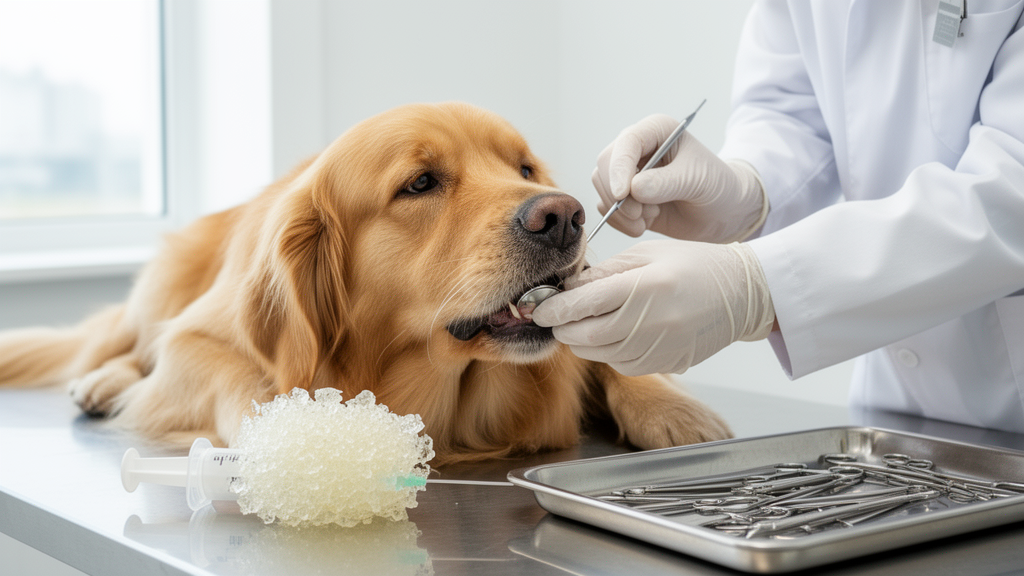
The scaffold itself is worth examining in more detail. Gelatin is derived from collagen, the dominant structural protein of the periodontium, and therefore presents cell-recognition motifs that are familiar to the migrating cells of the periodontal ligament and alveolar bone. Cross-linking with transglutaminase, an enzyme that forms covalent bonds between glutamine and lysine residues, stabilizes the gelatin matrix against rapid dissolution in the wet, enzyme-rich environment of an inflamed periodontal pocket while retaining biodegradability over the weeks needed for tissue ingrowth. The foam architecture creates an interconnected porous network, and pore size and interconnectivity are known determinants of how effectively cells infiltrate a scaffold, how vascularization proceeds, and how the material ultimately degrades. A flowable, injectable presentation is a practical advantage in veterinary dentistry because it allows the material to conform to irregular defect geometry without the need for a flap design that accommodates a rigid membrane or particulate graft, and it can be delivered through closed root planing sites as well as open surgical approaches.
The magnitude of the reported pocket depth reduction, a mean decrease of 1.9 millimeters across 21 treated sites, should be interpreted in the context of what is achievable with debridement alone. Mechanical therapy by itself typically produces pocket depth reductions, but the residual depth in deep infrabony and furcation defects tends to plateau, and the furcation component in particular rarely resolves without regenerative intervention. A mean reduction in furcation stage of 1.4 is clinically meaningful because furcation stages are stepwise categories: a tooth moving from a stage 2 furcation, where the probe extends more than halfway but not through the defect, to a stage 1 or stage 0 status represents a substantial recovery of the interradicular architecture. Similarly, a mean reduction of 0.8 in the periodontal stage of the treated teeth indicates that many sites shifted downward by a full stage on the four-stage AVDC severity scale, moving teeth away from the threshold at which extraction is typically recommended.
The imaging methodology deserves attention because it strengthens the credibility of the clinical findings. Cone beam computed tomography provides three-dimensional visualization of the alveolar bone at voxel resolutions on the order of 200 micrometers in this protocol, which is far more informative for furcation and infrabony defects than two-dimensional intraoral radiography alone. Furcation defects in particular are frequently underestimated on standard radiographs because the superimposition of the palatal or lingual cortical plate and the tooth roots can obscure the true extent of interradicular bone loss. The combination of computed radiography and CBCT, performed under general anesthesia at both baseline and recheck, allowed the investigators to document defect morphology before treatment and to reassess bony changes afterward, complementing the periodontal probing measurements that capture the soft tissue component of healing.
The follow-up interval in this series, with a mean of 169 days and a range extending from roughly three months to more than a year, spans the period during which periodontal healing matures. Early wound healing in a treated defect involves clot formation, granulation tissue ingrowth, and epithelial migration within the first weeks, while bone fill and periodontal ligament reorganization continue over months. Rechecks at this interval therefore capture not just immediate postoperative soft tissue response but a more stabilized outcome. The two-week conscious examination built into the protocol serves as an early check for wound dehiscence, inflammation, or material exposure, which are the common early failure modes for any regenerative periodontal therapy, particularly in furcation sites where the overlying soft tissue is thin and the defect communicates with the oral cavity.
It is also informative to consider the treatment allocation between closed and open root planing. Thirteen sites were managed with closed root planing, meaning the defect was debrided without elevating a flap, while eight sites received open root planing following envelope flap elevation, giving direct visual access to the root surfaces and the bony walls. Open approaches allow more thorough removal of diseased cementum and granulation tissue and permit assessment of the defect morphology, but they carry greater surgical burden and longer operative times. The fact that the scaffold was applied in both contexts suggests the material is compatible with minimally invasive delivery, which is relevant for primary care settings where advanced flap surgery and guided tissue regeneration may not be routinely performed. Guided tissue regeneration, the benchmark regenerative approach, requires membrane placement, flap design expertise, and meticulous soft tissue closure, and its technical demands have historically limited its adoption outside specialty practice.
The choice of strategic teeth for inclusion reflects the clinical stakes of the disease. Maxillary and mandibular canine teeth, maxillary fourth premolars, and mandibular first molars are the teeth whose loss most significantly compromises function, particularly in working and performance dogs, and they are also among the teeth most commonly affected by advanced periodontitis. Preserving these teeth, rather than extracting them, is the outcome that both owners and clinicians value most, and the periodontal staging framework used in the study provides a standardized vocabulary for communicating that value. A tooth that enters treatment at stage 3 or stage 4 periodontitis is a candidate for extraction under many treatment algorithms, so any therapy that reliably downstages such teeth expands the options available for tooth preservation.
Several biological principles underpin why a porcine-derived gelatin scaffold is a plausible candidate for periodontal regeneration. Xenogeneic collagen-based materials have a long history in bone and periodontal grafting because porcine collagen is closely homologous to mammalian collagen, is commercially processed to reduce immunogenicity, and provides a natural three-dimensional matrix that supports hemostasis by promoting platelet aggregation and clot retention. A stable clot within the defect is a prerequisite for regeneration, since the clot serves as the initial scaffold for granulation tissue and as a source of growth factors released from platelets. In furcation defects, where gravity, saliva, and tongue movement constantly threaten clot stability, a material that mechanically stabilizes the wound space addresses one of the principal reasons these defects heal poorly with debridement alone.
The single-practice, multi-operator design of the series introduces both strengths and limitations that readers should weigh. Having three different clinicians perform the treatments, with eleven, nine, and one site respectively, demonstrates that the technique is transferable across operators within a specialty setting, which is a modest but real signal of practical feasibility. At the same time, a case series without a concurrent control group cannot isolate the contribution of the scaffold from the effects of thorough debridement, open or closed root planing, professional maintenance, and the natural healing capacity of the periodontium. The absence of randomization and blinding means the reported improvements represent the combined effect of the full treatment protocol. Nonetheless, case series of this kind serve an important role in veterinary regenerative dentistry, where controlled trials are logistically difficult, by establishing that a therapy is feasible, apparently safe, and associated with clinically meaningful outcomes before larger comparative studies are undertaken.
The broader context of periodontal therapy in dogs also frames the significance of this work. Historically, the management of advanced periodontal disease in general practice has leaned heavily on extraction, both because of the technical demands of regenerative surgery and because diseased teeth are often identified late in the disease course. The authors note contributing factors that will resonate with practitioners: limited client awareness, the difficulty of detecting periodontal pathology in a conscious oral examination, the underuse of dental imaging, and inconsistent owner compliance with home care and recheck recommendations. Daily plaque control remains the foundation upon which any professional therapy rests, since no regenerative material can succeed in an environment where plaque biofilm is allowed to reaccumulate on the treated root surfaces. The scaffold, in this sense, is an adjunct to, not a substitute for, meticulous mechanical debridement and ongoing plaque control.
Finally, the availability of commercial regenerative options in veterinary dentistry has been limited, particularly products indicated for infrabony pockets and furcation defects rather than only suprabony pockets with antimicrobial delivery. An injectable, biodegradable, off-the-shelf scaffold that can be applied after routine root planing, whether closed or open, addresses a genuine gap in the therapeutic toolkit. If the findings of this case series are corroborated by controlled studies with larger cohorts, standardized recheck intervals, and longer-term imaging follow-up, this approach could broaden access to tooth-preserving periodontal care for dogs, shifting the management of advanced periodontal defects away from extraction and toward regeneration in a wider range of clinical settings.
Subject of Research: A clinical case series evaluation of cross-linked gelatin foam to treat naturally occurring periodontal pockets and furcation defects in dogs
Article Title: A clinical case series evaluation of cross-linked gelatin foam to treat naturally occurring periodontal pockets and furcation defects in dogs
Article References: Stepaniuk, K. S., Sievers, A. M., & Lalonde, A. A. (2026). A clinical case series evaluation of cross-linked gelatin foam to treat naturally occurring periodontal pockets and furcation defects in dogs. Frontiers in Veterinary Science, 13, Article 1917727. https://doi.org/10.3389/fvets.2026.1917727
Image Credits: AI Generated
DOI: 10.3389/fvets.2026.1917727
Keywords: dogs, periodontal disease, gelatin foam, veterinary dentistry, furcation defects, tissue scaffold, clinical, case, series, evaluation, cross-linked, gelatin
Cite Scienmag News
William Thompson. (October 16, 2026). Injectable Gelatin Foam Shows Promise for Saving Dogs’ Teeth From Advanced Gum Disease. Scienmag. https://scienmag.com/injectable-gelatin-foam-shows-promise-for-saving-dogs-teeth-from-advanced-gum-disease/
William Thompson. "Injectable Gelatin Foam Shows Promise for Saving Dogs’ Teeth From Advanced Gum Disease." Scienmag, 16 October 2026, https://scienmag.com/injectable-gelatin-foam-shows-promise-for-saving-dogs-teeth-from-advanced-gum-disease/. Accessed 16 October 2026.
William Thompson. "Injectable Gelatin Foam Shows Promise for Saving Dogs’ Teeth From Advanced Gum Disease." Scienmag. October 16, 2026. https://scienmag.com/injectable-gelatin-foam-shows-promise-for-saving-dogs-teeth-from-advanced-gum-disease/


