


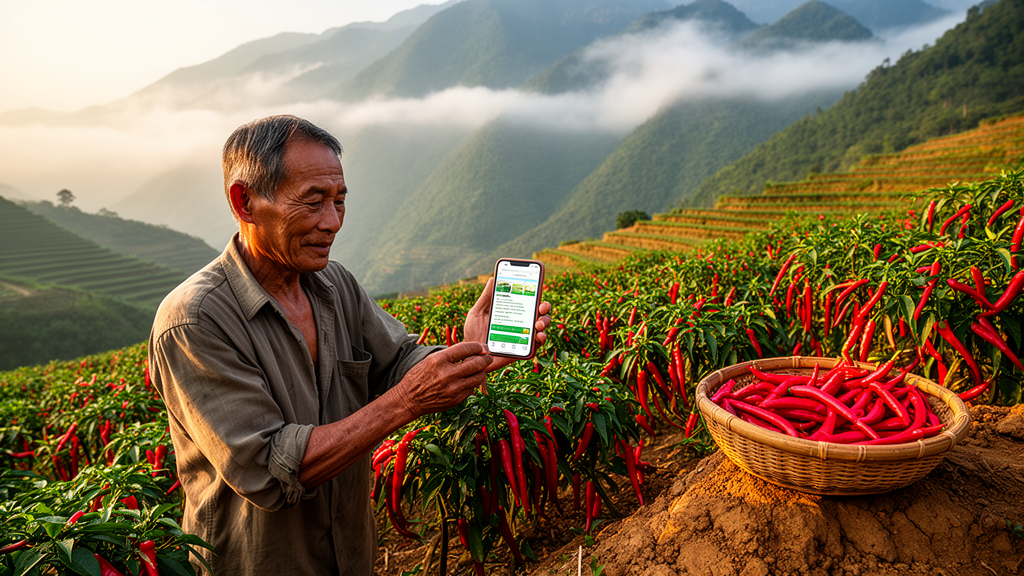
On the steep, terraced hillsides of Guizhou Province in southwestern China, chili pepper farmers are increasingly turning to their smartphones as a first line of defense against extreme weather. A new study published in Frontiers in Sustainable Food Systems provides some of the most detailed evidence yet that digital agricultural technology promotion, or DATP, is significantly and positively associated with farmers’ adoption of extreme climate adaptation technologies in mountainous farming systems. Drawing on survey data from 846 chili pepper farmers across five cities and prefectures, researchers Hongjuan Gao of Guizhou Education University and Huiqing Han of Guizhou Institute of Technology found that farmers who used digital devices to learn about climate adaptation technologies and participated in online exchanges or training adopted significantly more adaptation practices and expressed stronger willingness to continue using them than farmers who did not.
The stakes could hardly be higher for the region’s agricultural communities. Guizhou’s complex mountainous terrain, fragile ecosystems, and fragmented landholdings amplify farmers’ exposure to droughts, floods, heatwaves, cold spells, and other climate-related hazards while simultaneously constraining their capacity to absorb and recover from climate shocks. China’s agricultural sector experienced cumulative losses of approximately USD 137.1 billion between 2008 and 2018, accounting for 55 percent of global agricultural losses during that period. For smallholders in mountainous areas, where limited mechanization, small-scale production, and inadequate infrastructure restrict adaptive capacity, the consequences of extreme climate events can be particularly severe. Chili pepper production, which covers more than 5 million mu (approximately 333,000 hectares) in Guizhou and generates output value surpassing 2.86 billion USD, is especially sensitive to temperature fluctuations, precipitation variability, drought, excessive rainfall, and pest and disease pressures, making it an ideal crop for examining how farmers respond to climate risks.
DATP refers to the use of digital technologies, platforms, and communication tools to disseminate agricultural knowledge, technical information, production guidance, and technology-related services to farmers. Compared with conventional face-to-face agricultural extension, digital promotion can reduce the spatial and temporal constraints associated with technology dissemination, delivering timely information on weather conditions, crop management, production technologies, and adaptation options to farmers in remote and geographically fragmented areas. The researchers grounded their analysis in the Technology Acceptance Model, which proposes that perceived usefulness and perceived ease of use are fundamental cognitive determinants of users’ acceptance of new technologies. While the study used TAM primarily as a theoretical lens rather than directly testing its core constructs, the framework helps explain why farmers’ engagement with digitally mediated agricultural information may be associated with adaptation technology adoption: digital demonstrations, instructional videos, online consultations, and interactive technical services can provide farmers with information about how adaptation technologies work and how they can be implemented under local production conditions.
The survey was conducted between April and July 2023 through face-to-face household interviews using paper-based questionnaires. A three-stage multi-stage sampling procedure was employed, beginning with the selection of five cities and prefectures, Zunyi, Qiannan, Qianxinan, Qiandongnan, and Bijie, to capture differences in chili cultivation distribution, geographical conditions, and economic development. Counties were then ranked according to chili planting scale, and 13 counties were systematically selected, including Bozhou District, Xinpu District, Honghuagang District, Longli County, Guiding County, Weng’an County, Zongling County, and Zhijin County, among others. Finally, 35 villages were randomly selected from the sampled counties. Of the 900 questionnaires distributed, 893 were returned, and after screening for incomplete responses, logical inconsistencies, and missing key information, 846 valid questionnaires were retained, yielding an effective response rate of 94.0 percent.
The empirical analysis employed baseline regression with regional fixed effects and heteroskedasticity-robust standard errors, followed by mediation analysis, moderation analysis, and heterogeneity analysis. The core explanatory variable, DATP, was measured by asking farmers whether they had used communication devices such as mobile phones or computers to learn about extreme climate adaptation technologies via text, video, or live streaming and participated in online exchanges or training. Two dependent variables were considered: adoption degree, measured by the number of extreme climate adaptation technologies adopted, ranging from 0 to 6 across six categories including biological control, ecological management, soil management, water resource management, stress-resistant varieties, and intelligent prevention and control technologies; and sustained adoption willingness, measured on a five-point Likert scale. Among the 846 surveyed farmers, 57.5 percent reported using DATP, with mean adoption degree at 2.743 out of 6 and willingness to continue adoption averaging 3.182 out of 5.
The baseline regression results showed that DATP was significantly and positively associated with both adoption degree and sustained adoption willingness at the 1 percent level. The coefficients were 0.173 and 0.188 for adoption degree and 0.215 and 0.231 for sustained adoption willingness, respectively, remaining consistent across model specifications. In terms of magnitude, the estimated coefficients for adoption degree indicated an association of approximately 0.17 to 0.19 points on the 0-to-6 adoption-degree scale, equivalent to about 2.9 to 3.1 percent of the full scale, while the coefficients for sustained adoption willingness corresponded to approximately 4.3 to 4.6 percent of the five-point scale. Among the control variables, education level and health status were significantly and positively associated with both outcomes, as were chili cultivation area, labor force size, and disaster experience, while the proportion of agricultural income, gender, and age were not statistically significant.
Mediation analysis identified three potential pathways consistent with the positive association between DATP and adaptation adoption. DATP was significantly and positively associated with broadening information access channels, with a coefficient of 0.417; enhancing information trust, with a coefficient of 0.326; and improving information application ability, with a coefficient of 0.273, all at the 1 percent significance level. Each mediator was in turn significantly and positively associated with both adoption level and sustained adoption willingness, with coefficients of 0.142 and 0.187 for information access, 0.138 and 0.169 for information trust, and 0.121 and 0.145 for information application ability. These findings suggest that the association between digital agricultural promotion and adaptation behavior may operate through farmers’ information environment, encompassing not only greater access to digital information but also the credibility of that information and farmers’ ability to interpret and apply it in production decisions.
Moderation analysis further revealed that farmers’ benefit expectation confirmation and risk expectation confirmation significantly conditioned the association between DATP and adaptation behavior. Grounded in Expectation Confirmation Theory, which proposes that individuals form expectations before using a technology and subsequently compare perceived performance with those expectations, the analysis found that both interaction terms were positive and statistically significant at the 1 percent level. For adoption degree, the coefficients of benefit expectation confirmation multiplied by DATP and risk expectation confirmation multiplied by DATP were 0.102 and 0.085, respectively, while for sustained adoption willingness the corresponding coefficients were 0.269 and 0.217. The larger coefficient associated with benefit expectation confirmation for sustained adoption willingness suggests a stronger moderating association than that of risk expectation confirmation, indicating that when farmers perceive that experienced benefits meet or exceed prior expectations, the positive association between DATP and continued engagement with adaptation technologies becomes more pronounced.
Heterogeneity analysis indicated that the positive association between DATP and adoption varied across technology types, farmer groups, digital literacy levels, and chili planting scales. Across the six technology categories, the estimated coefficients ranged from 0.142 to 0.421, with the largest coefficients observed for water resource management at 0.421 and biological control at 0.374, while soil management, intelligent prevention and control, ecological management, and stress-resistant varieties showed comparatively smaller coefficients. The association was also relatively stronger among pure farmers, with coefficients of 0.224 and 0.293, than among Type I and Type II part-time farmers, with coefficients of 0.142 and 0.187 and 0.103 and 0.133, respectively. Farmers with higher digital information and social literacy showed stronger positive associations between DATP and both adoption outcomes than those with lower digital literacy, with coefficients for high digital information literacy reaching 0.326 and 0.408 compared with 0.084 and 0.133 among low-literacy farmers. Similarly, large-scale chili farmers exhibited larger coefficients, 0.327 and 0.415, than small-scale farmers, 0.132 and 0.162.
The authors acknowledge several limitations that warrant caution when interpreting the findings. The binary measurement of DATP does not capture the frequency, intensity, diversity of platforms, information quality, or interactions with agricultural experts, and the crop- and region-specific sample may limit generalizability beyond chili pepper farmers in Guizhou. Self-reported survey data may introduce measurement and response biases, the cross-sectional design limits the identification of temporal ordering and causal relationships, and potential omitted-variable bias and selection into DATP use should be considered, as farmers who engage with DATP may differ from other farmers in terms of access to agricultural extension services, household resources, digital infrastructure, smartphone ownership, cooperative membership, and market access. The estimated associations should therefore be interpreted as statistical associations rather than definitive causal effects. Nevertheless, the findings highlight the relevance of information access, information credibility, digital capabilities, and farmer heterogeneity in understanding digital approaches to climate adaptation in mountainous agricultural areas, providing empirical evidence for developing differentiated digital strategies to support farmers’ climate adaptation across technology types, farmer groups, and scales of production.
Subject of Research: Digital agricultural technology promotion is significantly and positively associated with chili pepper farmers' adoption of extreme climate adaptation technologies in mountainous Guizhou, China, operating through broader information access channels, greater information trust, and stronger information application ability, with benefit and risk expectation confirmation moderating the association and the strongest associations observed for water resource management and biological control technologies among pure farmers, farmers with higher digital literacy, and large-scale chili farmers.
Article Title: Association between digital agricultural technology promotion and farmers’ adoption of extreme climate adaptation technologies: evidence from chili pepper farmers in Guizhou Province, China
Article References: Gao, H., & Han, H. (2026). Association between digital agricultural technology promotion and farmers’ adoption of extreme climate adaptation technologies: evidence from chili pepper farmers in Guizhou Province, China. Frontiers in Sustainable Food Systems, 10, Article 1914305. https://doi.org/10.3389/fsufs.2026.1914305
Image Credits: AI Generated
DOI: 10.3389/fsufs.2026.1914305
Keywords: digital agriculture, climate adaptation, chili pepper farmers, Guizhou Province, extreme climate, agricultural extension, mountainous agriculture, sustainable food systems, China, technology adoption, Association, between
Cite Scienmag News
Sloane Callahan. (October 16, 2026). Digital Agricultural Extension Linked to Climate Adaptation Among Chili Farmers in Mountainous China. Scienmag. https://scienmag.com/digital-agricultural-extension-linked-to-climate-adaptation-among-chili-farmers-in-mountainous-china/
Sloane Callahan. "Digital Agricultural Extension Linked to Climate Adaptation Among Chili Farmers in Mountainous China." Scienmag, 16 October 2026, https://scienmag.com/digital-agricultural-extension-linked-to-climate-adaptation-among-chili-farmers-in-mountainous-china/. Accessed 16 October 2026.
Sloane Callahan. "Digital Agricultural Extension Linked to Climate Adaptation Among Chili Farmers in Mountainous China." Scienmag. October 16, 2026. https://scienmag.com/digital-agricultural-extension-linked-to-climate-adaptation-among-chili-farmers-in-mountainous-china/


