


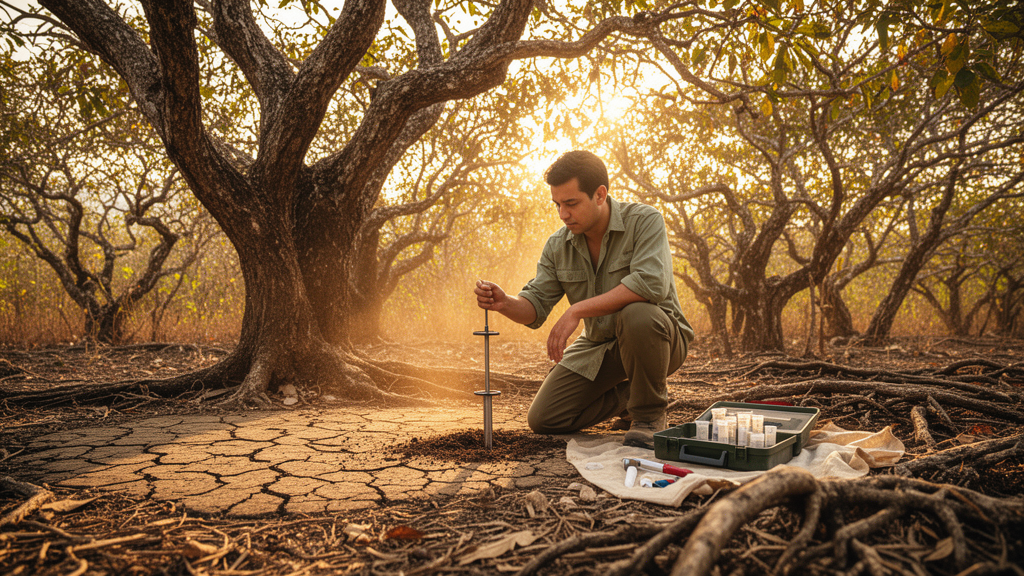
Beneath the cracked, sun-baked soils of Colombia’s tropical dry forests lies a biological universe that scientists have barely begun to chart. A new study published in Frontiers of Biogeography has now delivered the first cross-kingdom portrait of this hidden world, using soil environmental DNA to catalog bacteria, fungi, protists, plants, insects, and earthworms across eleven forest fragments spanning four distinct biogeographic regions of the country. The findings reveal that tropical dry forests harbor a belowground biota strikingly different from that of their rainforest cousins, dominated by organisms specially adapted to survive months without rain.
Tropical dry forests are defined by prolonged dry seasons, and although they support exceptionally rich floras, they rank among the most threatened biomes on Earth. In the Americas, which hold roughly 54 percent of the biome’s global area, an estimated 66 percent of the original forest cover has already been lost, with deforestation rates running six times higher than in Asia and Africa. Because these forests grow on fertile soils that are prized for agriculture, they have historically attracted intensive human exploitation, and the remaining fragments suffer widespread degradation and limited legal protection. Yet while the trees of these forests have received considerable attention, the life teeming within the soil itself has remained almost entirely undocumented.
The research team, working at eleven sites distributed from the arid Guajira Peninsula in the north through the inter-Andean valleys of the Cauca and Magdalena rivers to the isolated Patía valley in the south, sampled soils during the dry season between November 2018 and February 2019. Each site consisted of a one-hectare plot subdivided into a 20 by 20 meter sampling grid, yielding sixteen composite soil cores per plot. In total, the researchers collected 176 soil samples for DNA analysis and 44 samples for physicochemical characterization, covering elevations from 19 to 1,180 meters above sea level.
The molecular approach relied on eDNA metabarcoding, a technique that amplifies and sequences taxonomically informative DNA regions extracted directly from environmental samples. The team targeted six genetic markers spanning the tree of life: chloroplast trnL for plants, mitochondrial 16S for insects, mitochondrial 12S for oligochaete worms, ITS1 for fungi, 18S rRNA for eukaryotes, and 16S rRNA for bacteria. Rigorous filtering removed contaminants, PCR chimeras, and tag-jump artifacts, and the sequencing effort ultimately produced nearly 100 million reads representing 94,015 molecular operational taxonomic units across all markers and sites.
The taxonomic composition that emerged paints a vivid picture of drought-adapted life. Bacterial communities were dominated by Actinomycetota, a clade previously associated with dry environments and even desert soils, rather than the Acidobacteriota that typically prevail in wetter tropical forest soils. Among fungi, arbuscular mycorrhizal fungi of the class Glomeromycetes were unusually abundant, consistent with reports that these symbionts reach higher diversity in dry ecosystems than in humid tropical forests. Protists showed an elevated relative abundance of Amoebozoa, a group renowned for its drought resistance, while nematodes were conspicuously rare, echoing earlier observations that tropical soils are depauperate in these worms.
The soil mesofauna told a similar story of dry-adapted specialization. Insects detected in the samples consisted mainly of ants, beetles, and termites, groups known to contribute the bulk of soil arthropod biomass in tropical dry forests. Earthworms dominated the oligochaete marker, but enchytraeids, which are known to be sensitive to drought, were scarce. Intriguingly, the researchers also detected Tubificida, oligochaetes typically found in aquatic ecosystems, some of which form drought-resistant cysts that persist near the soil surface. Even the plant DNA recovered from the soil reflected the biome’s signature flora, with Fabaceae and Euphorbiaceae among the most represented families.
Beyond cataloging who lives in these soils, the study probed what governs their distribution. Using variation partitioning analyses that separated the effects of climate, soil properties, and biogeographic region, the researchers uncovered a fundamental divide between microorganisms and macroorganisms. Microbial alpha and beta diversity were primarily shaped by soil physicochemical conditions and climate, with bacteria proving more sensitive to aridity than fungi. Bacterial diversity increased with humidity but decreased with soil fertility, possibly reflecting the dominance of a few fast-growing copiotrophic taxa in nutrient-rich soils. Fungal diversity, by contrast, was highest in the most arid region, Guajira, a pattern that contrasts with global-scale trends and underscores the distinctive ecology of dry tropical soils.
Macroorganisms followed a different rulebook. Plants, insects, and earthworms displayed marked compositional differences among regions that were only weakly explained by measured environmental variables. Instead, most of their variation was associated with the sampled region itself, reflecting a strong biogeographic structure consistent with isolation by distance. The proportion of variation explained by all tested predictors declined steadily with organism size, from 71 percent in bacteria to just 11 percent in insects. This pattern suggests that larger soil organisms disperse less readily, allowing historical processes such as Andean uplift and the post-Pleistocene fragmentation of dry forest corridors to leave lasting imprints on their regional species pools.
Cross-kingdom co-variation analyses added another layer of complexity. Mantel tests revealed significant correlations in community composition between nearly all pairs of taxonomic groups, even after controlling for environmental dissimilarity and site identity. Associations were strongest among microbial groups, with bacteria and protists showing a correlation of 0.66, hinting at genuine biotic interactions such as bacterivory by protists or competition between bacteria and fungi. Weaker but significant correlations between plants and microbes may reflect the prevalence of Fabaceae, which partner with rhizobial bacteria, as well as the influence of plant litter chemistry on decomposer communities.
The implications for conservation are substantial. Because no single taxonomic group can serve as a reliable proxy for the rest of the soil community, restoration and management plans built solely on plant surveys will miss critical dimensions of belowground biodiversity. The study also establishes a vital baseline against which the effects of land-use change and restoration actions can be measured in these fragile environments. As tropical dry forests continue to vanish faster than almost any other tropical biome, understanding the invisible ecosystems beneath their roots may prove just as urgent as protecting the trees themselves, and environmental DNA offers a powerful new lens through which to do so.
Subject of Research: Soil biodiversity and its biogeographic drivers in Colombian tropical dry forests
Article Title: Biogeography of tropical dry forest soils
Article References: Biogeography of tropical dry forest soils. (n.d.). https://doi.org/10.21425/fob.19.182141
Image Credits: AI Generated
Keywords: tropical dry forest, soil biodiversity, environmental DNA, metabarcoding, biogeography, Colombia, microbiome, soil mesofauna, aridity, conservation, fungi, bacteria
Cite Scienmag News
Morgan Morrow. (October 16, 2026). Soil DNA Reveals a Hidden Dry-Adapted World Beneath Colombia’s Tropical Dry Forests. Scienmag. https://scienmag.com/soil-dna-reveals-a-hidden-dry-adapted-world-beneath-colombias-tropical-dry-forests/
Morgan Morrow. "Soil DNA Reveals a Hidden Dry-Adapted World Beneath Colombia’s Tropical Dry Forests." Scienmag, 16 October 2026, https://scienmag.com/soil-dna-reveals-a-hidden-dry-adapted-world-beneath-colombias-tropical-dry-forests/. Accessed 16 October 2026.
Morgan Morrow. "Soil DNA Reveals a Hidden Dry-Adapted World Beneath Colombia’s Tropical Dry Forests." Scienmag. October 16, 2026. https://scienmag.com/soil-dna-reveals-a-hidden-dry-adapted-world-beneath-colombias-tropical-dry-forests/


