


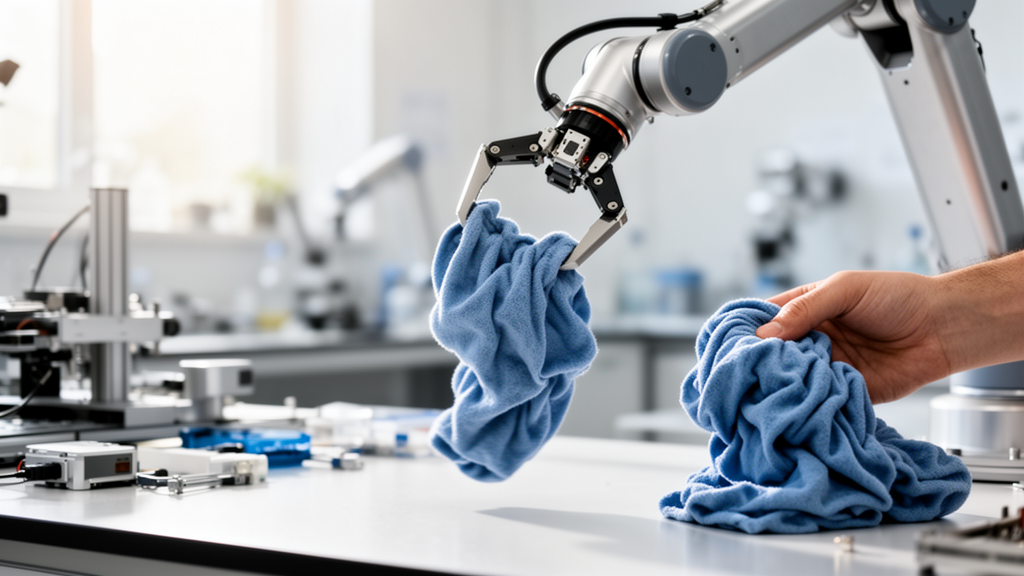
Robots have long struggled with one of the simplest things humans do every day: picking up a piece of cloth. Now a team of researchers in China has built a robotic system that grasps crumpled, tangled, and stacked fabrics with a success rate of 93.3 percent, by imitating the way humans perceive raised structures on fabric surfaces and make fuzzy, experience-driven decisions about where to grab. The work, published in Frontiers in Robotics and AI, could accelerate automation in domestic service, medical care, and industrial laundry, where fabric sorting remains a stubborn bottleneck for robots.
The challenge is deceptively hard. Unlike rigid objects, fabrics are flexible, easily deformable, and prone to self-occlusion, meaning that parts of a garment can hide other parts from view. When clothes are piled in a heap, severe occlusion and morphological distortion make it difficult for a robot to identify regions with any operational significance. Existing approaches have tried to solve this by detecting local features such as edges, wrinkles, and corners, or by segmenting semantic structures like collars and cuffs. But in stacked and entangled scenes, these cues often become unreliable, leading to misjudgments about where and how to grasp.
The research team, led by Jinde Chen of South China University of Technology and Hubo Chu of Guangdong Ocean University, took a different approach. They observed that when humans handle complex fabric grasping tasks, they typically rely on two mechanisms: local structural perception and experience-driven fuzzy decision-making. Humans first visually perceive raised structures on the fabric surface, then combine local geometric features with the overall stacking state to evaluate multiple candidate grasp poses and select the optimal one. Inspired by this observation, the researchers modeled stacked-fabric grasp-pose localization as two key processes: structural perception and fuzzy decision-making.
The first stage of the system uses point cloud geometric features to extract convex structural regions from fabric surfaces. A depth camera captures a three-dimensional point cloud of the scene, which is preprocessed using voxel downsampling and statistical filtering to remove noise. The researchers then apply principal component analysis to model the geometric distribution of local neighborhoods, computing eigenvalues that characterize surface variation in the normal and tangent-plane directions. For approximately flat regions, the dispersion in the normal direction is very small, while for locally curved regions it increases, indicating the presence of wrinkles or protrusions. A curvature threshold extracts high-curvature points, and a convexity criterion further distinguishes convex from concave variations, since convex feature points are more suitable for grasping.
Once convex feature points are identified, they are clustered into region-level structural units using the Density-Based Spatial Clustering of Applications with Noise algorithm, applied in a joint geometric feature space that combines spatial coordinates, normal directions, principal tangent directions, and curvature values. For each convex feature region, the system generates a candidate grasp pose by computing the geometric center of all points in the region and adding an adaptive offset along the approach direction, ensuring that the gripper can approach the target from outside the object without collision. A grasp-width constraint filters out poses that exceed the maximum gripper opening width, resulting in an operationally feasible candidate pose set.
The second stage addresses a subtler problem: how to select the best grasp pose from multiple feasible candidates. Because fabrics lack fixed structural patterns, different candidate poses exhibit significant differences in grasp feasibility, grasp stability, and single-layer separation capability. Evaluation methods that rely solely on geometric features cannot comprehensively characterize pose quality. The researchers proposed a Hierarchical Fuzzy Neural Network that simulates the human fuzzy decision-making process. The network takes three inputs: a global point cloud image representing the overall scene, a local point cloud corresponding to each candidate pose, and the six-dimensional pose parameters themselves.
To extract multi-level features, the network uses a hierarchical structure with a global layer based on a convolutional neural network, a local layer using a PointNet encoder, and a pose layer mapped through a multilayer perceptron. An attention aggregation strategy then adaptively fuses these features, allowing dimensions more strongly related to attribute discrimination to receive higher weights. The network adopts a multi-head structure with shared features and independent outputs for membership prediction, where each head outputs logits corresponding to three linguistic variables: Low, Medium, and High, for each of the three evaluation attributes. Fuzzy rule-based reasoning then combines these membership degrees to produce a comprehensive score for each candidate pose.
The fuzzy rule base contains 27 rules, jointly agreed upon by several experts with relevant experience. When all three attributes are High, the comprehensive evaluation is Excellent with a score of 100; when all three are Low, the evaluation is Very Poor with a score of 40. Intermediate combinations receive scores between 90 and 50. The rules are preset by experts and are not treated as learnable network parameters, ensuring consistency between the training objective and the format of manually annotated data. The model is trained using a multi-attribute supervised learning strategy with cross-entropy loss functions, and the Adam optimizer updates parameters through backpropagation.
Comparative experiments on a constructed fabric grasping dataset showed that the proposed method outperformed several baseline models. Compared with the best-performing baseline, the method improved prediction accuracy of grasp feasibility, grasp separation effectiveness, and grasp reliability by 1.3 percent, 0.3 percent, and 0.7 percent respectively. Robotic grasping experiments further demonstrated a grasp success rate of 93.3 percent in randomly stacked scenarios, compared with 80.0 percent for a method using manually designed scoring. The 13.3 percent improvement verifies that the fuzzy inference module can effectively evaluate candidate poses and select better grasp positions.
The results demonstrate that integrating convex structure perception with hierarchical fuzzy decision-making provides an effective and interpretable strategy for grasp pose localization and selection in stacked-fabric grasping. Unlike black-box deep learning models that lack explicit decision mechanisms, the proposed approach reflects the experience and preferences involved in human grasping, offering transparency alongside strong performance. As robots continue to expand into environments filled with soft, deformable objects, this human-inspired framework points toward a future where machines can handle the messy reality of crumpled clothes with the same intuitive confidence as their human counterparts.
Subject of Research: Robotics
Article Title: Grasping like humans: a stacked-fabric grasp localization strategy based on convex structure perception and hierarchical fuzzy decision-making
Article References: Chen, J., Chu, H., Chao, Z., & Zhang, T. (2026). Grasping like humans: a stacked-fabric grasp localization strategy based on convex structure perception and hierarchical fuzzy decision-making. Frontiers in Robotics and AI, 13, Article 1917009. https://doi.org/10.3389/frobt.2026.1917009
Image Credits: AI Generated
DOI: 10.3389/frobt.2026.1917009
Keywords: robotics, fabric grasping, fuzzy logic, point cloud perception, human-robot imitation, deformable objects, artificial intelligence, Grasping, like, humans, stacked-fabric, grasp
Cite Scienmag News
Denise Maddox. (October 16, 2026). Robots Learn to Grasp Crumpled Fabric the Way Humans Do. Scienmag. https://scienmag.com/robots-learn-to-grasp-crumpled-fabric-the-way-humans-do/
Denise Maddox. "Robots Learn to Grasp Crumpled Fabric the Way Humans Do." Scienmag, 16 October 2026, https://scienmag.com/robots-learn-to-grasp-crumpled-fabric-the-way-humans-do/. Accessed 16 October 2026.
Denise Maddox. "Robots Learn to Grasp Crumpled Fabric the Way Humans Do." Scienmag. October 16, 2026. https://scienmag.com/robots-learn-to-grasp-crumpled-fabric-the-way-humans-do/


