


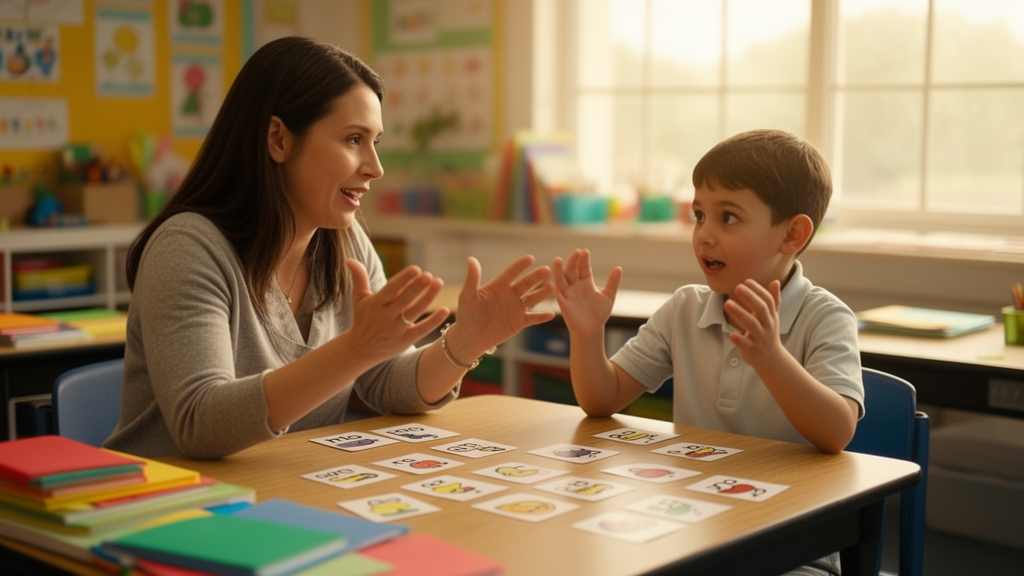
A team of researchers from the University of Macau, the Open Universiteit of the Netherlands, and Erasmus University Rotterdam has found that gesture-based vocabulary instruction may help students in special education learn new words, but the benefit appears to depend critically on how often students receive the lessons. The exploratory intervention study, published in Educational Psychology Review, involved 44 Dutch primary-school children attending a special education school and offers some of the first experimental evidence on embodied learning techniques in this under-studied population.
Embodied cognition holds that thinking is not confined to the brain but is shaped by the body’s interactions with the world. Decades of research, from foundational theories of metaphor and grounding to modern neuroimaging linking language and motor systems, suggest that movement can enrich how we encode and retrieve information. Gestures, in particular, have attracted attention in educational research because they combine verbal content with motor activity, potentially giving learners two complementary routes into a new concept. Meta-analyses have documented that gesture can improve comprehension, and studies in mainstream classrooms have shown that children learning foreign-language vocabulary benefit when lessons incorporate physical movement.
Yet evidence in special education settings has remained scarce, despite theoretical reasons to expect both promise and risk. Many students in special education, such as those with autism spectrum disorder or ADHD, show differences in motor control, working memory, and executive function. Cognitive load theory offers a framework for thinking about when gestures might help or hinder such learners. If a gesture reduces the mental effort needed to connect a word’s sound to its meaning, it offloads work from a limited working memory system. But if the gesture itself demands attention and coordination, it could add rather than relieve cognitive load. Fred Paas and colleagues have argued for integrating these two theories, proposing that the human motor system can serve as an additional memory resource, and a 2024 meta-analysis grounded in cognitive load theory found overall support for embodied learning, while cautioning that effects depend on task design and learner characteristics.
The new study addressed this gap directly. The researchers taught vocabulary to 44 children using a carefully structured design that crossed three factors. The first was word type: some target words referred to manipulable objects, while others were abstract. The second was gesture: for half of the students, selected randomly, lessons included gestures; the other half received identical instruction without them. The third was lesson frequency: some students had one lesson on the vocabulary, while others received two.
That third factor carries an important methodological caveat. Gesture use was randomized at the student level, meaning the comparison between gesture and no-gesture conditions was experimentally controlled. Lesson frequency, however, varied quasi-experimentally. During the first phase of data collection, the researchers observed floor performance, with children scoring near the bottom of the assessment regardless of condition. In response, they introduced a second lesson for later participants. This decision, while pragmatically sensible, means the lesson-frequency comparison was not randomized and could be confounded with other differences between the two phases of the study.
Learning was measured with a 20-point composite performance test. The key result was a significant interaction between gesture use and lesson frequency. In the two-lesson condition, students who received gesture-supported instruction outperformed those taught without gestures. After a single lesson, however, no difference between the gesture and no-gesture groups was observed. Notably, word type did not moderate this pattern: the advantage of gestures in the repeated-lesson condition held regardless of whether the words named manipulable objects or abstract concepts, a finding that speaks to ongoing debates about whether embodiment matters more for concrete than abstract vocabulary.
Why might gestures need repetition to show their value? One interpretation, which the authors describe as an embodied-cognitive load account, is that gestures initially impose processing demands on learners who must simultaneously attend to speech, meaning, and movement. With repeated exposure, that overhead diminishes while the mnemonic benefits of the motor encoding persist and accumulate across lessons. Consistent with the broader vocabulary literature, repetition alone is a well-established driver of word learning, and gestures may amplify what repetition builds. An alternative reading is more sobering: because cognitive load was not directly measured in this study, and because lesson frequency was not randomized, the data are consistent with the embodied-cognitive load account but do not test it directly. The researchers are explicit that the findings should be treated as preliminary.
The practical implications for special education are nonetheless intriguing. If gestures truly function like a cognitive load reducer whose benefits emerge over time, then the timing of their introduction in a curriculum matters. A one-off gesture-enriched lesson, the sort of design common in previous research with neurotypical children, may understate what gestures can do for learners who need more support and more practice. Teachers in special education settings, where lesson pacing is often adjusted to individual needs, may find that pairing movement-based techniques with deliberate repetition offers a low-cost way to enrich vocabulary instruction, though the quasi-experimental nature of the frequency comparison means this should be treated as a hypothesis to be verified rather than an established prescription.
The study also contributes to a broader scientific conversation about how the body shapes learning. Recent theoretical work has proposed a synergy between embodied cognition and cognitive load theory as a route to optimized instruction, and researchers continue to map how different degrees of bodily engagement, from observing gestures to performing whole-body movements, affect learning outcomes, motivation, and mental effort. Much of this work has been conducted with university students or typically developing children. Extending it to special education populations is essential, because theories built on one population do not automatically transfer to another, particularly when the populations differ in the very systems, motor, attentional, and memory-related, that embodied theories place at the center of cognition.
The researchers emphasize that the study was exploratory, and its limitations are part of its scientific value. The sample size was modest, the lesson-frequency manipulation was introduced in response to floor effects rather than random assignment, and cognitive load was never directly assessed. Future work should replicate the gesture-by-frequency interaction with randomized lesson schedules and validated load measures, ideally across a range of special education diagnoses and age groups. If the pattern holds, the message would be a hopeful one: for learners who often face the steepest barriers in language learning, the simplest intervention may be combining the oldest tools in pedagogy, movement and repetition, in ways that modern cognitive theory is only beginning to explain.
Subject of Research: Gesture-supported vocabulary instruction and lesson frequency in special education students
Article Title: Gesture-Based Vocabulary Instruction in a Special Education Context: Exploratory Evidence on Gesture Use and Lesson Frequency
Article References: Lin, L., van Bergen, A., Xu, K. M., Ouwehand, K., & Paas, F. (2026). Gesture-Based Vocabulary Instruction in a Special Education Context: Exploratory Evidence on Gesture Use and Lesson Frequency. Educational Psychology Review, 38(1), Article 133. https://doi.org/10.1007/s10648-026-10228-2
Image Credits: AI Generated
DOI: 10.1007/s10648-026-10228-2
Keywords: embodied cognition, gesture, vocabulary learning, special education, cognitive load theory, primary school, lesson frequency, word learning, instructional design, quasi-experimental study, Educational Psychology Review, Gesture-Based
Cite Scienmag News
Courtney Benton. (October 16, 2026). Hand Gestures Boost Vocabulary Learning in Special Education, But Only After Repeated Lessons. Scienmag. https://scienmag.com/hand-gestures-boost-vocabulary-learning-in-special-education-but-only-after-repeated-lessons/
Courtney Benton. "Hand Gestures Boost Vocabulary Learning in Special Education, But Only After Repeated Lessons." Scienmag, 16 October 2026, https://scienmag.com/hand-gestures-boost-vocabulary-learning-in-special-education-but-only-after-repeated-lessons/. Accessed 16 October 2026.
Courtney Benton. "Hand Gestures Boost Vocabulary Learning in Special Education, But Only After Repeated Lessons." Scienmag. October 16, 2026. https://scienmag.com/hand-gestures-boost-vocabulary-learning-in-special-education-but-only-after-repeated-lessons/


