


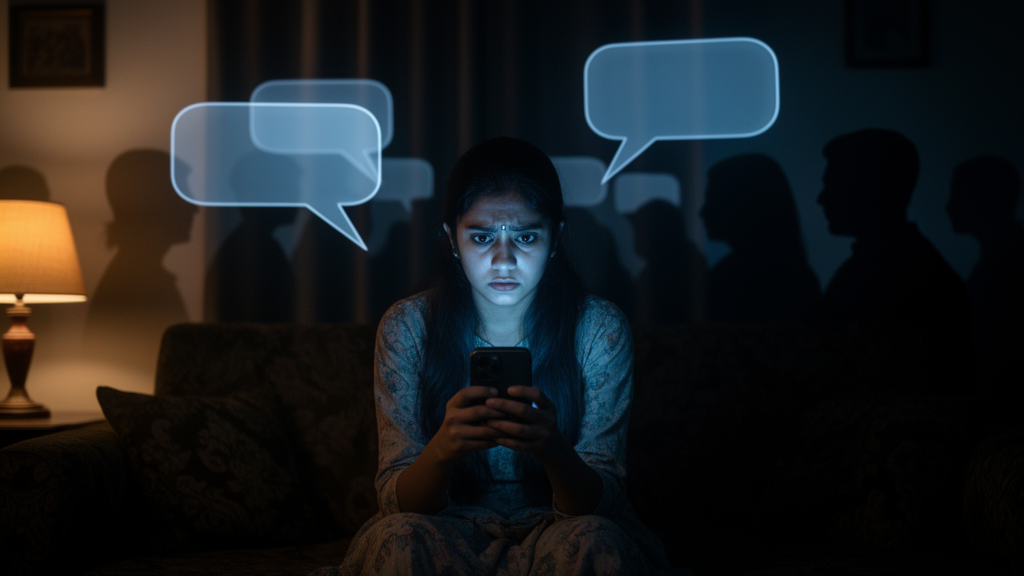
When a rape case dominates the news in India, the conversation does not stay confined to television studios or newspaper columns. It spills into the comment sections of YouTube, where millions of viewers react in real time to documentaries, news reports and explainer videos about real-life cases. A new study published in Discover Global Society has mined those reactions systematically, analysing comments on 26 YouTube videos about actual rape cases in India to map what the public actually feels and says about sexual violence. The results paint a picture of a digital public sphere dominated by negative sentiment, deep distrust of the legal system, competing narratives about gender, and occasional but striking expressions of empathy for survivors.
The research, conducted by Sravya Palla and Vipin Vijan Nair of the Jindal Institute of Behavioural Sciences at O.P. Jindal Global University, sits against a grim statistical backdrop. According to the National Crime Records Bureau, 29,536 rape cases were recorded in India in 2024, with Rajasthan reporting the highest number among the states listed in the study. The Public Health Foundation of India has documented a 70 percent rise in rape incidents over two decades, from 18,359 reported cases in 2005 to a peak of 38,947 in 2016, before a slight decline to 31,677 in 2021. In 2022, rape accounted for 7.1 percent of all crimes against women. High-profile cases such as the 2012 Nirbhaya case in Delhi, the 2017 Unnao case, the 2019 Hyderabad veterinary doctor case and the 2020 Hathras case shocked the nation and drew international attention to the brutality of such crimes.
To capture how ordinary people respond to these events, the researchers turned to YouTube, a platform with more than two billion registered users and over 500 hours of video uploaded every hour. Unlike conventional media reports, YouTube comment sections offer access to audience-generated discourse rather than journalist-produced narratives. The study is grounded in Uses and Gratifications Theory, a communication framework that treats audiences as active media users who select and engage with content to fulfil particular needs, whether information seeking, emotional expression, social interaction or identity work. In this view, a comment under a rape-case documentary is not just a reaction; it is a form of participation through which users articulate their views on justice, gender and victimisation.
The methodology combined qualitative content analysis with descriptive quantitative sentiment analysis. The researchers shortlisted videos using strict criteria: the content had to concern real-life Indian rape cases, and each video needed more than 100,000 views, more than 500 comments, over 100,000 likes, and a channel with more than 200,000 subscribers. Only videos uploaded between 1 January 2022 and 31 January 2024 were included, a deliberate cutoff before the implementation of India’s new criminal laws, the Bharatiya Nyaya Sanhita, the Bharatiya Nagarik Suraksha Sanhita and the Bharatiya Sakshya Adhiniyam, to prevent legal changes from contaminating the sentiment data. Comments in English and Hindi written in English were retained, and 26 videos ultimately made the final dataset. Usernames and participant identifiers were stripped during extraction to preserve anonymity, and the researchers explicitly avoided inferring commenters’ gender, age or location from pseudonyms or profile details.
The analytical pipeline was rigorous. Comments were exported, pre-processed to remove filler words, and coded using ATLAS.ti, a computer-assisted qualitative data analysis package. Two researchers coded the dataset independently, achieving 87 percent agreement on a 10 percent subset before resolving disagreements through discussion. Sentiment was assigned manually based on the emotional polarity of words in context: terms like ‘rape’, ‘false’, ‘accusations’, ‘violence’ and ‘stigma’ anchored the negative category, while ‘innocent’, ‘equality’, ‘hope’, ‘support’ and ‘rights’ characterised positive comments. Neutral comments simply stated facts without taking a stance. The team also conducted co-occurrence analysis to identify which words tend to appear together, revealing the semantic architecture of the discourse.
The headline finding is unambiguous: negative comments predominated across all 26 videos. The most-commented video attracted 1,969 comments, of which 1,026 were negative, while even the least-discussed video yielded 34 negative comments against just 5 positive ones. Yet the word-level data contained a paradox. Positive emotion words actually appeared with higher frequency than negative ones, but sentence-level analysis showed that negative emotions dominated overall. The researchers suggest this reflects how individual words of hope or support are embedded within sentences that ultimately express anger, frustration or despair about the state of justice and gender relations in India.
From the coded comments, five dominant themes emerged. The first, justice and public distrust in legal institutions, was the most voluminous, with justice-related words appearing 5,682 times and punishment-related terms 1,075 times. Commenters demanded fair trials, accountability and effective institutional responses, with one writing, ‘Hope justice is delivered both for the victim and for the father.’ Others pushed for deterrence through severity, arguing, ‘If the punishment is harsh, then anyone will think 100 times before doing it again.’ The second theme, victim-blaming and gendered social attitudes, contained the largest vocabulary of all, with gender-related words appearing 10,196 times. Here the discourse fractured: some comments condemned the dehumanisation of women, while others reproduced patriarchal logic, as in the remark, ‘This is what happens when you give women too free space.’ Discussions of consent and feminism were similarly contested, with some users affirming sexual autonomy and others questioning whether feminist advocacy remained necessary given formal legal equality.
The remaining themes revealed the social and cultural layers of the discourse. Media and social influence comments, appearing 452 times for media-related terms and 3,540 times for community-related terms, positioned films, news and the internet as powerful shapers of perception, and located prevention in families, schools and everyday socialisation, with comments like ‘Family need to teach their kids values and respect’ and ‘We should teach our son/brother/friend how to treat a woman.’ Emotional responses and survivor support captured both empathy, through words like ‘support’, ‘courage’ and ‘humanity’, and trauma, fear and outrage, with commenters attempting to imagine victims’ suffering. The fifth theme, religious and communal narratives, showed how discussions of rape could slide into questions of caste, religion and political identity, with words like ‘God’, ‘caste’, ‘Hindus’ and ‘Muslims’ appearing hundreds of times, shifting attention from the criminal act itself to communal identification.
The co-occurrence analysis added technical texture to these themes. ‘Anger’ clustered most often with ‘criticism’, ‘disgust’, ‘gender’ and ‘social issues’, signalling widespread frustration with gender relations. ‘False accusations’ emerged as a recurring node, intertwined with justice, legal aid, sympathy and violence, indicating that a substantial strand of public opinion sympathises with the wrongly accused and links perceived misuse of the law to broader gender tensions. ‘Misuse of justice’ connected with misogyny and social issues, while ‘sexual assault’ and ‘violence’ both co-occurred with false accusations and gender inequality. Taken together, the network of word associations suggests that public perceptions of rape in India are filtered through anxieties about gender, law and social change rather than discussed as isolated criminal events.
The authors argue that these findings extend Uses and Gratifications Theory in an important direction. Traditional applications of the theory focused on why people consume media for information, entertainment or identity, but this study shows that commenting on rape-related videos satisfies emotional and civic needs: venting outrage, expressing sympathy, seeking reassurance and advocating for legal reform. YouTube comment sections, in this reading, function as interactive public spaces where citizens negotiate criminal justice issues rather than passively consume content. The practical implications are equally significant. The researchers suggest that policymakers treat online platforms as arenas for understanding public emotion, and that awareness campaigns, gender-sensitive education and victim-support initiatives be designed with the sentiment patterns documented here in mind, including the persistence of rape myths, victim-blaming and distrust of institutions.
The study does carry limitations that the authors acknowledge candidly. Because YouTube users often post anonymously, no verified demographic information was available, making it impossible to compare attitudes across gender, age or region. Only English and Hindi comments were analysed, and the sample was restricted to 26 videos, limiting generalisability to India’s linguistically diverse population. Future work, the authors suggest, should incorporate multiple languages, larger video samples and primary data collection. Even with these constraints, the study offers one of the first systematic windows into how digitally expressed public discourse on rape in India is organised, revealing a comment culture that is simultaneously a site of anger and prejudice, and a space of empathy, solidarity and demands for accountability.
Subject of Research: Public sentiment toward rape in India expressed in YouTube comments, analysed through sentiment and qualitative content analysis
Article Title: Interpreting public sentiment on rape in India through online narratives on YouTube
Article References: Palla, S., & Nair, V. V. (2026). Interpreting public sentiment on rape in India through online narratives on YouTube. Discover Global Society, 4(1), Article 275. https://doi.org/10.1007/s44282-026-00614-0
Image Credits: AI Generated
DOI: 10.1007/s44282-026-00614-0
Keywords: sentiment analysis, YouTube, rape, India, public discourse, victim-blaming, criminal justice system, gender inequality, social media, Uses and Gratifications Theory, content analysis, survivor support
Cite Scienmag News
Courtney Benton. (October 16, 2026). YouTube Comments Reveal Anger, Distrust and Victim-Blaming in India’s Rape Discourse. Scienmag. https://scienmag.com/youtube-comments-reveal-anger-distrust-and-victim-blaming-in-indias-rape-discourse/
Courtney Benton. "YouTube Comments Reveal Anger, Distrust and Victim-Blaming in India’s Rape Discourse." Scienmag, 16 October 2026, https://scienmag.com/youtube-comments-reveal-anger-distrust-and-victim-blaming-in-indias-rape-discourse/. Accessed 16 October 2026.
Courtney Benton. "YouTube Comments Reveal Anger, Distrust and Victim-Blaming in India’s Rape Discourse." Scienmag. October 16, 2026. https://scienmag.com/youtube-comments-reveal-anger-distrust-and-victim-blaming-in-indias-rape-discourse/


