


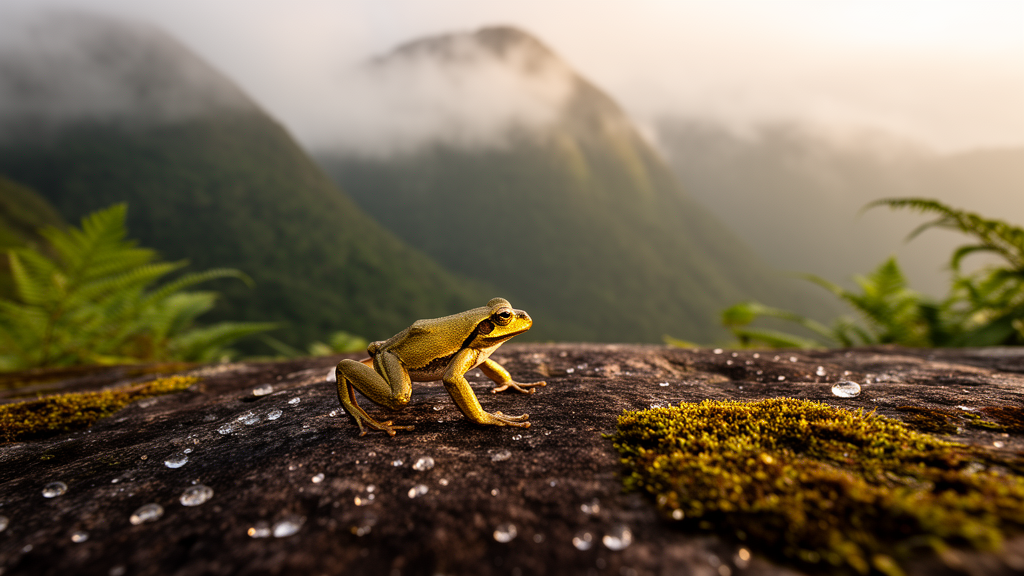
High in the misty peaks of Brazil’s Atlantic Forest, a frog’s body temperature is written on the ground beneath its feet. That is the central finding of a new field study that climbed from 980 to 2,600 meters above sea level in two of Brazil’s most celebrated mountain parks, capturing and measuring 146 individuals from 16 frog species to understand what actually determines the thermal status of tropical amphibians in some of the most thermally complex habitats on Earth. The results, published in Frontiers in Amphibian and Reptile Science, reveal a strikingly simple rule: substrate temperature and microhabitat type, not air temperature, body size, or sex, are the main drivers of frog body temperature in these mountains.
The research team, led by Ivy Miranda Amaral-Alves of the Federal University of Bahia and Luisa Maria Diele-Viegas, worked across two major mountain chains: the Serra da Mantiqueira, sampled in Itatiaia National Park, and the Serra do Mar, sampled in Serra dos Órgãos National Park. At Itatiaia, they focused on high-altitude zones between 2,100 and 2,450 meters, while at Serra dos Órgãos they covered a broader elevational sweep from 980 to 2,200 meters over multiple years. This design intentionally combined a multi-year temporal breadth at one site with a focused spatial snapshot at another, providing a robust assessment of thermal biology across distinct montane thermal regimes.
The technical approach was elegantly non-invasive. Rather than handling frogs with cloacal thermometers, which can inflate body temperature readings through capture-induced stress, the researchers used a portable infrared digital thermometer to measure the dorsal skin surface from a fixed distance of 30 centimeters, ensuring the field of view focused exclusively on the animal’s body and avoiding interference from the background substrate. Air temperature was measured one centimeter above the substrate with a quick-reading thermometer, and substrate temperature was recorded immediately after capture at the same location. The team also measured snout-vent length with digital calipers, body mass with a precision scale, and elevation with GPS, while recording sex and the specific microhabitat type at each capture site, whether arboreal, bromeliad-dwelling, riparian, or terrestrial.
Only active individuals were measured. Frogs that were calling, moving, or foraging at the time of encounter provided body temperatures that reflected realized thermal status during activity, while inactive or sheltered animals were excluded. Sampling was primarily conducted between 30 minutes and 3 hours after dusk to standardize nocturnal encounters, with one notable exception: the small toad Melanophryniscus moreirae, the only diurnal species in the assemblage, was sampled during its peak daytime activity on high-altitude rocky outcrops around 2,450 meters.
The results paint a vivid picture of thermal life in these mountains. Body temperatures ranged from a chilly 12.2 degrees Celsius in the terrestrial leaf-litter frog Ischnocnema melanopygia to a comparatively balmy 22.1 degrees Celsius in the riparian Cycloramphus brasiliensis. The diurnal Melanophryniscus moreirae, sampled 50 times, exhibited significantly greater intraspecific thermal variation than the pooled nocturnal assemblage, a pattern consistent with exposure to the daily thermal heterogeneity of daytime activity. Among nocturnal species, the greatest intraspecific variation was observed in Aplastodiscus arildae, though the researchers caution that this observation is based on only three individuals and must be interpreted as preliminary.
The statistical analysis, using linear mixed-effects models with species identity as a random effect, delivered a clear verdict. Substrate temperature was the primary significant predictor of body temperature in nocturnal anurans, while air temperature lost significance when additional covariates were included. Microhabitat specialization also mattered: individuals captured in riparian habitats exhibited significantly higher body temperatures than those in other microhabitats, suggesting that streamside environments offer distinct thermal opportunities or constraints. In contrast, body size, body mass, and sex showed no significant effects, and the random effect variance attributed to species identity was negligible, indicating that thermoconformity is a generalized physiological pattern across the nocturnal assemblage rather than a trait of individual species.
Perhaps the most technically interesting result concerns thermal inertia. Physiological theory predicts that larger individuals, with their higher thermal inertia and lower surface area-to-volume ratios, should maintain more stable body temperatures under fluctuating conditions. To test this explicitly, the researchers regressed species-specific body temperature variability against mean body mass and found no significant relationship. Larger individuals did not exhibit greater thermal stability in this dataset. The strong collinearity between body mass and environmental temperatures suggests that environmental variables effectively capture the thermal variance that might otherwise be attributed to morphological traits, explaining why body mass lost significance in the full model. Environmental forcing, it turns out, exerts a stronger influence on frog body temperature than subtle morphological buffering capacity at the spatial scale considered here.
The conservation implications are sobering. In the relatively preserved montane forests of the study sites, dense canopy cover likely acts as a thermal buffer, dampening the amplitude of microclimatic fluctuations. But in areas where forest cover is reduced or fragmented, the loss of canopy-induced buffering would likely lead to significantly higher microclimatic thermal extremes, threatening amphibian persistence. Given that these species lack the physiological capacity to buffer their internal temperatures through active thermoregulation, they may become susceptible to thermal stress and dehydration in open, modified environments. The situation is compounded by elevation-dependent warming, the phenomenon of accelerated temperature increases at higher altitudes, and by projected nocturnal warming trends that may disproportionately affect thermally constrained nocturnal species.
The focal assemblage includes species of conservation concern, including the range-restricted endemic Ischnocnema parnaso, classified as Vulnerable by the IUCN Red List, and Melanophryniscus moreirae, which relies on the microclimatic stability of high-altitude rocky outcrops. The researchers propose a tiered conservation approach: prioritizing the protection of riparian buffers and areas with dense, multi-strata canopy cover, which serve as essential thermal refugia, and maintaining elevational connectivity where topographic conditions allow, facilitating local movements among microclimatically suitable habitats under future warming.
Ultimately, this study provides a foundational assessment of thermoconforming strategies in tropical montane amphibians, one that integrates physiological data with diel niche dynamics. The researchers acknowledge limitations, including uneven sampling effort across species, the inherent measurement noise of infrared thermometry for small ectotherms, and the absence of continuous fine-scale microhabitat covariates such as relative humidity, canopy cover density, or leaf litter depth. Future studies incorporating these factors, along with phylogenetically informed comparative models and explicit vulnerability metrics such as critical thermal limits and thermal safety margins, will be essential for predicting species persistence under ongoing climate change. For now, the message is clear: in these mountains, a frog’s thermal fate is coupled to the immediate thermal environment at the scale of substrate contact, and protecting that environment is protecting the frogs themselves.
Subject of Research: Ecology
Article Title: Environmental conditions and body temperature of anurans in mountain regions of the Atlantic Forest, Brazil
Article References: Amaral-Alves, I. M., Rocha, C. F. D., Nogueira-Costa, P., Almeida-Santos, P., Drummond, L. D. O., & Diele-Viegas, L. M. (2026). Environmental conditions and body temperature of anurans in mountain regions of the Atlantic Forest, Brazil. Frontiers in Amphibian and Reptile Science, 4, Article 1867020. https://doi.org/10.3389/famrs.2026.1867020
Image Credits: AI Generated
DOI: 10.3389/famrs.2026.1867020
Keywords: amphibians, thermal ecology, Atlantic Forest, climate change, ectotherms, Environmental, conditions, body, temperature, anurans, mountain, regions
Cite Scienmag News
Gavin Prescott. (October 16, 2026). Frogs in Brazil’s Mountains Run on Substrate Heat, Not Body Size. Scienmag. https://scienmag.com/frogs-in-brazils-mountains-run-on-substrate-heat-not-body-size/
Gavin Prescott. "Frogs in Brazil’s Mountains Run on Substrate Heat, Not Body Size." Scienmag, 16 October 2026, https://scienmag.com/frogs-in-brazils-mountains-run-on-substrate-heat-not-body-size/. Accessed 16 October 2026.
Gavin Prescott. "Frogs in Brazil’s Mountains Run on Substrate Heat, Not Body Size." Scienmag. October 16, 2026. https://scienmag.com/frogs-in-brazils-mountains-run-on-substrate-heat-not-body-size/


