


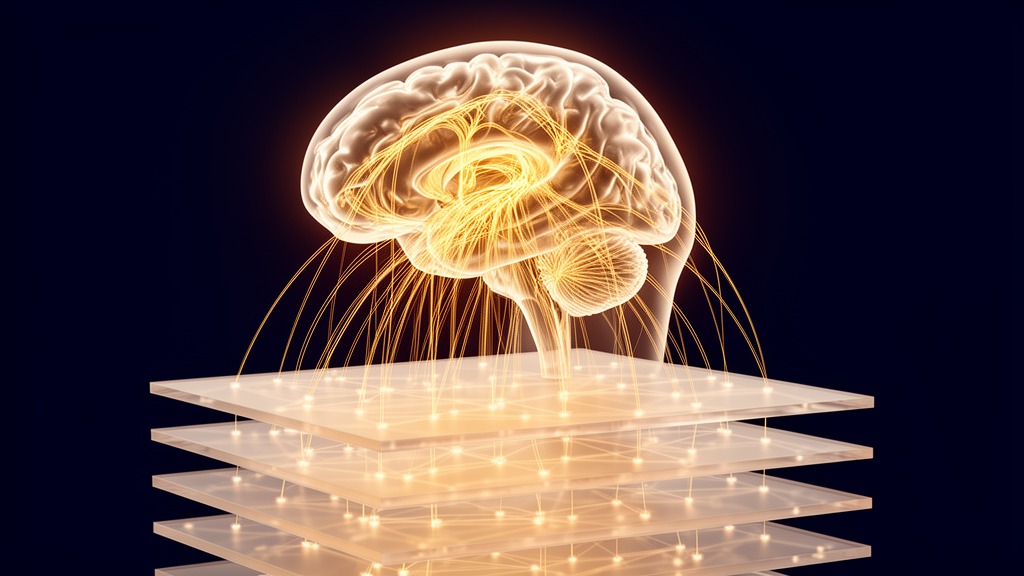
Deep inside the brain’s visual system sits a structure that has long puzzled neuroscientists: the pulvinar, the largest nucleus of the human thalamus. For decades it was treated as a passive relay station, a kind of biological switchboard shuffling signals between the eyes and the cortex. Modern anatomy tells a very different story. The pulvinar receives dense, reciprocal projections from nearly every level of the visual cortical hierarchy, and its neurons show receptive-field properties comparable to those of cortical cells, including selectivity for orientation, motion direction, and global motion patterns. Now, a team at the Visual Neuroscience Laboratory of the Université de Montréal has asked a strikingly modern question: what happens computationally if you transplant this thalamic architecture into an artificial neural network? Their answer, published in Frontiers in Neuroimaging, suggests that the pulvinar is not an accuracy booster at all, but a gain controller and decision-criterion regulator, a finding that could reshape how we think about both brains and machines.
Narmin Zarinabadi, Christian Casanova, and Nelson Cortes built their model around an analogy that is as elegant as it is technically precise. In deep learning, skip connections allow early feature representations to directly influence deeper processing stages, improving signal propagation and stabilizing hierarchical computations. The pulvinar, as a higher-order thalamic nucleus, participates in cortico-thalamo-cortical loops that link distant cortical regions while bypassing long chains of intermediate cortical processing. The researchers formalized this correspondence by adding a long-range skip pathway to a hierarchical convolutional vision model: a learned projection from early to late feature maps, coupled with a gain-controlled gating mechanism inspired by squeeze-and-excitation designs. The pathway receives a pooled copy of activity from a mid-level, V1-like cortical layer, transforms it through a cortico-pulvinar projection, and feeds a modulatory signal back to a higher, decision-related layer, where it is combined with cortical activity through a learned fusion parameter alpha.
The technical details matter because they separate this mechanism from generic attention. The projected signal passes through a PulvinarGate that computes a channel-wise gating vector between zero and one, dynamically scaling the strength of the thalamic feedback based on a compressed summary of early cortical activity. When gating is disabled, the gain is fixed to unity, yielding a non-modulatory skip connection. To test whether the observed effects were specific to this pulvino-cortical design, the team implemented two controls: a squeeze-and-excitation model that applies channel-wise modulation locally within a single layer, and a projection-only skip model that preserves the structural pathway but removes all modulatory components, including the gain gate and the learned fusion parameter. This control architecture allowed the researchers to dissociate the effects of long-range information routing from those of dynamic gain modulation.
The first experiment used CIFAR-10, the standard benchmark of 60,000 tiny images across ten classes, to compare a purely cortical baseline with the pulvinar-augmented network. The results delivered a surprise. The pulvinar model produced only a small but statistically reliable improvement in classification accuracy, from 87.47 percent to 88.22 percent, with a moderate effect size below one on Cohen’s d. But the effects on internal representations were enormous. The gain linearity index, which measures how consistently feature magnitude scales with stimulus contrast, swung from a strongly negative value in the baseline to a robustly positive one in the pulvinar model, with an effect size of nearly 64. Representational invariance, measured as the preservation of feature-vector direction across contrast changes, rose from 0.813 to 0.991. In plain terms, the pulvinar pathway did not make the network dramatically smarter; it made its internal signals dramatically better scaled and stabilized.
The team then ran a controlled architectural comparison under strictly matched optimization settings, training the cortical baseline, the squeeze-and-excitation control, the projection-only skip control, and the pulvinar model with identical hyperparameters, data augmentation, and loss formulations. They also restricted comparisons to overlapping regions of the representational space defined by the invariance and gain-linearity metrics, ensuring that all models were evaluated under comparable representational conditions. Even within this matched regime, only the pulvino-cortical model translated the controlled representational profile into a systematic accuracy improvement. The baseline, simple skip, and squeeze-and-excitation models reached comparable representational values but failed to achieve the same performance. The advantage, the authors conclude, cannot be explained by optimization, generic attention, or the mere addition of a parallel pathway; it reflects a distinct interaction between long-range routing and gain modulation.
The second experiment probed the same architecture under sensory uncertainty. Synthetic grayscale stimuli consisted of a noisy background with a 1/f noise spectrum and, on target-present trials, a faint circular target whose contrast ranged from 0.005 to 4 percent. Target radius and background noise amplitude were systematically varied, with 1,000 stimuli generated per configuration and balanced target-present and target-absent trials. Both models were trained from scratch on identical stimuli to mimic a naive observer, and pulvinar-specific regularization terms were removed so that any observed effects would reflect the intrinsic properties of the transthalamic pathway rather than task-specific training objectives. From the full confusion matrices, the researchers computed accuracy, sensitivity, decision criterion, and false alarm rate within the framework of signal detection theory.
Once again, the pulvinar pathway refused to behave as a uniform enhancer. Under low background noise, both architectures performed near chance, with accuracies around 55 to 59 percent, and the pulvinar model showed only mild redistributions of detection outcomes. Under high noise with small targets, both models achieved similar accuracies near 87 to 88 percent. But in the most demanding condition, high background noise combined with large stimulus radius, the pulvinar-cortical model exhibited a significant increase in sensitivity, the signal detection measure of genuine discriminability, despite only a modest difference in overall accuracy. Crucially, this gain in sensitivity was accompanied by both increased hit rates and reduced false alarms, indicating an improvement in discriminability that cannot be attributed to a liberal shift in decision criterion. The authors suggest that pulvinar-like modulation enhances perceptual sensitivity only when global stimulus integration is required to stabilize perceptual decisions under noise.
Across the full stimulus space, the most prominent effect was a systematic, condition-dependent redistribution of decision outcomes rather than a uniform gain in sensitivity. In the near-threshold quadrant of small stimuli under low noise, the pulvinar model showed a selective increase in false alarms and false positives, consistent with a localized liberal shift in decision criterion under weak sensory evidence. In contrast, under conditions demanding large-scale spatial integration, the dominant effect was an increase in false negatives, indicating impaired discriminability when integration demands were high but noise was low. When responses were pooled across all conditions, the pulvinar model showed a modest but significant reduction in hit rate and sensitivity together with an increase in false negatives, while false alarm rates did not increase at the global level. The pulvinar pathway, in other words, modulates the balance between signal and noise in a stimulus-dependent manner rather than inducing indiscriminate false percepts.
The internal network dynamics told the same story from the inside. The researchers analyzed stimulus-evoked activity across three layers serving as functional analogs of a hierarchical visual-decision pathway: an early V1-like layer, an intermediate V4-like layer, and a late, decision-related PFC-like layer. Early and intermediate layers showed modest or minimal separation between hit and miss trials, and were similar across architectures. The strongest divergence emerged at the decision-related layer. In the cortical-only model, activity there was predominantly negative and weakly differentiated between hits and misses. In the pulvinar-cortical model, the same layer showed positive activity for hits and near-baseline activity for misses, producing a large positive hit-miss separation across noise conditions. Pulvinar-like input, the authors conclude, primarily reshapes late-stage decision-related representations, biasing them toward stable, decision-consistent activity states.
These findings carry implications that reach well beyond the benchmark scores. The authors propose that the pulvinar regulates how sensory evidence is weighted and converted into decisions, rather than directly enhancing task accuracy, a view consistent with predictive coding accounts in which the thalamus implements precision or gain control within cortical hierarchies. The work also connects to recent large-scale adversarial tests of consciousness theories, which indicate that prefrontal signatures associated with conscious access predominantly reflect late, task-dependent decision states rather than enhanced sensory encoding. Within this framework, the pulvinar emerges as a precision-gating structure that modulates effective connectivity across cortical levels, facilitating cortical ignition, the transition from localized sensory processing to distributed, decision-relevant cortical states, by shaping when weak or ambiguous evidence engages late-stage cortical dynamics. The authors argue that the mechanism is fundamentally distinct from standard attention modules, which reweight feature channels within a given layer; the pulvinar-inspired pathway instead modulates the effective strength of a fixed, long-range communication pathway based on a compressed summary of early activity. The study generates testable predictions: pulvinar perturbations should primarily affect gain regulation and decision criteria, with minimal impact on early sensory encoding, and effects should be strongest under uncertainty or when spatial integration is required. For neuroscientists, the work offers a computational blueprint for transthalamic gain control. For machine learning researchers, it suggests that the next generation of skip connections may need to be modulatory, gain-controlled, and biologically grounded, routing information not merely to shortcut hierarchical processing, but to regulate how representations are used to guide downstream decisions.
Subject of Research: Neuroscience
Article Title: Pulvinar pathways as skip connections in deep neural networks for vision
Article References: Pulvinar pathways as skip connections in deep neural networks for vision. (n.d.). https://doi.org/10.3389/fnimg.2026.1800369
Image Credits: AI Generated
DOI: 10.3389/fnimg.2026.1800369
Keywords: pulvinar, deep neural networks, skip connections, gain control, decision criterion, transthalamic pathways, visual neuroscience, signal detection theory, pathways, skip, connections, deep
Cite Scienmag News
Cassandra Pierce. (October 16, 2026). Pulvinar pathways as skip connections in deep neural networks for vision. Scienmag. https://scienmag.com/pulvinar-pathways-as-skip-connections-in-deep-neural-networks-for-vision/
Cassandra Pierce. "Pulvinar pathways as skip connections in deep neural networks for vision." Scienmag, 16 October 2026, https://scienmag.com/pulvinar-pathways-as-skip-connections-in-deep-neural-networks-for-vision/. Accessed 16 October 2026.
Cassandra Pierce. "Pulvinar pathways as skip connections in deep neural networks for vision." Scienmag. October 16, 2026. https://scienmag.com/pulvinar-pathways-as-skip-connections-in-deep-neural-networks-for-vision/


