


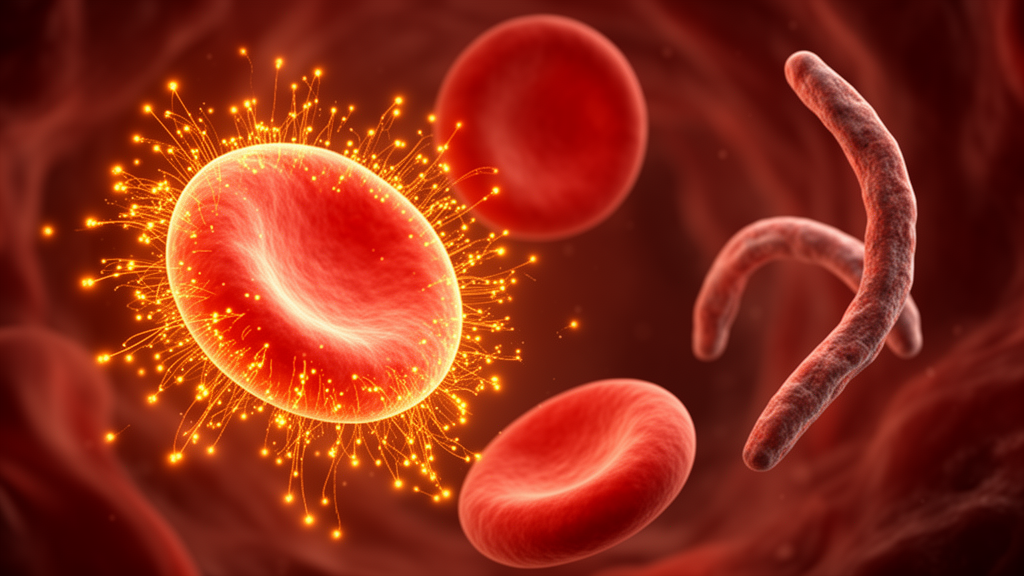
Red blood cells are often imagined as simple oxygen couriers, but they are also metabolic powerhouses with a secret second job: exporting ATP, the cell’s energy currency, into the bloodstream. A new ex vivo study from Duke University researchers, published in Frontiers in Hematology, reveals a striking asymmetry in how a promising drug class manipulates this hidden vasoregulatory system in health versus sickle cell disease.
The drug in question, mitapivat (AG-348), is an allosteric activator of pyruvate kinase, the enzyme that catalyzes the final step of glycolysis. By accelerating the conversion of phosphoenolpyruvate to pyruvate, mitapivat boosts intracellular ATP production while simultaneously consuming upstream 2,3-diphosphoglycerate (2,3-DPG), a negative allosteric effector of hemoglobin’s oxygen binding. This dual action—more ATP, less DPG—has already earned mitapivat approval for pyruvate kinase deficiency and placed it under active clinical investigation in sickle cell disease (SCD).
But ATP inside a red blood cell is only half the story. Red blood cells also export ATP into the extracellular space, where it acts as a vasodilator in proportion to the degree of hypoxia, inhibits intercellular adhesion, and prevents unwanted capillary permeability. This exported ATP is thought to be a key mechanism by which red blood cells help match blood flow to metabolic demand. The Duke team, led by Apoorva Jagadish and Tim J. McMahon, set out to determine whether pharmacologic pyruvate kinase activation could augment this export capacity in both healthy and sickle red blood cells.
The experimental design was meticulous. Whole blood from 15 pediatric SCD patients (ages 3 to 19, nearly all on hydroxyurea) and 13 healthy control subjects was incubated with mitapivat (10 µM) or vehicle (DMSO) at 4°C for 18–24 hours. The treated red blood cells were then isolated, washed, and exposed to either normoxic (21% O₂) or hypoxic (1% O₂) conditions using a rotating glass-bulb tonometer. Supernatant and intracellular ATP were measured by luciferase assay, and hemoglobin was quantified to assess hemolysis. In parallel, adhesion assays perfused treated or control whole blood through laminin-coated microfluidic channels under increasing shear stress (0.3–10 dyn/cm²), with adhesion quantified as the percentage of cells remaining at each shear increment.
The results in healthy red blood cells were unambiguous and, in one respect, entirely novel. Mitapivat raised intra-RBC ATP in healthy blood under both normoxic conditions (57.84 ± 5.64 µM after vehicle vs. 77.59 ± 10.12 µM after AG-348) and hypoxic conditions (57.67 ± 5.69 µM vs. 81.03 ± 9.98 µM), confirming prior reports. More strikingly, ATP export from healthy red blood cells increased significantly after mitapivat treatment in normoxia (80.31 ± 22.27 nM vs. 109.0 ± 30.23 nM) and in hypoxia. The authors state that this is the first demonstration that a pyruvate kinase activator increases ATP export from healthy red blood cells—a finding with potentially broad therapeutic and safety implications beyond hematology, including cardiovascular disease and sepsis.
In sharp contrast, the same drug applied under identical conditions to sickle red blood cells produced no significant change in either intracellular ATP or ATP export. In SCD samples, mitapivat treatment did not increase intra-RBC ATP in normoxia (71.48 ± 11.96 µM after vehicle vs. 75.17 ± 19.41 µM after AG-348) or hypoxia. Exported ATP from sickle cells also failed to respond to the drug (79.70 ± 20.58 nM vs. 77.12 ± 19.91 nM in normoxia). Untreated sickle red blood cells did export more ATP in hypoxia than in normoxia, mirroring the healthy cells’ hypoxic response, but the pharmacologic boost seen in healthy cells was absent.
The discordance is puzzling, and the authors offer several hypotheses. One possibility relates to the enzyme-stabilizing actions of pyruvate kinase activators on PKR itself: a single-dose ex vivo treatment scheme may underestimate the effects of longer-term, repeated administration. In healthy red blood cells, where the enzyme is presumably stable, a single dose may be sufficient to activate PKR robustly. Another hypothesis centers on hydroxyurea: nearly all the SCD patients in the study were on this therapy, which has been reported to increase ATP generation in and release from red blood cells. The authors speculate that ATP content and export in these patients may already be elevated secondary to hydroxyurea treatment and thus unlikely to rise further after pyruvate kinase activation.
There is also a mechanistic wrinkle involving 2,3-DPG. Pyruvate kinase activation consumes DPG as it generates ATP, and because DPG is a negative allosteric effector of hemoglobin’s oxygen binding, its depletion raises hemoglobin’s oxygen affinity. Higher oxygen affinity means less oxygen desaturation, which could in turn disfavor ATP export, since hypoxia and deoxygenation are known stimuli for ATP release. Sickle red blood cells have elevated DPG levels compared to healthy cells, so the DPG-depressing effects of pyruvate kinase activators may be greater in sickle cells, potentially offsetting any increase in ATP content. The authors note that the overall lack of increased ATP export from sickle cells following drug treatment could be viewed as reassuring, given that extracellular ATP can play injurious roles as a damage-associated molecular pattern in inflammatory states.
Perhaps the most unexpected finding involved adhesion. Sickle red blood cells are notorious for adhering excessively to endothelial cells and basement membrane substrates like laminin, contributing to the vaso-occlusive crises that define SCD. When the researchers applied mitapivat to isolated sickle red blood cells, adhesivity to laminin did not change significantly across the range of physiologically relevant shear stresses. But when the drug was applied to whole blood, sickle red blood cell adhesion to laminin decreased significantly at shear stresses of 0.3, 1, and 3 dynes/cm²—the physiologically relevant range. This differential effect suggests a modulatory interaction between ATP derived from red blood cells and another element of whole blood, such as plasma, platelets, or leukocytes.
The antiadhesive effect of mitapivat on whole blood is intriguing precisely because it occurred without a measurable increase in sickle cell ATP content or export. The authors propose that interventions raising intracellular ATP are hypothesized to promote the capacity for increased ATP export, and that elevated intra-RBC ATP supports membrane homeostasis, counteracting damage that could otherwise lead to a pro-adhesive phenotype. Pyruvate kinase activation has also been shown to improve the mechanical properties of sickle red blood cells, including deformability and the tendency to sickle. Since mechanical deformation is a known stimulus for ATP release, maintaining better deformability through adequate ATP levels could be essential for effective vasoregulation.
The study has inherent limitations that the authors acknowledge candidly. Post-tonometry red blood cell lysis levels were approximately 1–2% under all conditions and did not differ significantly as a function of drug treatment, hypoxia exposure, or between healthy and sickle cells, ruling out hemolysis as an explanation for the exported ATP measurements. The ex vivo microfluidics-based model of red blood cell adhesivity does not match the absolute extent of adhesion taking place in vivo, but it does correlate with clinical severity in SCD and has typically predicted the direction of disease- or drug-induced changes in adhesion. The generalizability of the adhesion findings is also limited by the fact that the researchers examined adhesion to laminin but not to endothelial cells.
Correlating the experimental findings with clinical data from the SCD cohort revealed a positive and significant correlation between reticulocyte count and intra-RBC ATP (p=0.046), while HbF, age, sex, MCV, and RDW showed no significant associations. This reticulocyte-ATP link raises an interesting question for future research: whether therapeutic benefits of pyruvate kinase activators relate primarily to effects in reticulocytes—the young, still metabolically active red blood cells—and only later, perhaps, in the more mature cells they become.
The broader context of this work is a rapidly expanding drug class. Beyond mitapivat, the RBC-specific pyruvate kinase activator etavopivat (FT-4202) has demonstrated dose-dependent increases in red blood cell ATP in healthy subjects and SCD patients over up to 12 weeks of treatment, along with reductions in 2,3-DPG and favorable shifts in the oxygen dissociation curve. Tebapivat (AG-946), a newer activator of both PKR and PKM2 isoforms, has shown increases in hemoglobin and red blood cell ATP from baseline in a phase 1 study in adult SCD patients. These agents exert multimodal effects: increasing ATP production, decreasing DPG, reducing sickling propensity, and improving red blood cell resilience.
What makes the Duke study particularly valuable is its willingness to report a negative result in sickle cells alongside a positive one in healthy cells. The discordance between ex vivo single-dose treatment and in vivo repeated administration is a critical caveat for the entire field. The authors point out that in vivo treatment with mitapivat or etavopivat has been shown to raise red blood cell ATP levels in SCD patients, contrasting with the lack of effect observed here under ex vivo conditions. Differences in incubation conditions, the specific red blood cell disorder studied, and the duration of therapy exposure may all account for these discrepancies.
Ongoing work from the Duke group addresses the determinants of cellular and exported ATP in both healthy and sickle red blood cells, basal and treated, as well as the basis of the antiadhesive effect of mitapivat on sickle cells in whole blood. Also of interest is future study of the ability of red blood cells from SCD patients maintained on pyruvate kinase activator therapy—rather than treated ex vivo with a single dose—to export ATP, and the functional consequences of such changes. The authors suggest it would also be worthwhile to study the effect of ex vivo drug treatment on samples from SCD patients not on hydroxyurea, to see if a significant difference in ATP export emerges in that untreated population.
For now, the study stands as a technically rigorous demonstration that the vasoregulatory arm of red blood cell metabolism—ATP export—can be pharmacologically enhanced in healthy cells, while sickle cells under identical conditions remain stubbornly unresponsive. The unexpected antiadhesive effect of mitapivat on whole blood, operating through a mechanism that does not require increased ATP export from the red blood cells themselves, adds a new dimension to the therapeutic profile of this emerging drug class and underscores how much remains to be learned about the metabolic conversations red blood cells hold with the vasculature.
Subject of Research: sickle cell disease
Article Title: Influence of the pyruvate kinase activator mitapivat (AG-348) on RBC ATP content and export and RBC adhesivity in blood from healthy subjects and sickle cell disease patients
Article References: Jagadish, A., Chen, Y., Zhu, H., Mai, W., Chow, S.-C., Li, Z., Lee, G. M., Telen, M. J., & McMahon, T. J. (2026). Influence of the pyruvate kinase activator mitapivat (AG-348) on RBC ATP content and export and RBC adhesivity in blood from healthy subjects and sickle cell disease patients. Frontiers in Hematology, 5, Article 1766692. https://doi.org/10.3389/frhem.2026.1766692
Image Credits: AI Generated
DOI: 10.3389/frhem.2026.1766692
Keywords: sickle cell disease, red blood cells, mitapivat, pyruvate kinase, ATP export, glycolysis, vaso-occlusion, hematology, Influence, pyruvate, kinase, activator
Cite Scienmag News
Daisy Hatcher. (October 16, 2026). Mitapivat Supercharges ATP Export in Healthy Red Blood Cells but Leaves Sickle Cells Unmoved. Scienmag. https://scienmag.com/mitapivat-supercharges-atp-export-in-healthy-red-blood-cells-but-leaves-sickle-cells-unmoved/
Daisy Hatcher. "Mitapivat Supercharges ATP Export in Healthy Red Blood Cells but Leaves Sickle Cells Unmoved." Scienmag, 16 October 2026, https://scienmag.com/mitapivat-supercharges-atp-export-in-healthy-red-blood-cells-but-leaves-sickle-cells-unmoved/. Accessed 16 October 2026.
Daisy Hatcher. "Mitapivat Supercharges ATP Export in Healthy Red Blood Cells but Leaves Sickle Cells Unmoved." Scienmag. October 16, 2026. https://scienmag.com/mitapivat-supercharges-atp-export-in-healthy-red-blood-cells-but-leaves-sickle-cells-unmoved/


